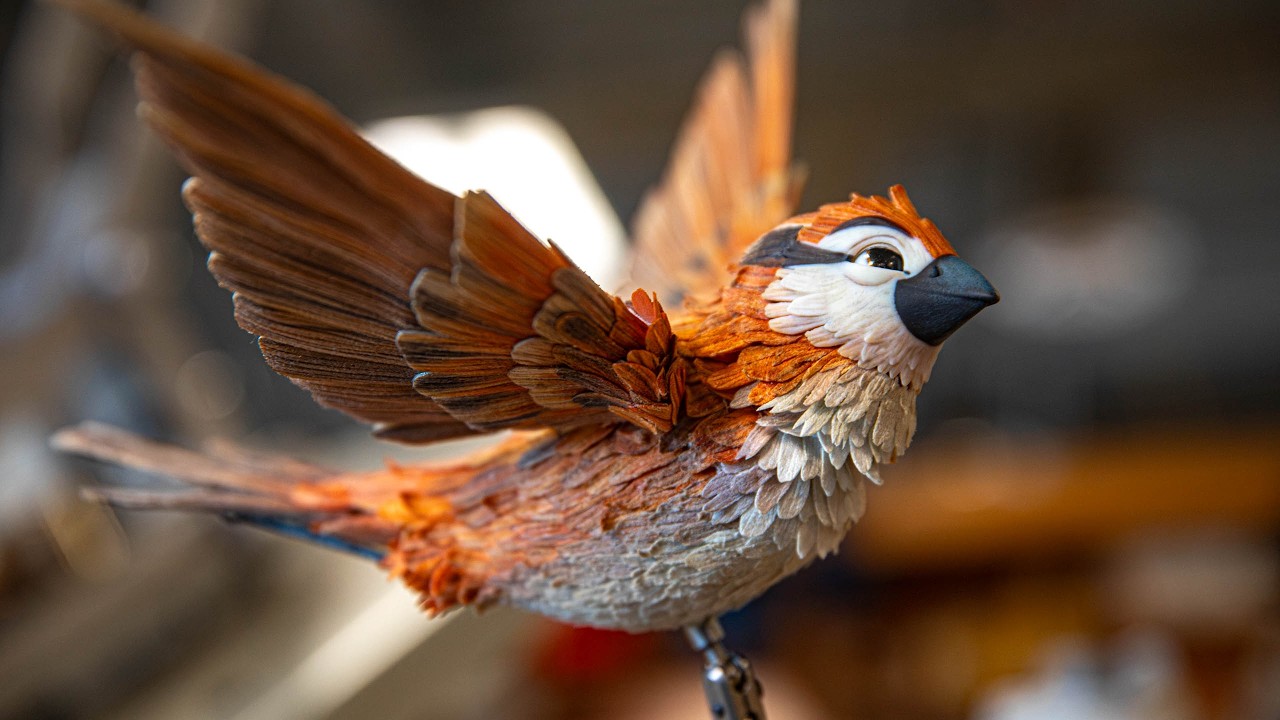
Austin lays a freshly heat-pressed sheet of poly satin onto a workbench at LAIKA Studios and peels back a corner to reveal the print underneath, still warm from the press. The color has shifted almost beyond recognition from what went in, a problem the team fights every single time, and the feather has not even been laser-cut yet. This is the unglamorous middle of one of the most labor-intensive fabrication challenges in stop-motion history: building a fully animatable bird from scratch, 16,000 feathers at a time. When every frame of animation is a still photograph, and every feather must hold its precise position after an animator’s fingertips leave it, the margin for a flimsy or unpredictable material is exactly zero.
Puppets on puppets of manipulation
The project started, as most LAIKA challenges do, with a wall of failed attempts. The team built three versions of the same bird character, calling them ‘the generals,’ and the wing alone required a separate line of research from the feathers themselves. Early rigs used goose-neck armature wire just to explore how a wing could be posed and collapsed. Popsicle sticks mapped folding geometry. 3D-printed paddles tested the natural flex of the material before anyone committed to a final structure. Eventually the team settled on a slider-based system that let animators sculpt broad wing shapes with their hands rather than chase dozens of individual control points.
The feather problem was harder. Each primary feather is a small manufactured object: poly satin fabric, dye-sublimated with a digitally illustrated color pattern, backed in vinyl, coated in medical adhesive on both sides, reinforced with a laser-cut beveled styrene insert, and threaded with a wire bundle that uses piano wire at the base for stiffness and shorter lengths toward the tip for graduated flex. The wire bundle is then wrapped by hand in wax thread, a technique borrowed from the wig department, to prevent light from catching the metal inside. Austin put the labor plainly: ‘It is puppets on puppets worth of manipulation.’ Each general carries 24 primary feathers on each side of each wing, and the neck feathers are a separate system entirely, backed in Duralar with aluminum foil cores so animators can adjust them frame by frame to simulate wind movement around the character’s face.
The skin underneath everything
While Austin’s team built the feathers, fabricator Anne was developing an entirely new type of puppet skin to hold them. Standard low-durometer rubbers and power mesh surfaces have one fatal flaw for feathered characters: displacement. If a skin shifts when touched, feathers shift with it and an animator has to chase every one back into position after every single frame. Anne’s solution was soluble displacement silicone, a material the studio tested in the gap between productions and deployed here for the first time. It compresses and then returns, completely, to where it was. Stretched aggressively and released, it snaps back without bulging. Feathers glued to it stay where the animator leaves them. The pattern for each skin piece is developed by stretching the material over the form, cutting, running the result through a copy machine, and adjusting until the fit is right. Anne noted they went through roughly 50 or so of a very specific pantyhose variety to supply the stocking fabric component before that supply ran critically low.
A wire bundle nobody has wrapped yet
On the feather workshop table, one wire bundle sits unfinished, its piano wire lengths fanned out and not yet lashed together. Austin sets it aside without comment, picks up a finished primary feather, and flexes it: rigid from the base, then gradually more responsive toward the tip, exactly mimicking the rachis mechanics of a real flight feather. He visited a great horned owl at the Portland Audubon during research. The owl stared at him. He stared back.
The finished feather that Austin and Adam assembled together during the session will travel home after the conversation ends. It is a single primary, one of roughly 4,000 on each general, made in an afternoon from the same materials the production line used, and it flexes exactly the way the real ones do.
 Wake up to Only Happy News!