The plane held 19 seats, two pilots, and one deeply nervous traveler from Germany named Ken who had to duck just to get through the door. American Samoa, a U.S. territory roughly 2,600 miles southwest of Hawaii, sits so far off the grid that the only eSIM provider covering it charges $75 for a single day of data, there is no ATM at the airport, and arriving on a Sunday means waiting until Monday just to buy a local SIM card. That combination of American infrastructure and genuinely remote Pacific reality is exactly what makes this corner of the United States unlike anywhere else on the flag.
Ken flew in from the neighboring independent country of Samoa on a 19-seat turboprop, crossing the international date line mid-flight. He departed on a Monday at noon and landed 30 minutes later on a Sunday at 12:30 p.m., the previous calendar day. He had already booked his hotel on that date once before.
What the first day on the ground actually looks like
The Tradewinds Hotel, the only full-scale hotel on the island, runs about $200 per night and charges an additional $5 a day for Wi-Fi, something Ken noted he had not encountered at any hotel in roughly two decades of travel. A scooter rental, the most practical way to circle the island, cost $50 a day, which he described as the most expensive motorbike rental he had ever paid. Those are the two anchoring costs for any visitor trying to do this independently.
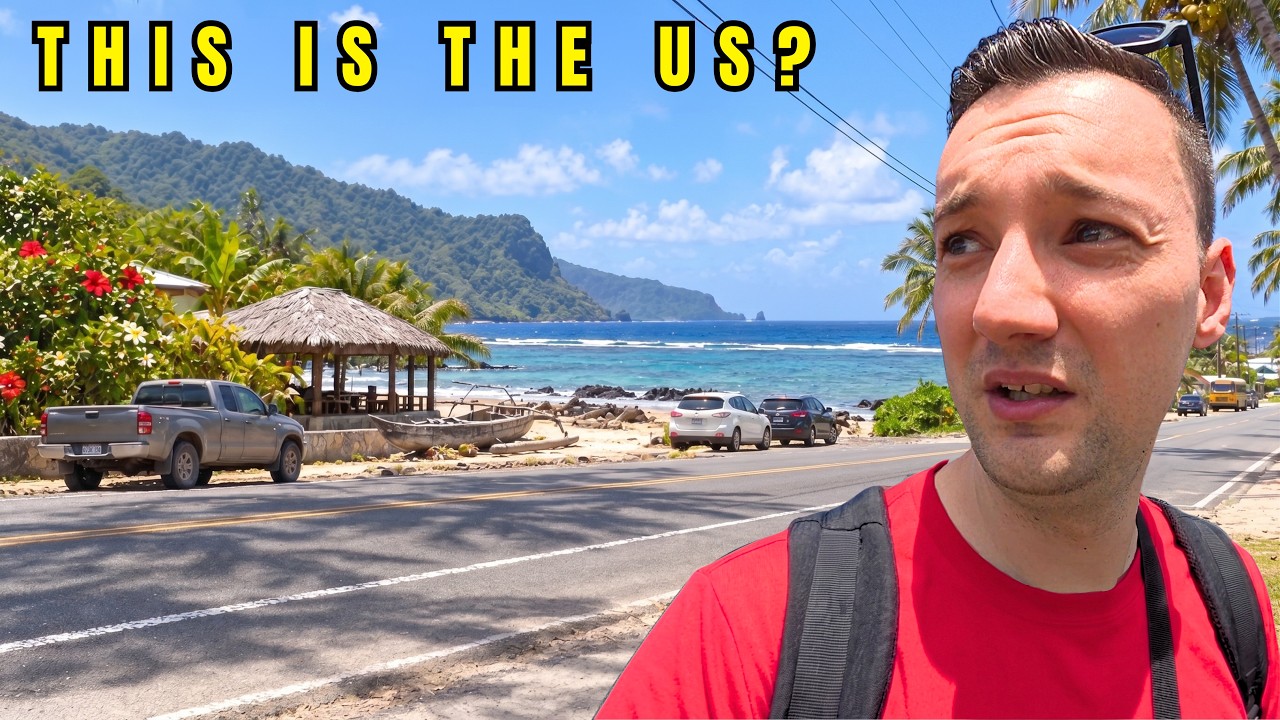
Once on the road, the surface-level signals are unmistakably American: yellow school buses, Ford trucks seemingly around every bend, Coca-Cola and Mountain Dew in the convenience stores, and high school kids running American football drills on a grass field. A 12-pack of Coca-Cola at the local warehouse-style supermarket called Cost-U-Less ran $10.98. Ground beef was priced at $19 for roughly half a kilogram. A bag of apples cost between $7.50 and $8. Almost everything came in bulk sizes, with no smaller option available, a logic Ken chalked up to the island’s limited number of shops and the distances some residents travel to reach them.
Gas was $4.93 per gallon, pumped for you by an attendant, a full-service norm Ken had not seen across his recent stops in New York, Chicago, Miami, Boston, and Los Angeles.
What the locals actually say when you ask the hard questions
Every person Ken asked the same question gave him the same answer. Do you feel American or Samoan? ‘We feel like Samoan,’ one shopkeeper told him flatly. That answer came back consistently from every person he raised it with, on camera and off. It did not surprise him. The territory has had formal U.S. control since 1900, when local chiefs signed a deed transferring sovereignty after the U.S. and Germany divided the Samoan islands in 1899, with the Americans drawn specifically by the deep, well-protected harbor inside Pago Pago Bay. Today roughly 50,000 people live here. Those born on the island hold U.S. national status but are not full citizens and cannot vote in presidential elections.
One young man born in Western Samoa but raised in American Samoa, whose American father gave him a U.S. passport alongside his Samoan one, offered Ken a quieter piece of advice: at night, stay alert, because drugs are a real and growing problem, mostly among young people. The roadside signs saying the same thing, anti-synthetic-drug warnings appearing every few minutes along the coastal road, backed him up.
A retired Fijian fisherman now working for the local government, who came to the island through the fishing industry and therefore does not need a U.S. visa to stay, summed up the harbor’s continuing role simply: ‘Many boats here.’
The road that keeps looking the same
The island can be circumnavigated by scooter in roughly two hours. Ken rode for just over an hour along the coast and found the scenery consistently beautiful and consistently similar: open ocean on one side, coconut trees on the other, small villages with single-room convenience shops, and tsunami evacuation signs near sections sitting only five or six meters above sea level. A fresh coconut from a vendor at the Fagatogo market area cost $3.
Restaurant prices at a local bar and grill came in mostly under $20 per dish, with no sales tax added, a contrast Ken flagged repeatedly against his mainland U.S. experience. A deluxe cheeseburger with onion rings, fries, and water came to $16 final.
The yellow school bus nobody thought to mention
Parked along the main road through Pago Pago, one of the classic American yellow school buses sat in the afternoon shade. Someone had to ship it here across thousands of miles of open Pacific so that children on this island could ride to school in it.
The same fuel that brought it here costs $4.93 a gallon, pumped by hand, on an island where everything arrives by sea or by air, and where the next-nearest landmass offering something meaningfully different is a 30-minute flight back in time.
 Wake up to Only Happy News!