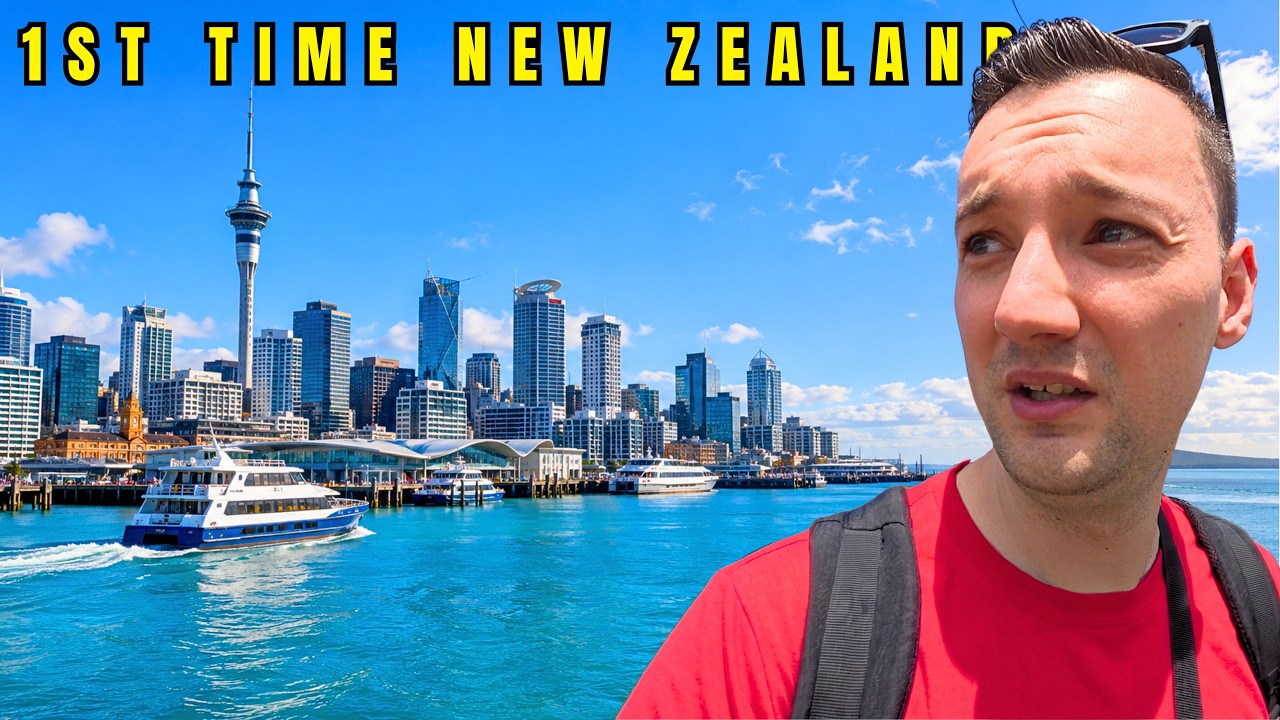
Ken, a German traveler arriving in Auckland for the first time, stepped out of immigration into a city he freely admitted knowing almost nothing about, a country so far from home that most people back in Germany had never really discussed it. That distance, geographic and cultural, is exactly what made every small logistical decision feel like a minor expedition. Auckland has 1.8 million people and no direct train from its airport, which meant the first task was not sightseeing but problem-solving, one bus and one train at a time, with the city still somewhere over the horizon.
From the airport to the CBD, the slow way
A staff member at the airport pointed Ken toward Bus Stop A, which connects to a train station further into the suburbs. The bus itself was straightforward, a tap of a contactless card and roughly ten to twelve minutes through what felt, unexpectedly, like open farmland. Sheep and cows appeared outside the window. The sense of approaching a city of nearly two million people was completely absent.
At the train station, a ticket to the central city station required a separate purchase at the counter. The red line heading south toward the CBD took a little over half an hour. An Uber from the airport straight to the city center was running around 70 to 75 New Zealand dollars at the time. The bus and train together came to roughly ten New Zealand dollars in total, which Ken put at approximately five to six US dollars, against the Uber’s roughly 40 US equivalent. As he put it plainly: ‘If you want to save time, take the taxi. If you want to save money, take the train.’
One detail stood out on the ride: all announcements ran in both English and Maori, the indigenous language that became an official language in 1987. The same bilingual pattern appeared on signs at the airport and throughout the station. Ken found it genuinely impressive rather than ceremonial, noting it on nearly every sign he passed.
Meat pies, a famous local drink, and three unusual ice cream scoops
The first food mission did not go smoothly. A recommended pie shop near the CBD was sold out before the afternoon was done. A bakery nearby had also sold through its pies. A supermarket called Four Square, suggested by a bakery staff member, turned out to be the solution. Ken picked up a mince pie from the deli section for 6.50 New Zealand dollars, ate it on a bench inside the store, and described the filling as genuinely comforting: minced meat and gravy that reminded him of a pasta dish from home.
Before the pie, a convenience store encounter produced a local soft drink called L&P, which describes itself on the bottle as tasting like the moment after you dive into water and everything goes ‘all tingly and refreshing.’ Ken noted the bottle contained 65 grams of sugar, more than double the recommended daily adult intake, and still finished it. It tasted, he said, like a very sweet carbonated lemon soda.
The ice cream stop delivered the most distinctive experience of the day. An artisan shop in the CBD makes all its flavors fresh each morning and runs a weekly kitchen experiment alongside the permanent menu. Ken tried three scoops: hokey pokey, the best-seller, which is vanilla ice cream studded with crunchy honeycomb pieces; kiwi fruit, which tasted exactly as the name promised; and that week’s experiment, mint and cucumber, which he called surprisingly refreshing. The three scoops together cost 14 New Zealand dollars.
The postcard that never arrives
Outside a gift shop near the waterfront, Ken picked out a postcard of the Auckland skyline showing the city’s famous central tower. It was for his fiancee Lisa, part of an ongoing countdown to their wedding in January 2027. He has been mailing her postcards from each city on this trip, starting in Boston, then Toronto, then Sydney, then Fiji, and now Auckland. As of the day he arrived in Auckland, not one of those cards had reached her.
The Hilton Auckland sits directly on the harbor, extending out toward the water on a pier-like structure. Ken checked in to a fourth-floor room with a balcony, a bathtub, a large bed, and a sea view looking out over the harbor and the city skyline. The minibar was stocked but not complimentary: beer at 12 New Zealand dollars, Coke at six, a Snickers at five. The rate was 230 US dollars per night. Outside, as he had walked along the waterfront, the 1912 Ferry Building stood a short distance away, its century-old facade sitting directly beside the glass towers that surrounded it.
The balcony faced east, toward sunrise rather than sunset. Ken, by his own admission, rarely wakes up early enough to catch a sunrise. The harbor lights were already starting to reflect off the water as the evening came in cold off the sea, cold enough that a traveler in shorts and a shirt designed for the tropics had very few options except to go inside.
 Wake up to Only Happy News!