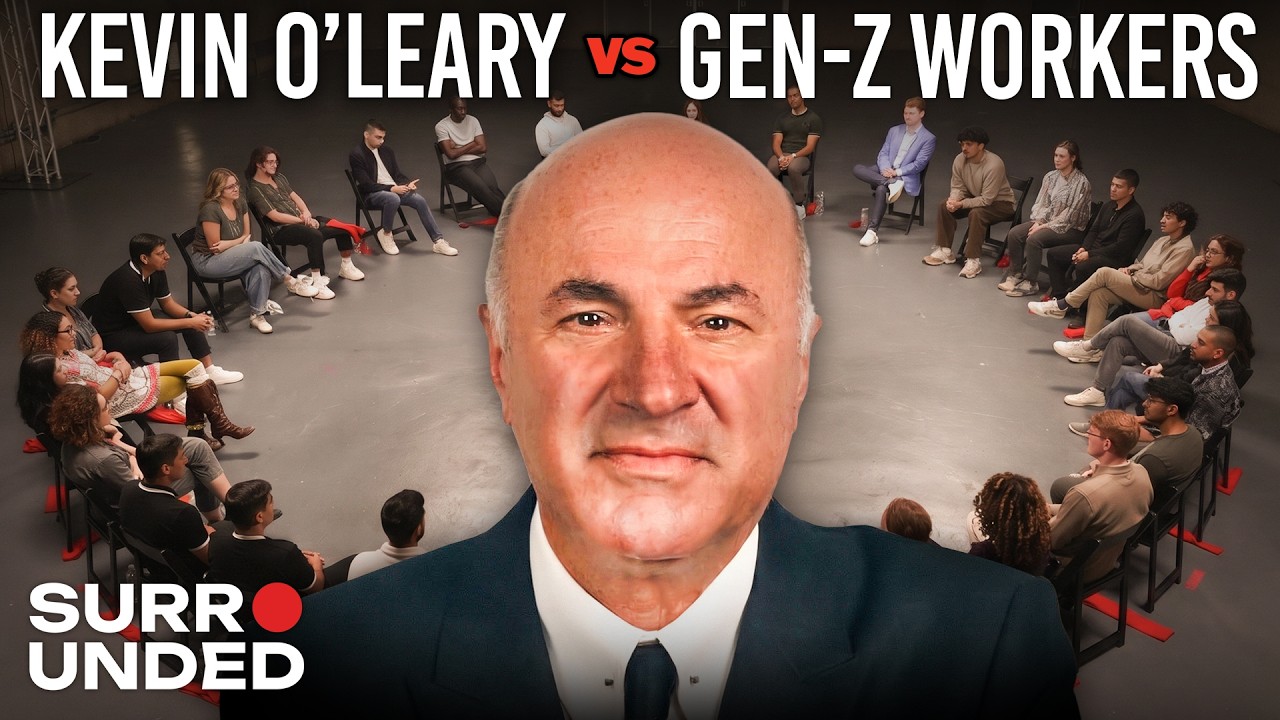
A security guard named Kieran sat down across from Kevin O’Leary and said, matter-of-factly, that he works 80 hours a week and pays 55 percent of his income toward rent. He had applied to hundreds of jobs over the past year. Four interviews resulted. That was the number he gave, unprompted, while O’Leary told him to make a 90-second video and find a supervisor role somewhere else.
That exchange, one of roughly a dozen inside a Jubilee production called ‘Surrounded,’ captures the core friction running through nearly two hours of debate between O’Leary, the investor and television personality known as Mr. Wonderful, and 20 Gen Z workers who had prepared arguments, statistics, and personal stories before taking turns in the chair opposite him.
What the chair across from Mr. Wonderful actually looked like
The format was direct. One person at a time walked to a seat facing O’Leary. The rest of the group voted on whether that debater had won or lost ground. When a majority voted against them, they returned to the floor. Some lasted several minutes. A few pushed O’Leary into positions he had not fully anticipated.
O’Leary opened with a claim that work-life balance comes second if you want to be successful. His first challenger, Luke, identified himself as a former NASA staffer who joined the agency at 19. Luke pressed O’Leary on whether 80-hour weeks were necessary or whether executional results were the real standard. O’Leary agreed that project-based outcomes matter more than hours logged. ‘Nobody cares if you worked all night the night before,’ he said, ‘as long as you got it done.’ That round ended with something resembling agreement.
Carlos followed with a different set of numbers. He cited a productivity gap, arguing that productivity has risen 90 percent since 1979 while wages have risen only 30 percent. He also referenced a World Economic Forum study claiming that the current generation is the first in America to be poorer than their parents. O’Leary disputed the framing and called Carlos a whiner. Carlos pushed back, saying he was speaking for a generation, not complaining about himself. The room voted Carlos out before the exchange fully resolved.
Where the conversation broke open and where it stalled
The sharpest exchange came from a software engineer who went unnamed in the debate but challenged O’Leary on equity compensation. He pointed out that a software engineer at Amazon receives stock units worth roughly $100,000 more annually than a warehouse worker doing comparable hours under constant surveillance. ‘I work probably harder doing 10-hour days on the warehouse floor,’ he said, ‘and I get zero equity.’ O’Leary’s response moved toward shareholder returns and capital risk rather than directly addressing the equity question. The debater told O’Leary, with some precision, that Mark Cuban, O’Leary’s Shark Tank co-host, had publicly argued that all employees at every company he invested in should receive equity. O’Leary did not dispute that Cuban had said it.
Omar, who identified himself as a veteran and a bartender working two jobs, took on O’Leary’s claim that execution skills alone determine advancement. Omar argued that if workers are not rewarded for strong performance, the incentive to execute disappears entirely. He gave his own military service as an example, describing how soldiers who perform well are sometimes kept at their current level because they are too valuable to promote. O’Leary acknowledged that this was not how it should work, but maintained that in his 54 companies, top performers always moved up.
Erica described working as the top-performing fundraiser on the East Coast during her first year at a nonprofit, then being denied a management role and offered no recognition. O’Leary called the organization poorly managed. He said there was no economic logic to holding back a high performer. He seemed genuinely surprised. ‘You must be kidding,’ he said. ‘I can’t even believe that.’
The final segment shifted to a debater named Naima, who brought a claim of her own: there is no such thing as an ethical billionaire. O’Leary used SpaceX as his opening example. Naima countered with Grok-generated content, the proliferation of extremist material on X, and what she described as election interference through targeted political advertising on Meta. The two worked through Richard Branson, Zuckerberg, and AI’s potential to cure cancer before Naima arrived at a data point: the top 1 percent of Americans own 30 percent of national wealth while the bottom 50 percent own 2.5 percent, according to her account. Twenty thousand people a year die from malnutrition in the United States, she said. O’Leary did not dispute the figures. He disputed the solution.
A debater who identified himself as working in media investment challenged O’Leary on the claim that a job only needs to pay you, not reflect your values. He argued that company culture drives employee buy-in, and that buy-in directly affects execution quality. O’Leary said he had hired people from every background and religion and that the only criterion he applied was executional ability. The debater said culture and execution were not opposites. They agreed on more than the debate format made room for.
Toward the end, a debater who studied macroeconomics pressed O’Leary on inelastic goods, housing costs relative to median income, and the United States being the only major developed nation without universal healthcare. O’Leary redirected toward technology and medical records interoperability. The debater pointed out that most people in the room do not have doctors in two states simultaneously. O’Leary acknowledged the gap.
The moment O’Leary confirmed what he had sacrificed
A debater named Ryan asked O’Leary directly whether very wealthy people neglect their families. O’Leary paused, then said it had happened to him in the early years of building his business. He said his wife had done the work of raising their children while he was building equity. He described it as a sacrifice he lived through. Ryan told him that many people watching would not agree that this was a worthwhile trade. O’Leary did not argue with that.
Kieran, the security guard working 80 hours a week, never got a clean answer to his core question. O’Leary told him he was articulate enough to be a supervisor and urged him to make a video resume and apply more aggressively. Kieran said he had applied to hundreds of positions and gotten four interviews over two years. O’Leary said he was not looking hard enough. The room voted O’Leary’s answer out.
Source: Watch original
This article was reported in November 2026.
OHN Editorial Note: This article is based on publicly available sources. If you spot an error or have updated information, contact us at editorial@onlyhappynews.com. We correct mistakes promptly.
 Wake up to Only Happy News!