Mark Rober stood at the rail of a cage barely wide enough to turn around in, somewhere in the cold waters off New Zealand, watching a 2,500-pound great white shark glide toward him from below. His stomach was already queasy from the hour-long boat ride out. Now it was significantly worse. The question that had pulled him here, to five countries and five of the planet’s most dangerous animals, was deceptively simple: which creature on Earth is actually the most dominant? Almost everyone he asked got the answer wrong. What he found, after building custom bite-force sensors, losing multiple tug-of-war matches to a shark, and spending six fruitless hours scanning the ocean from a helicopter, was that the answer is not even close.
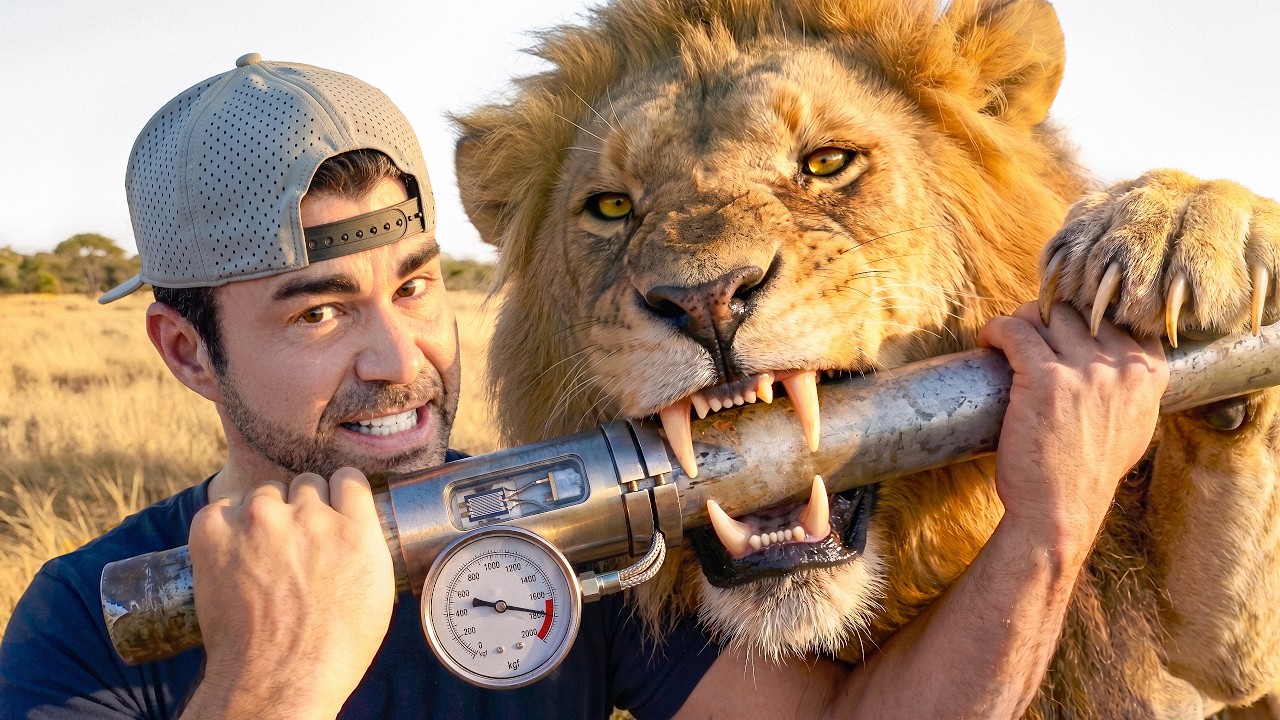
The investigation started with a lion named Ira at a facility where a zookeeper’s presence was the only thing keeping the situation professional. Rober placed a Kevlar bag packed with progressively denser materials, from rubber to high-density foam to plywood, directly in front of Ira and watched him go to work. The bag was fixed to a half-inch steel cable, so when Ira could not drag it away, he tried to shred it. The resulting bite impression went into what Rober called the Chomp 9000, a device that recreated the exact bite geometry in a fresh sandwich of materials and measured the force required to match it. Ira’s result: just over 400 pounds. Enough to detonate a watermelon spectacularly, not enough to dent a coconut. The lion scored a five for bite force, a five for strength, but a nine for intelligence, the product of multigenerational pack strategies where specific hunting roles, left wing, right wing, and ambush position, pass from parent to cub.
When a crocodile held on for nine hours straight
Science Bob, Rober’s reluctant collaborator, carried the Kevlar bite bag to a large female crocodile next. She clamped down immediately, shook the entire bridge they were standing on, and then simply refused to let go. She held the bag for over nine hours, finally releasing it at 2:00 a.m. The Chomp 9000 put her bite force at over 4,000 pounds, ten times the lion’s output, enough to split a cast-iron skillet. Rober noted that the crocodile’s 68 interlocking teeth are not built for chewing. They are built to prevent escape, functioning as a bear trap attached to a body that can swim up to 22 miles per hour. The croc scored a nine for bite force, a six for strength, and a five for intelligence, with a brain the size of a walnut compensated for by 9,000 pressure sensors on its face sensitive enough to detect a ripple from a single drop of water.
The hippo arrived next and immediately reframed the conversation about size. Tipping the scales at nearly 10,000 pounds, four times larger than any other animal in the ranking, the hippo kills more humans than lions, crocodiles, great whites, and orcas combined, averaging around 500 people per year. It can sprint at 30 miles per hour, faster than the fastest human ever recorded, and because its muscle-to-body-fat ratio resembles that of an elite bodybuilder, it sinks rather than floats, allowing it to run underwater without any visible warning. Zazy the hippo bit down on the sensor for a reading of 2,000 pounds, strong enough, as one expert put it, to bite a crocodile in half. The hippo earned a six for bite force, a nine for strength, and a four for intelligence. It does not need to be smart. Grass does not run.
The animal that maxes every category and has never killed a human in the wild
The orca required the most effort to find. After a full day of searching New Zealand waters by boat and six hours by helicopter with nothing to show for it, the team flew 7,000 miles back to California before learning that Monterey Bay, 75 miles from Rober’s own lab, is one of the best-known orca hunting grounds on the planet. Marine naturalist Sophia explained at sea what the science already suggested: orca bite force, calculated from muscle cross-sections, nearly doubled the crocodile’s. Their hunting success rate reaches 98 percent, against a lion pride’s 20 to 30 percent. When a pod of orcas appeared off South Africa in 2017 to surgically remove the livers from great white sharks, every tagged great white in the region fled within hours, including sharks that had never encountered those particular orcas, and almost none have returned in the years since.
Rober put it plainly after talking with Sophia: ‘The reason I had such a hard time finding an orca was simply because they were choosing not to be found.’ Their hunts go acoustically silent, coordinated entirely through body language and pre-planning, until the first strike. Each pod carries its own dialect, its own hunting traditions, and its own inherited strategies tailored to local geography. One pod in Antarctica learned to swim in formation beneath ice floes to generate a wave that washes seals directly into their mouths. A pod in Argentina practiced beaching itself on purpose for generations before the technique became reliable, with the pod grandmother present at every training session. In all of recorded history, no wild orca has ever killed a human. Several have been documented offering food to people, apparently out of curiosity.
The orca scored a 10 for bite force, a 10 for strength, and a 10 for intelligence. Nothing in nature hunts them, regardless of age or injury.
A Kevlar bag at the bottom of a cage in New Zealand
The bite sandwich Rober fed to the great white came back with quarter-inch rubber bitten clean through to the wood underneath, 300 serrated teeth leaving marks no other animal on the list produced quite that way.
By the time the orca topped every category, Rober had circled back to where the whole thing started: standing at the edge of a cage, watching something enormous approach from below. The orca does not hunt humans. But it also, as Sophia noted, does not announce itself until the water is already erupting.
 Wake up to Only Happy News!