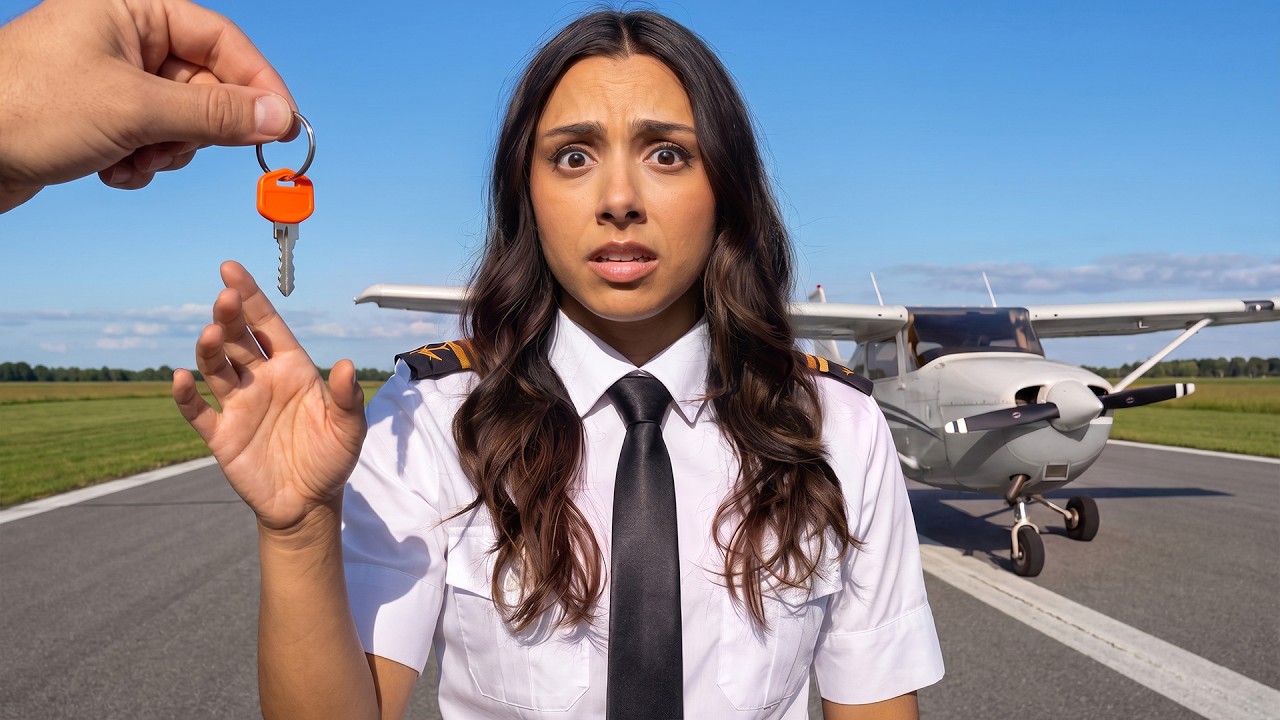
On day thirteen, Michelle Khare was alone in the cockpit of a Cessna 172, lined up on runway 25 at Oxnard airport, with a 15-knot headwind and no one beside her who could grab the controls. The solo flight that aviation training programs promise in two weeks had arrived one day late, and the entire point was finally, terrifyingly clear: a stranger who signs up to become a pilot is not just learning to operate a machine. They are learning to trust themselves when no safety net exists. Khare had arrived at Oxnard weeks earlier with zero flight time, a head full of textbook theory, and the specific, optimistic question of whether a private pilot certificate was something a determined person could collect in the same number of days a kid spends at summer camp.
How 14 days became something much longer and more real
The challenge launched with a formal structure: days one through seven to build basic flying confidence and prepare for a solo, and day fourteen reserved for the FAA check ride, the multi-hour practical exam with an official examiner. Flight instructor Jason, one of the most respected flight educators on the internet, flew his own plane down from Northern California to Los Angeles to run the program. He was direct about the odds from the first briefing: ‘It’s not likely. Honestly, I would tell most people not to try to get a pilot certificate in 14 days.’ He agreed to try anyway, measuring success not by whether a certificate was produced but by whether a safe pilot was produced.
The written exam came first. Khare passed with an 85 percent on a 60-question FAA multiple-choice test after cramming through five textbooks, a score she admitted was ‘pretty okay’ but not the standard she intended to hold herself to in the air. The flying itself began immediately after, and the gap between reading about flight and doing it arrived fast. Radio communication at what Jason described as literally the busiest airspace in the world required constant focus. Stall recovery, the maneuver where a wing stops generating lift at too steep an angle, carried genuine stakes after Jason described a student pilot years earlier who stalled on a first solo, rolled left, and crashed on the side of the runway. The student survived. The lesson stuck.
Landings became the wall. For days, Khare could get the plane into the air and navigate the pattern but could not consistently grease the final flare without Jason’s hand briefly touching the controls. He described the problem plainly: ‘Everyone thinks that means push toward the runway. That’s the wrong thing. You have to tease the airplane into landing. You have to pretend you don’t want it to land.’ When frustration peaked, he put foggles on her, opaque training lenses that blocked the view out the windshield and forced her to fly purely by instruments, citing the scan rhythm as matching the beat of ‘Levitating’ by Dua Lipa.
A solo, an emergency, and a runway with nothing left behind it
The solo happened on day thirteen, not day seven, and the conditions were not gentle. Winds were reported at 15 knots at takeoff, right at the top of Jason’s endorsed limit. By the second landing attempt on that solo, the tower called winds at 17 knots, above that limit, and Khare had to decide in real time whether to go around or put the plane down. She put it down. Jason, watching from the ground, described what he felt: ‘I felt that in my stomach for sure.’
The check ride, originally set for day fourteen, was rescheduled. Then rescheduled again after a mayday declaration when the oil pressure gauge dropped to zero in flight and fire trucks met them on landing. Then cancelled twice more, once by examiner unavailability and once by weather. By the time the journey reached its current stopping point, Khare had logged 135 flight hours against the 40-hour minimum requirement and had spent three months flying nearly every single day.
Jason put it plainly in one of their last conversations: ‘When you very first called me about this video, you were very much a YouTuber trying to make a video about aviation. When you called me last night, I was like, I just talked to an aviator.’
The biplane from 1937 that showed up at the right moment
Midway through the most grinding stretch of landings, a yellow biplane descended onto the ramp at Oxnard. It was from 1937, a primary trainer that had actually been based at Oxnard during World War II, and it was flown by Aaron Fitzgerald, a Red Bull helicopter pilot who had flown the camera helicopter for a Tom Cruise stunt the previous year. Fitzgerald had done his own first flight training in tail-draggers just like that one and had a single piece of advice: ‘Never quit. In professional flying, you have good days and bad days. And in the beginning, the bad days are way worse than the good days. And then those oscillations get much narrower over time.’
The check ride has not happened yet. The 80 percent of student pilots who quit before finishing remains a statistic Khare is aware of and intends to be on the other side of. The runway behind her, as Jason likes to say, is the most useless thing in aviation.
 Wake up to Only Happy News!