
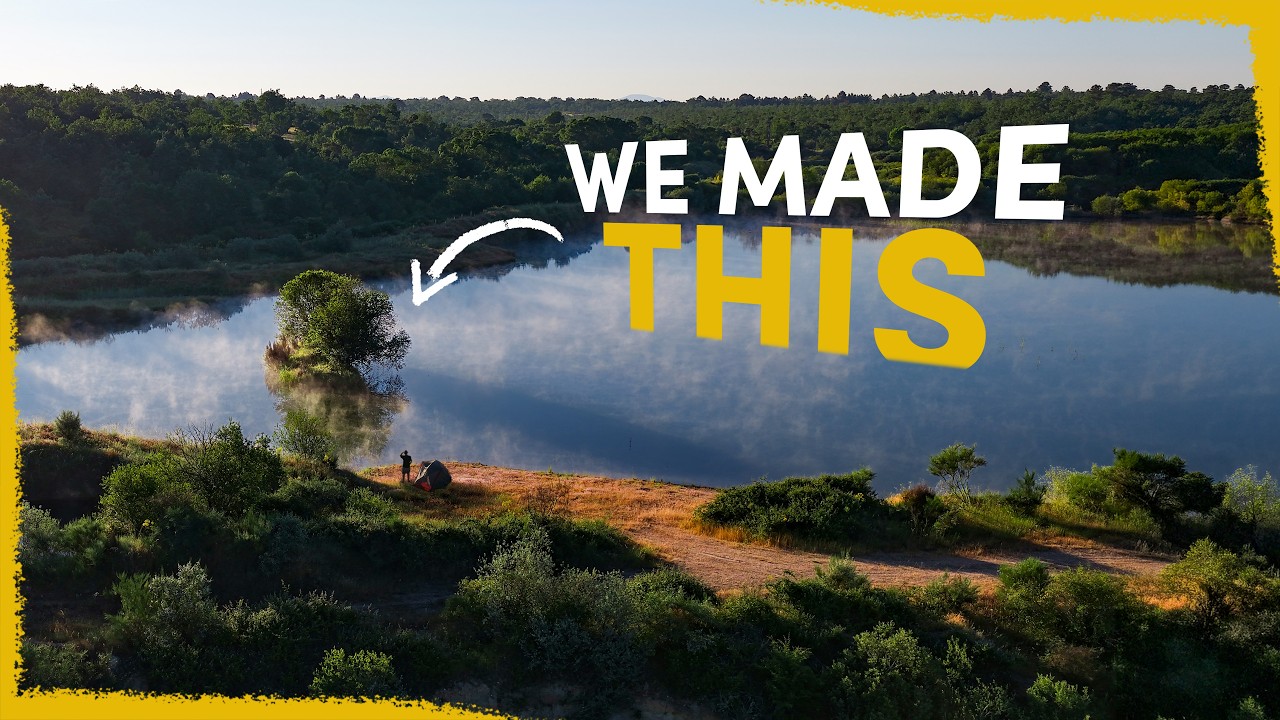
In the northeast of Portugal, inside a flooded quarry that once felt like a murky, lifeless desert, two new islands broke the surface of a bright blue lake. The team at Mossy Earth had spent the autumn of 2024 moving earth, smoothing steep banks, and reshaping a place that had been quietly failing its own wildlife for years. What happens when rewilders build land from scratch inside an invasive-species nightmare is not guaranteed, and the results here were equal parts frustrating, funny, and genuinely moving.
A lake held hostage by crayfish
The Blue Lake looked promising from a drone. Up close, it told a different story. Flora, one of the Mossy Earth biologists who was present when the construction began, described the core problem plainly: the steep banks left behind by the mining operation and the presence of Louisiana crayfish had kept the lake ‘at an early stage of succession.’ The crayfish had colonized every vertical wall, boring nesting holes through what amounted to prime habitat for an invasive population. No vegetation could establish. No healthy food web could build. When the team dove the lake in 2024, the walls were riddled with crayfish holes and the silt cloud they kicked up was constant.
The plan was not eradication, which the team considered simply not feasible, but suppression. By removing some of the steep vertical banks that made ideal crayfish nesting sites and replacing them with gently sloping margins, the project aimed to reduce the population’s hold on the lake over time. The excess material from that bank-smoothing had to go somewhere, and that is where the islands came in.
Andre, a team member from Rewilding Portugal, the partner organization that manages the quarry, explained the logic: isolated ground near the water, with little dense vegetation and no easy predator access, is exactly what several wading and nesting bird species need. The two new islands were built to provide that. Total spending on the Blue Lake portion of the project came to 17,000 euros, as part of a broader 61,000 euros invested across the quarry as a whole, covering all surveying and earthwork across every area.
One island went underwater, and the birds came anyway
When the team returned in May to document the results, one of the two islands had completely vanished. Portugal had experienced an unusually rainy winter, filling every dam and lake in the country, and the lower of the two islands was sitting just below the surface. The team could see its outline from the bank. That setback turned out to matter less than expected.
White wagtails hunted insects on the gentle new slopes. Wood pigeons pecked around the margins. Storks fed calmly along the shoreline. A green shank, a wading bird rare in this dry inland region, was spotted working one of the newly smoothed banks, apparently using the quarry as a migration stepping stone. Red kites and a marsh harrier patrolled overhead. At dusk, a small but unmistakable murmuration of starlings formed above the lake, before the whole group landed to roost on the visible island. As the team member filming noted with unconcealed satisfaction: ‘I won’t pretend not to be satisfied to see them use it.’
The underwater recording that night captured the crayfish still very much in residence, their activity producing a constant sizzling sound through the hydrophone, described as similar to tofu frying in a pan. The lake’s cocktail of invasives, including juvenile fish almost certainly introduced, confirmed that the ecosystem work here is long and slow.
The bee-eater that kept its distance
The European bee-eater had been the one species the team most wanted to document at the quarry, and it had stayed just out of reach. A flash of color vanished before a camera could lock on it one afternoon. That evening, no bee-eater. No otter either, though one had come close during an earlier scouting walk and then disappeared the moment a proper camera arrived.
The next morning, as fog gathered over the lake in the early light, the bee-eater finally appeared, circling the small island in full color, its blues and oranges sharp in the morning sun.
The island still below the surface
The submerged island sits just visible in the blue water, its shape intact, waiting for the water level to drop back toward normal.
The starlings that roosted on the visible island above it are long gone by now, somewhere further along their route. The frogs and toads that filled the night with sound remain. The crayfish, for the moment, remain too.
 Wake up to Only Happy News!