
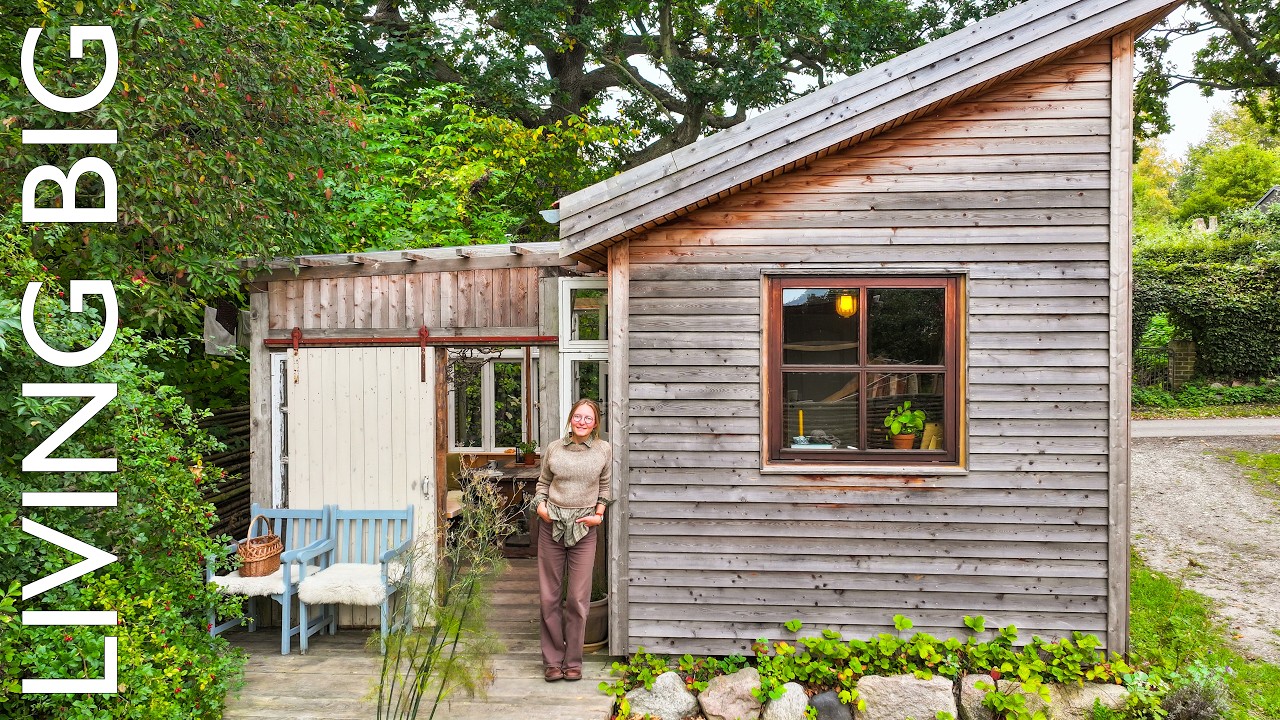
Emma was 23 years old and standing in a muddy Danish village on a rainy November afternoon when a truck carrying everything she had built stopped on the road because the wheels could not reach her plot. The tiny house had to be lifted over an oak tree to reach its resting place. ‘It was like all of my investments just hanging up there in the air,’ she said later, watching from below. That moment, equal parts terrifying and absurd, turned out to be a fitting entrance for a home that would become the most precise physical expression of permacultural thinking most visitors had ever stepped inside. Emma had built the whole thing herself, with help from friends and family, entirely from recycled and renewable materials, for 200,000 Danish kroner, roughly €27,000, and without borrowing a single euro.
A year of watching before a single nail went in
Emma did not arrive at the Danish folk high school with a blueprint. The school, running on a tradition dating to the 1800s, had recently acquired land and put out an open call for anyone willing to help develop a permaculture garden to supply food for its student community. Emma was studying at the time, disliked city life, and started showing up to volunteer. Over several years she took on more responsibility until the garden work became a formal teaching job. When the school offered her a place to live, she moved into a different tiny house already on site and spent an entire year simply living in it, applying the first principle of permaculture, observe and interact, to herself. What did she actually need? What worked? What felt wrong? Only after that year did she begin designing and building her own structure on the same grounds.
The framework she used was the permacultural hierarchy of resources, which sorts materials by whether modest use causes them to increase, remain stable, or degrade. A coppiced tree increases its yield over time. Clay walls hold steady for decades. Newly manufactured windows, by contrast, consume fossil fuels to produce and represent a resource in decline. So every window, door, roof tile, and high-energy component in Emma’s house came from someone else’s leftover stock. The roof tiles themselves came from a man online who had a spare lot from his own build, a perfect fit for her 3-by-7 metre footprint. Her kitchen was designed with her mother’s partner, a woodworker, using secondhand cabinetry he had from previous jobs. Her mother sewed the curtains. A colleague’s discarded wooden ladder, oiled and fitted with hooks, became the access point to the sleeping loft.
Inside a home that breathes without a ventilation system
The structure uses no vapour barrier, only a vapour slower, meaning moisture moves through the walls passively. The clay render on the interior walls will not change meaningfully over time and needs no energy to maintain. The wooden ceiling, only noticed for what it resembled after Emma put it up, looks like a night sky full of small faces and constellations when the light catches the grain. The sleeping loft is elevated high enough that Emma can sit fully upright and open the windows completely, looking directly into the branches of the old oak tree outside. The bathroom, disproportionately large by tiny house standards and a source of gentle jokes from visitors, holds a bathtub Emma also uses for laundry, storage for clothing, and a 30-litre water heater tucked inside a vanity that runs continuously from the kitchen cabinetry.
Gray water from the sinks and tub flows through a grease trap, a bucket system where grease rises and only cleaner water passes through to a rock filtration bed, and then feeds the oak tree’s roots. A composting toilet closes the waste loop. The sunroom added to the entrance, built entirely from leftover build materials and found pieces, solved the specific problem of arriving from a muddy field without tracking dirt directly into the living space.
For her birthday, Emma fit 14 people inside around a folding table extended down the middle of the room, the wooden bench along one wall doubling as seating with storage below. She described it plainly: ‘it’s very good that we hold each other dear.’
A chair that belonged to a friend who moved away
In the corner of the living area sits a chair a friend gave Emma when she no longer had room for it. Emma knits in it and says it makes her feel as if she lived a long time ago.
She has been living in the house for three years, part-time now while studying regenerative agriculture in Norway, and plans to return full-time when that program ends. Her longer-term plan is to buy her own land and start a permaculture project from the ground up. For now, the house stays at the folk high school, rooted beside the oak tree it was once lifted over, the same tree the gray water system quietly feeds every day.
 Wake up to Only Happy News!