
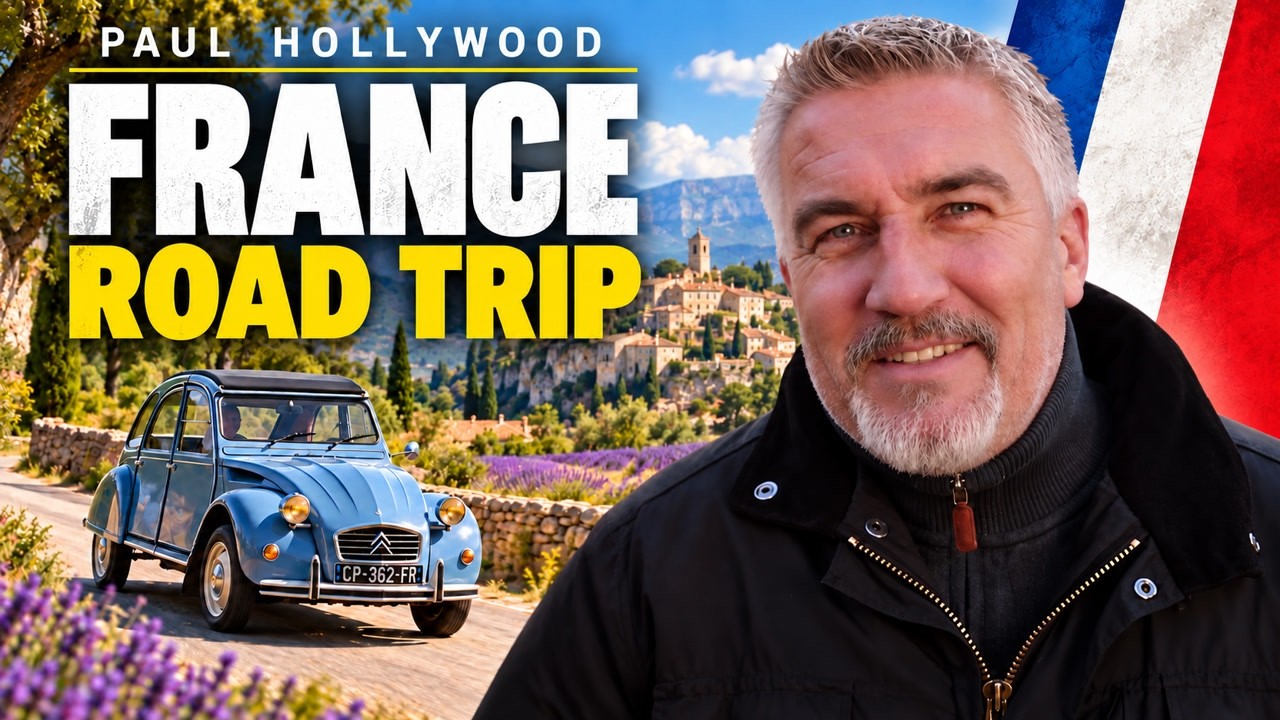
Paul Hollywood was sitting on the start line at Magny-Cours, feeling the vibrations of a Renault turbocharged Formula 1 car rumbling beside him, with six days and roughly 1,000 miles of central France already behind him. The question he had been chasing across the whole trip, whether the French relationship with cars reveals something essential about the French themselves, was about to be answered in the wettest, most gloriously absurd way possible. What began as a road trip through Paris traffic, rural toll roads, and a one-horsepower microcar had arrived here: a standing-start race against a 74-year-old Le Mans legend piloting the car that changed Formula 1 forever.
A DS in the rain and a parking lesson in someone’s mum’s Vauxhall
The trip opened in Paris with Philippe Lellouche, host of Top Gear France, as guide. Their vehicle of choice was the Citroen DS, a car philosopher Roland Barthes once said looked as if it had fallen from the sky, and which Philippe selected the moment they were given any say in the matter. The DS was leaking in the rain almost immediately. ‘Looks like you peed yourself,’ Philippe observed helpfully as water dripped onto the seat. Through the Arc de Triomphe roundabout, where 12 roads converge without a single road marking and any crash results in an automatic 50/50 cost split regardless of fault, Philippe’s driving instruction was precise: ‘Don’t be British. Just be a rude guy.’ The DS proved its worth on the cobblestones, its hydropneumatic suspension absorbing every rut so smoothly that Hollywood compared it to driving on a sofa. That same suspension, he learned, had saved President de Gaulle’s life in 1962 when at least 14 bullets struck the car during an assassination attempt and a punctured rear tyre simply refused to go flat.
Parking in Paris required a different vehicle. Philippe commandeered his own 10-year-old Vauxhall, which he cheerfully noted was now technically French since Peugeot had bought the company, and demonstrated the local approach to tight spaces: ‘Just a little bump. Not a big bump.’ The lesson concluded successfully. Hollywood remained visibly unsettled.
In Poissy, a golf club outside Paris produced one of the trip’s sharpest surprises. Thibault Le Marie, who owns a string of language schools and lives in a family château sitting in 200 hectares, drives a seven-year-old Renault Clio he inherited from his mother, who had bought it second hand. ‘Life is a question of priorities,’ he said. ‘Honestly, I don’t care.’ The club car park, Hollywood noted, looked like it had been painted beige.
Michelin tires, a one-horsepower car, and the man who drove back to the pub
The road south brought Michelin-starred chef Jean-Christophe Novelli into the passenger seat and introduced the relais routier, a network of around 500 truckers’ restaurants established in the 1930s offering three courses for typically 13 euros. Eating in the car, Novelli explained with complete seriousness, was not just illegal at 75 euros per offence but constituted a failure of class. ‘You basically have no class,’ he confirmed, as Hollywood chewed a baguette at the wheel.
The single-horsepower Exam Crossline Evo microcar, deployed shortly afterward as what Novelli called both a punishment and a humiliation, maxed out at 28 mph and attracted a queue of traffic stretching back further than Hollywood could bear to look. He pulled over, announced he was walking back to the pub, and left Novelli in the microcar alone. Novelli drove on.
At Le Mans, four-time race winner Henri Pescarolo explained over coffee on the circuit how he crashed at over 150 mph on the Mulsanne Straight during 1969 practice, was trapped inside the burning car, and knew that after 16 seconds he would not survive. He did survive. Two months later he won the Formula 1 Grand Prix at the Nurburgring on his return race. His assessment of how racing drivers manage the fear was matter-of-fact: ‘You know that could happen, but that’s normal.’
The 2CV section, driven from the town of Riom through rural France with British comedian Alexis Dubus, clarified the French automotive philosophy most plainly. The car was designed in the 1930s to carry 50 kg of farm goods to market and cross a field without breaking a basket of eggs. During the war, Citroen developer Pierre Boulanger refused Nazi demands and hid all 47 prototypes across France. Three of the originals were still hidden in a barn near Paris when they were recently discovered. Dubus put the cultural logic plainly: ‘Having a flashy car would be a sign of the bourgeoisie. They measure prestige in other things. It’s just a way of getting to the next meal.’
Jean-Pierre Jabouille at 74 and a wet track that changed everything
At Magny-Cours, the circuit that hosted the French Formula 1 Grand Prix for 17 years, the original 1977 Renault RS01 turbo F1 car sat in the pit lane. Jean-Pierre Jabouille, the driver who took that car to its first ever race win at the 1979 French Grand Prix, was 74 years old and about to drive it again. The rain made the turbo nearly useless: without enough heat in the engine, the single large turbo could not kick in properly, even with the car’s intakes partially blocked with gaffer tape to retain warmth.
Hollywood climbed into the cockpit to check the fit. His assessment was immediate. ‘This could be a slight issue with aerodynamics. My ass is a foot too wide.’ He was handed the keys to a 220-brake-horsepower Renault Sport Clio instead, lined up beside the F1 car on the wet circuit, and given a standing start. Jabouille pulled away instantly. Then, out of the third bend, Hollywood floored the Clio and overtook the Formula 1 car. On the next bend, Jabouille came straight back past him. Then the track became, as Hollywood described it, ‘a river,’ and Jabouille lost the rear himself. Hollywood took him again. ‘Yesterday I lost to a horse,’ he said back in the pits, ‘and today I beat a Formula One car.’
The DS drip, still sitting there
Back in the Citroen DS near the Arc de Triomphe, early in the trip, water was coming through the roof and pooling on the seat as the car glided over the cobblestones as if the road did not exist.
The race at Magny-Cours confirmed what the DS had suggested on day one, what the Clio at the golf club confirmed, what the 2CV rolling through toll booths at 47 mph stated plainly: France is a country that will make the most revolutionary car in the room and use it to fetch bread.
 Wake up to Only Happy News!