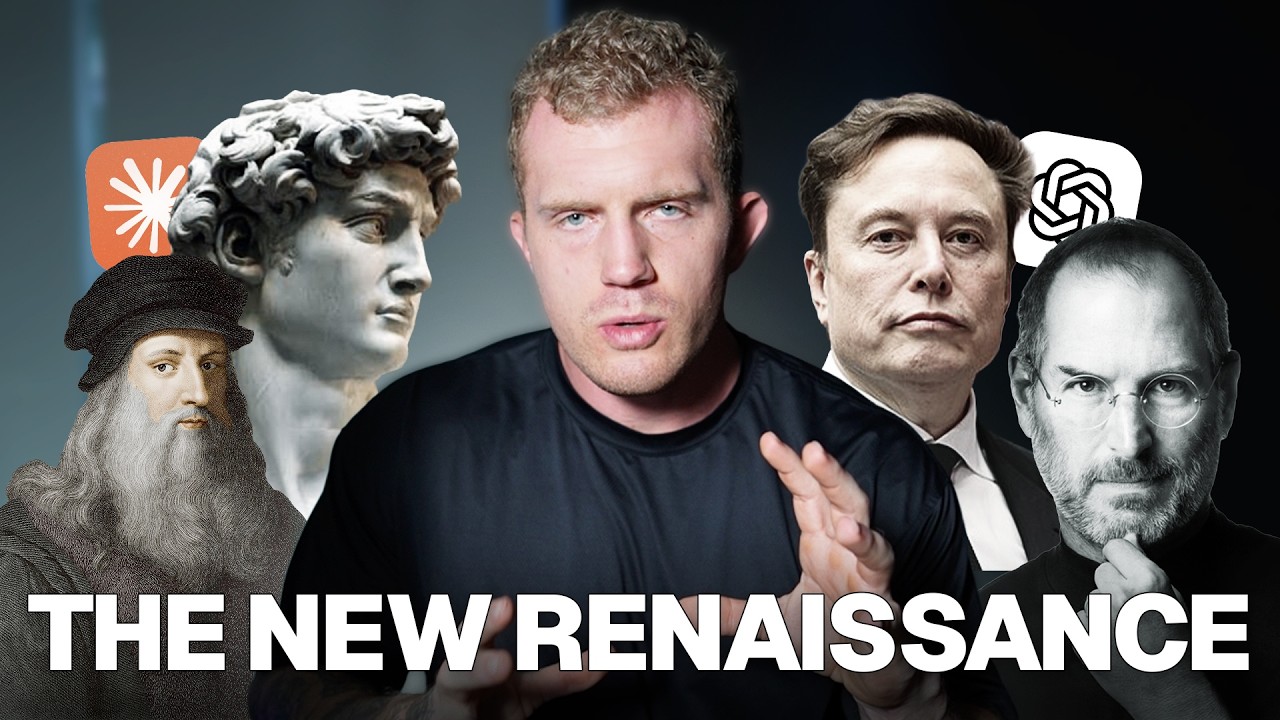
Leonardo da Vinci walked into Verrochio’s workshop to learn painting and left knowing anatomy, engineering, optics, and bronze casting. Nobody told him those were separate disciplines requiring separate credentials. That combination, writer and thinker, artist and scientist operating from a single restless mind, is exactly the template that creator and writer Dan Koe argues the next decade will reward most handsomely. His case is not nostalgia. It is a direct challenge to the assumption that specialization is the safe path, issued at a moment when AI is quietly making specialists the most exposed people in the workforce.
The two wrong answers most people are choosing right now
Koe opens by sorting people into three camps. The first are what he calls the purists: those who reject AI entirely, retreat to screen-free aesthetics, and signal simplicity while often being the heaviest screen users in the room. The second are the automatons, people who outsource every decision to technology, optimize every corner of their lives, and lose track of where the tool ends and the person begins. Both camps, he argues, are making the same mistake from opposite directions: each rejects an entire portion of reality.
He frames this using a four-quadrant model adapted from Ken Wilbur’s integral theory, covering the personal mental world, the personal physical world, the collective mental world, and the collective physical world. The purist collapses inward, rejecting money, society, and external contribution. The automaton collapses outward, chasing productivity and power while letting the internal world go dark. Koe’s point is blunt: you cannot max out one quadrant and expect the others to cover for you. In his words, ‘it doesn’t matter how spiritual or enlightened you are if your body is frail and you’re unhealthy and you don’t have any money to your name, which is the lifeblood of society. More spirituality is not going to solve that problem because it’s not in the same domain of reality.’
What Charles Darwin’s three-hour workday reveals about deep output
The alternative Koe proposes is what he calls the digital Renaissance person: someone who builds across domains, uses AI as leverage rather than crutch, and structures their days around contrast rather than flat balance. His anchor example is Charles Darwin, who wrote 19 books across his lifetime on a schedule that would look irresponsible by modern hustle standards. Darwin’s first work session ran from 8 to 9:30 in the morning. A break followed for letters and family. A second session ran from 10:30 to noon, at which point Darwin considered his productive day complete. Three separate walks filled the afternoon, including laps around the quarter-mile gravel path he built specifically for thinking. Total focused creative work: roughly three hours a day.
The modern version of the same structure, Koe argues, pairs that deep-rest and deep-work contrast with AI handling the machine-like layer beneath: building landing pages, researching patterns across large bodies of content, drafting first iterations of software or funnels. The human role moves up, from execution to taste, direction, and judgment. ‘The output of AI does not have perspective,’ he notes. ‘AI is simply artificial intelligence. It’s like a bag of water that you must mold.’
The skill stack he recommends has three layers. The foundation is human psychology, marketing, writing, and an understanding of attention. The middle layer is domain obsession, whatever constellation of genuine interests a person actually has. The third layer is technical tools, which he explicitly ranks as the least durable investment, since AI is rapidly absorbing that layer. His practical entry point for AI: open a chat interface, describe a simple app you want to build, ask it to explain every step it takes, and iterate for a few days. The first version will be rough. That is the point.
The gravel path Darwin built for thinking
A quarter-mile loop of gravel, laid deliberately outside Darwin’s home and walked three times a day for decades, sits in the source as a small and specific object. Koe mentions wanting to build one himself someday.
The job description for the next ten years, as Koe frames it, is not to pick a lane. It is to own the whole road: choose a craft, stay genuinely curious across domains, learn by doing rather than by watching, and treat the first draft of anything, a landing page, a software build, a newsletter, a career, as exactly that. The gravel path gets worn smooth by repetition, not by getting it perfect on the first loop.
 Wake up to Only Happy News!