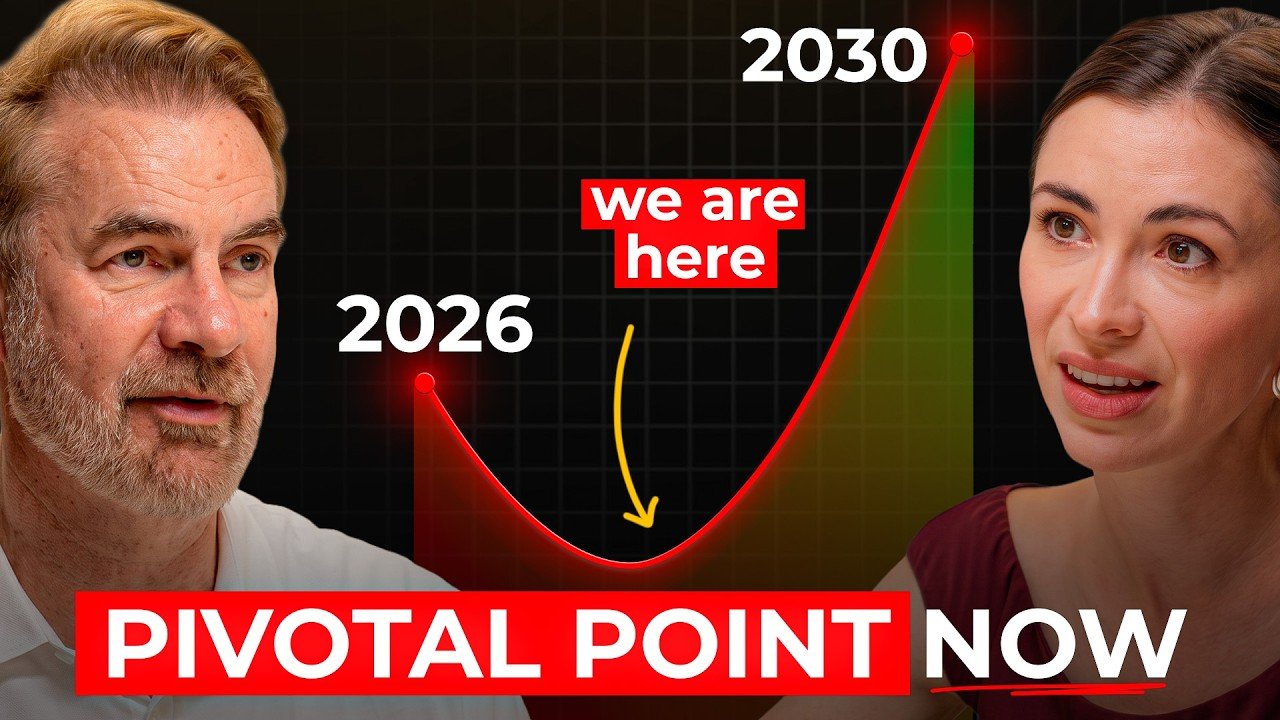
Erik Brynjolfsson had just come back from London, where the researchers at DeepMind had told him something that stuck with him: within 18 to 24 months, capabilities would arrive that most people were not prepared for. The Stanford economist has spent 30 years measuring what technology actually does to jobs and wages, not what people predict it will do, and he sat down to deliver a verdict that is neither comforting nor catastrophic. It lands somewhere more useful: the next decade is genuinely a fork in the road. ‘The next decade, if we play our cards right, will be the best decade in human history by far,’ he said. ‘Or this could be like one of the worst 10 years ever.’
The jobs already disappearing before anyone noticed
Brynjolfsson’s lab published a paper called ‘Canaries in the Coal Mine,’ and the title was chosen carefully. Among workers under 25 in the most AI-exposed occupations, the data showed a 16 percent drop in employment, and that number has grown every month since the paper came out. Coding and call centers sit at the center of the damage. Junior software engineers at around $95,000 a year and mid-level marketing managers at $115,000 are both, in his assessment, squarely in the bullseye. Paralegals fare even worse.
The mechanism is not simply replacement. It runs through what economists call the demand curve. When AI makes a task cheaper to perform, the outcome for workers depends entirely on how much demand expands in response. In some fields, cheaper service leads to more demand, not less spending. Brynjolfsson uses radiology as the clearest example. When Geoffrey Hinton declared in 2017 that radiologists should stop being trained because AI could read medical images, the opposite happened: there are now more radiologists than ever, close to a shortage, because reading images is only one of roughly 26 distinct tasks a radiologist performs, and making that one task cheaper caused overall demand for imaging to surge. A shoulder MRI that costs $2,000 goes unordered; at $200, people go get it checked.
The half of the economy where lower prices lead to more spending is, he argues, where the real opportunity lives. His comparison is jet engines: air travel became vastly cheaper, and the result was not less spending on flights. People simply flew far more.
What actually survives and what you should build instead
Brynjolfsson divides most work into three stages: defining the right question, executing on it, and evaluating whether the result is actually what you wanted. AI agents are rapidly taking over the middle stage. His advice for workers is to become expert at the first and third parts, because that is increasingly where human value concentrates. He calls this being the CEO of a fleet of agents rather than an individual contributor.
At Stanford, his course no longer accepts PowerPoint presentations. Every student, regardless of whether they arrived as a programmer, had to present running code at the final session. ‘Everybody’s a coder now,’ he said. ‘That’s a good message for your listeners.’
For the deeper question of what remains uniquely human as intelligence becomes a commodity, he identifies four areas: initiative and agency, authentic human connection, physical skilled work (though he sees a closing window there), and, perhaps most intriguingly, the jobs that have not been invented yet. He noted that 200 years ago, neither he nor anyone else would have predicted the existence of the podcaster.
He made a formal wager with fellow economist Bob Gordon that by 2030, productivity will be significantly higher than what the Bureau of Labor Statistics currently projects. He believes he is already slightly ahead in that bet.
His warning cuts equally hard in the other direction. He was one of the economists who championed free trade by arguing that a larger economic pie would ultimately benefit everyone. The redistribution and retraining that was supposed to accompany it never materialized, and the backlash arrived like, in his words, a tidal wave. He sees AI as ten times larger than that disruption and worries the same mistake is being made again.
A five-year-old’s question about the next 30 years
The interview ended with a question about a daughter who had just turned five.
Brynjolfsson sat with it for a moment. He had been at DeepMind recently, and Demis Hassabis had told him he believed a majority of diseases could begin to be cured within ten years. Brynjolfsson said he hoped that was right, and that a five-year-old today would see it happen. He then added, without softening it, that the same decade holds the potential for catastrophic outcomes: AI-powered autonomous weapons, mass centralization of economic and political power, manipulation at scale. ‘If you’re not both excited and scared,’ he said, ‘you’re missing at least half the story.’
The DeepMind building is still there, and so is the 18-to-24-month timeline Brynjolfsson carried home from it.
 Wake up to Only Happy News!