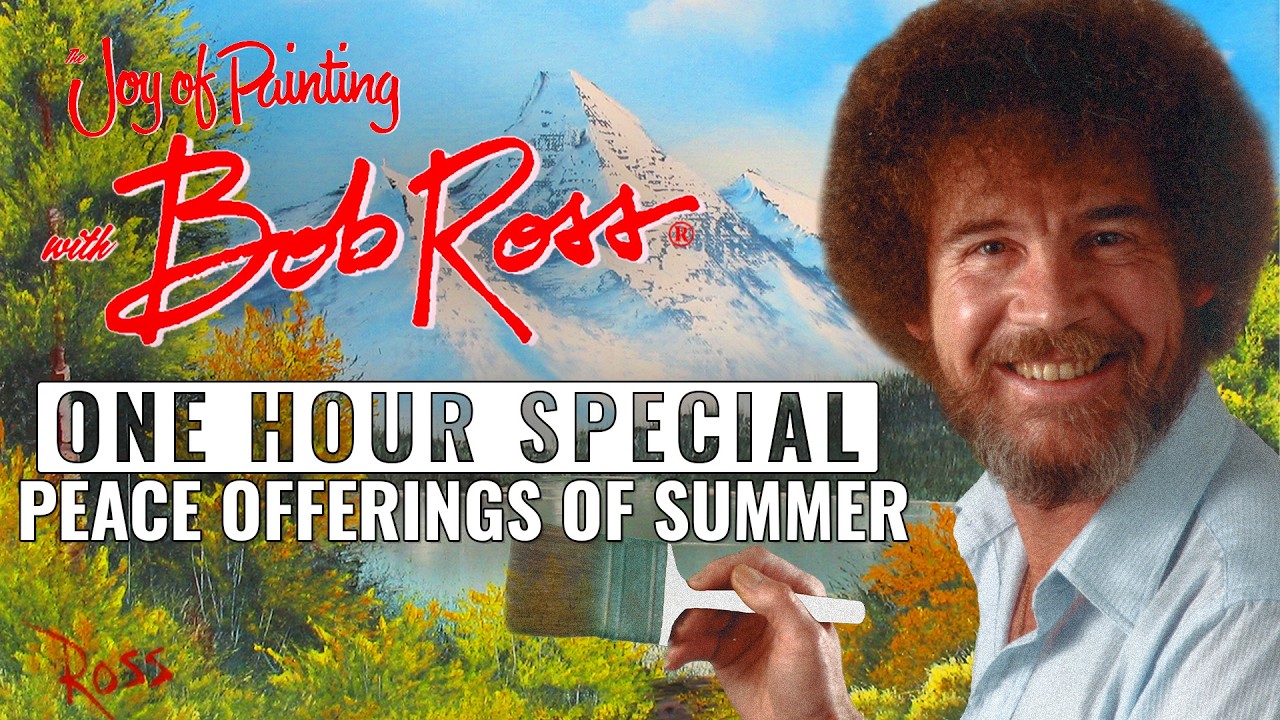
Bob Ross sets a tall glass of iced tea on the table and asks you to sit down before picking up a single brush. That is the first instruction in this hour-long private studio session, and it tells you everything about what follows: a methodical, warm, technically specific walk through a complete landscape painting that never appeared on the Joy of Painting television series, designed so that a first-time painter can follow every step without rewinding more than once.
Why the liquid white is the whole foundation
Before any color touches the canvas, Ross covers the entire surface with liquid white, a thin oil-based paint that keeps the canvas wet and slick throughout the session. He is direct about the single most common beginner mistake: applying too much. All you need, he explains, is a very thin, even coat, worked in long horizontal and vertical strokes with the two-inch brush. The wet surface is what makes everything else possible. A thin paint sticks to a thick paint, and that principle drives every layer that follows. For anyone without a gray-primed canvas, he offers a practical workaround: add a small amount of liquid black to the liquid white to create a gray tint, so you can see exactly where coverage ends and bare canvas begins.
The sky comes first. A small amount of phthalo blue, tapped into the bristles in a crisscross pattern, goes on at the top of the canvas and is worked downward in little X strokes, automatically lightening as it mixes with the liquid white below. Clouds follow using the fan brush loaded with titanium white and a touch of bright red for warmth. Ross is emphatic on one point: do not overwork them. Get in, place the shape, and step away. The two-inch brush then blends the base of each cloud in tiny circles while the tops are left alone, and a final sweeping upward motion pulls soft streaks into the sky. He calls the technique ‘two hairs and some air’ for how lightly the brush should graze the surface.
Mountains, mist, and the knife that does everything
The painting knife, specifically the number ten, is Ross’s most-used tool for the middle section of the painting. A mixture of Prussian blue, midnight black, and a touch of alizarin crimson goes onto the palette, pulled flat and cut across so a small roll of paint sits right on the knife’s straight edge. That edge is everything: it is what lets the paint transfer with almost no pressure. When teaching his son Steve to paint, Ross told him to pretend he was a whisper and would float away if he pressed too hard, and that instruction reappears here as the fix for the most common knife mistake, pressing so hard the result looks like a cake has been iced rather than a mountain painted.
Once the mountain shape is set, the two-inch brush blends the base into the liquid white to create the illusion of mist, following the angles of the mountain rather than chopping straight across, which would look as if someone had taken a large knife to the base. Foothills in a mixture of the mountain color, sap green, and a touch of blue come next, tapped in with the corner of the brush and pulled slightly downward. Their reflections go straight down into the water below, a point Ross repeats several times because any angled reflection immediately breaks the illusion of still water.
Highlighting the foreground bushes with the one-inch brush, loaded with liquid white first and then yellow and sap green, is where many beginners stall. The fix is the same as with the mountain: remove the excess with the knife, replace the dark undercoat, and try again. Ross frames every correction the same way: each time you make a mistake, you learn something, and the painting grows.
The tree trunk Ross made with a clean knife edge
A tree trunk goes in with a small amount of dark sienna and van Dyke brown, left marbled rather than fully mixed, cut onto the knife edge and pressed lightly onto the canvas. Ross then drags the clean knife straight through the wet paint in short quick pulls to scratch in fine sticks and twigs. Most of these will disappear under the final layer of highlighted leaves, but a few will show through, and people will think you spent a week with a one-haired brush putting them in. Do not correct that impression, he says.
A brush that never quite stops moving
At the end of the session, the canvas holds a sky with three clouds, a snow-capped mountain receding into mist, foothills reflected in still water, and a foreground of layered bushes with a burst of orange-red catching the light. Ross adds the final touches of bright color with a one-inch brush pushing upward in the same direction throughout, building layer after layer so the depth reads as distance. The brush is still bent slightly from being pulled through the paint.