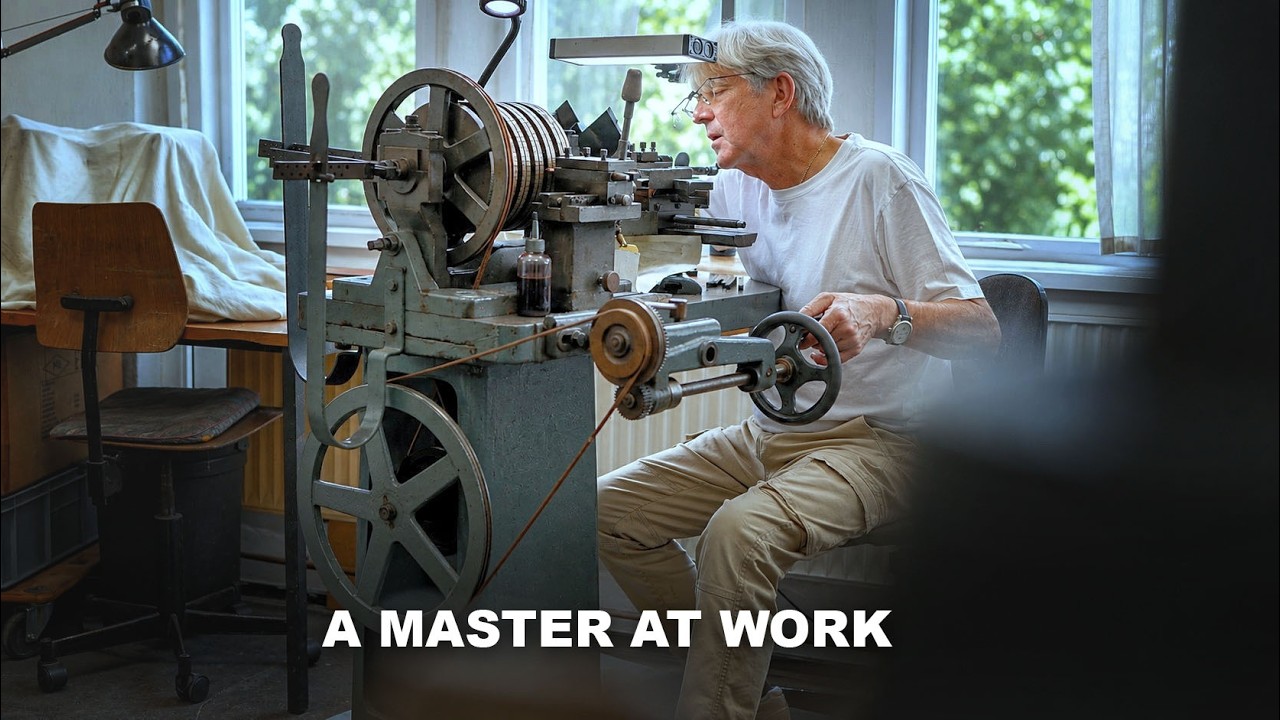
In a workshop in Pforzheim, Germany, a man in a plain t-shirt and trousers sits behind a bench that smells of oils and lubricants, coaxing a pattern from raw brass using a machine that runs on nothing but his own hands and feet. Johann Benzinger is not widely famous, but his work has circled the globe on the wrists of some of its most demanding collectors. What happens inside this room is a quiet argument against the idea that the highest form of craft has to be loud.
A craftsman whose tools are polished by his own palms
Pforzheim has long been a city of respected watchmakers, but the genuinely artisanal side of that tradition has thinned considerably over the decades. Benzinger is one of the few who kept going. He began his formal training in 1978 at a goldsmith school, learning decorative jewelry techniques before watchmaking entered the picture at all. His exceptional skill in guilloche finishing led to a commission that stopped visitors cold when they heard it: he was asked to create guilloche patterns on Faberge’s famous eggs. Over time, the mastery of fine jewelry techniques carried him into engraving, beveling, skeletonization of watch dials and movements, and gear-shaped decorative patterns, a list that grows more specific and more demanding the longer you stand and watch him work.
None of the machines around him are plugged into a wall socket. The only power source driving his tools is the man himself. A light switch gets used. A Swiss-made coffee machine does, too. Beyond that, every pattern that emerges from the metal exists first only in Benzinger’s mind, then, seconds later, in the brass in front of him.
Photographer Peter Kotsa, who had already handled a Benzinger watch professionally before the visit, expected someone outspoken and business-like. What he found was the opposite. ‘He doesn’t say much,’ Kotsa noted, ‘but he doesn’t have to.’ The confidence shows in the hand movements. The fine adjustments are made with tools whose contact points have been polished smooth by decades of his grip alone.
The Bugatti, the footballer, and the clientele list nobody expects
The brands that have commissioned Benzinger over the years include IWC, Moritz Grossman, and Glashutte Original. During the visit, he showed Kotsa a center console from a Bugatti Chiron, a piece of metalwork he was decorating for the car’s owner. Kotsa asked, half-joking, whether the car belonged to Cristiano Ronaldo. Benzinger confirmed it did. He mentioned it the same way he mentions most things: briefly, without theater.
The workshop doubles as a kind of private museum. Drawings and design sheets from past and present commissions line the space, decades of work rendered in pencil and brass. Benzinger showed Kotsa a book of rose engine designs dating to the 1700s, the same turning machines that royalty once used in the evenings to work wood and pass time. The machine category and the leisure category were, in that era, the same thing. In this workshop, they still are.
A quiet afternoon with Johann and his wife Stephanie
The slow, meticulous grind of tool against metal is the dominant sound inside the room. That, and the gentle ratcheting of a gear system being turned by hand. Benzinger’s wife Stephanie was present during the visit, part of a life the two have built around a workspace that Kotsa described as tranquil and calm.
Benzinger is now far past the stage where craft requires effort. The beveling, the engraving, the skeletonization: Kotsa observed that these techniques seem to come to Benzinger the way conversation comes to most people. Second nature. The parts of his tools where his hands make contact have gone smooth over the years, polished not by any finishing process but by the simple accumulation of time and work.
The brass edge of a tool, worn to a shine by thirty-plus years of contact
Along the bench, the metal where Benzinger’s palms have rested longest carries a polish that no manufacturer put there.
Kotsa came from a background in mechanical engineering and had his own history with the smell of oils and machine parts. He left Pforzheim having reclassified what he saw: not machines, but tools, objects that only do anything at all because the right person is operating them. That distinction, he found, was the whole point.
 Wake up to Only Happy News!