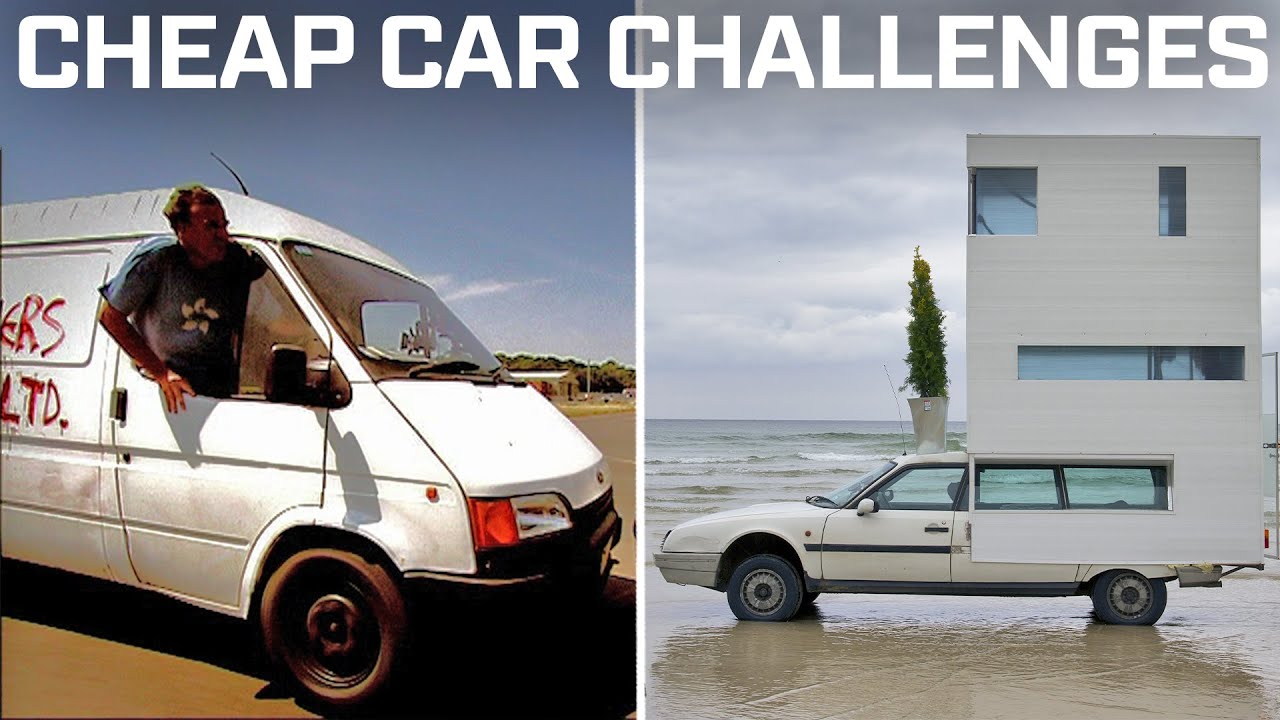
A friend walked into a Volvo dealership with a single pound coin and walked out with a car. The dealer, stuck with an old banger he was legally required to pay a scrapyard £150 to take off his hands, accepted the quid without hesitation. That transaction, quietly arranged on behalf of Jeremy Clarkson, set the stage for one of the most chaotic and genuinely funny engineering stress tests ever devised for a budget motor: a series of scored challenges pitting a £1 Volvo GLE, a Rover GTI, and an Audi A80 against each other across fuel economy, braking, electrical reliability, structural integrity, and ultimately a head-on collision with a concrete wall.
The scoring nearly made sense until someone broke a thumb
The rules were elegantly simple. Thirty miles per gallon was the fuel economy target for the Manchester run: beat it and earn a point per MPG, fall short and lose one. James May’s Audi delivered a remarkable 35 MPG, banking five points straight away. Richard Hammond’s Rover scraped 23 MPG for minus seven. The Volvo managed 20 MPG, leaving Clarkson on minus ten before the second challenge had even been announced.
The track lap followed, with the Stig driving each car around a circuit against a 1 minute 50 second target. Hammond’s Rover posted 1 minute 42, earning eight points. May’s Audi went round in 1 minute 46 for four points. Clarkson’s Volvo came in at 1 minute 48 and collected two. Then came the braking test from 60 mph, with the Highway Code’s 60-yard stopping distance as the baseline. The Volvo, fitted with anti-lock brakes, hauled up in just 34 yards: 26 yards inside the target, the best score of the day. The electrical audit then gutted everyone. The Rover dropped three points for faults. The Audi lost four. The Volvo shed twelve.
The crash test was the centrepiece. Each car would be driven into a wall at 30 mph. Ten points lost for death, five for a broken bone, one for a blood injury. Clarkson went last, his speedometer broken, and guessed at 30. He hit the wall at 40. The Volvo survived intact. Clarkson did not. As he put it after seeing the x-ray: ‘It is chipped. If a teacup is chipped my mother would say it’s broken. And it’s broken.’ The broken thumb cost him five points, putting his final tally at minus two, after everything.
The budget round, worth a point per pound saved from the original £100, became the decider. Clarkson, who had spent precisely £1 on his car, was mathematically out of contention because of his accumulated penalty points. Hammond had spent £80. May had spent £75, putting him fifteen pounds ahead and securing the win.
Lorries, wedding cakes, and a gear lever in an unfortunate location
A separate challenge sent the trio to a secret Alpine test location in Bedfordshire behind the wheels of heavy goods vehicles. Clarkson had acquired a Scania sleeper cab. May had a Renault with a flat floor he pointed out was ‘easier to fit the carpet.’ Hammond had, by his own admission, bought something that looked like a shed.
The Stig’s lorry-driving cousin demonstrated a power slide in a tuned rig before one of the tyres detonated and sent everyone running. The trio then attempted their own versions, which produced, among other outcomes, May clipping a parked car, the suspension linkage separating from Clarkson’s vehicle mid-manoeuvre, and the Renault’s gear lever finding its way into Clarkson’s anatomy during a particularly optimistic slide attempt.
The Alpine course stage required each driver to tow a trailer containing fragile cargo: Hammond had an unfastened car inside his, May had a wedding cake, and Clarkson was carrying an electric fire with loose straw at the far end. In the heat of a drag race up the handling circuit, nobody gave much thought to the cargo. May’s cake survived in broadly recognisable form. Clarkson arrived at the finish line on fire.
One handbrake, one very steep hill
A 1-in-3 gradient handbrake test followed. The cars were to be left in neutral with only the handbrake holding them on the slope. Hammond’s car rolled. The Rover knocked over the warning sign on its way down. The Audi held. The Volvo held.
The final water-submersion test filled each car to the brim via fire hose before sending the drivers around the track. Hammond’s car leaked so quickly that the level dropped below the steering wheel before he reached the follow-through. May’s Austin Princess, sealed tightly enough to hold its drink, completed a full lap and then lapped Hammond again. The Rover required three hoses running simultaneously just to get it brimmed, and the doors came off before it reached the end of the straight.
The pound coin that started it all
The Volvo, the car bought for a single pound from a main dealer who was relieved not to be paying £150 for its disposal, still parked in the pit lane after the water test, doors sealed with gaffer tape, bodywork intact from the 40 mph wall hit, anti-lock brakes still functioning.