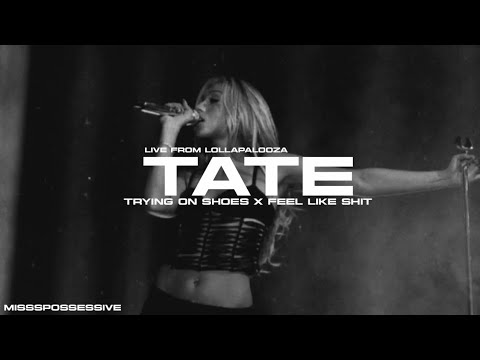
The lights had barely settled over the Lollapalooza stage when Tate McRae pulled two of her most emotionally exposed songs into a single, unbroken performance. For anyone who has ever replayed a breakup conversation at 2 a.m. and still come up empty, this live studio version of ‘Trying On Shoes’ folding directly into ‘Feel Like Shit’ lands with the precision of something lived, not staged.
Two songs, one wound
The performance opens mid-feeling rather than mid-ceremony. There is no preamble, no crowd address, just the music beginning and McRae stepping into the lyric as though the argument never actually ended. ‘I used to idolize you,’ she delivers early, and the past tense does more damage than any louder line could. The relationship being described is not gone in an explosive way; it dissolved quietly, which is often the harder kind to explain to anyone who was not inside it.
The transition between the two songs is almost imperceptible, which is exactly the point. ‘Trying On Shoes’ traces the awareness that a relationship no longer fits: ‘You need a girl that isn’t me.’ ‘Feel Like Shit’ picks up where that awareness drops you, alone with the ceiling and the silence of a phone that did not ring. ‘I couldn’t even sleep at all,’ McRae sings, and the line is less a confession than a weather report, something factual about the night before.
McRae put the emotional center plainly in the lyric itself: ‘I’m not just like she is.’ It is the one line in the medley that refuses to negotiate, and its refusal is what makes it stick.
What the live studio version preserves
Recording a Lollapalooza performance as a live studio version means the energy of the outdoor stage gets shaped by a more controlled acoustic environment, and the result here is that McRae’s vocal nuances survive the translation intact. The moments that might blur in an open field, the quieter second-guessing phrases, the slight catch before ‘maybe I’ll get used to it,’ come through with the clarity the songs require.
The medley structure itself is an argument: these two songs are not just thematically linked but emotionally sequential. First you recognize the incompatibility, then you lie awake with it. Running them together without a break removes any chance for the listener to look away from that sequence.
The line that didn’t get an answer
Near the close, the medley opens up one unreturned question: ‘Or can we go back and talk that face to face? Just this once.’ The phrase sits inside the arrangement without resolution, which is precisely its function.
The performance ends where it began, in that specific kind of sleeplessness that has nothing to do with the hour and everything to do with what someone did not do. McRae does not editorialize around it. She just stays in it, which turns out to be the whole performance.