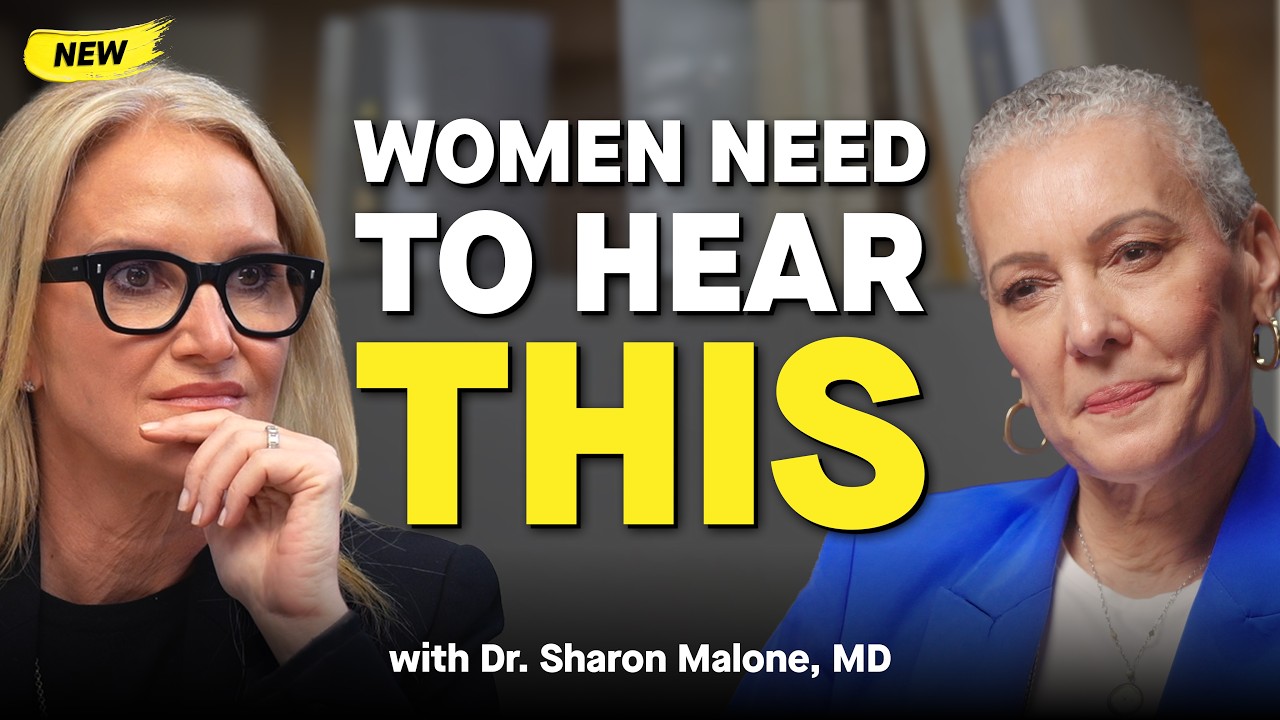
Dr. Sharon Malone has been having the conversation that most women never get to have: a straight, science-backed account of what hormones are actually doing to the body from the first period to the final hot flash, and what any woman can do about it right now. For anyone who has ever been handed a sleeping pill when what she really needed was an estrogen patch, or who walked out of a doctor’s office with an SSRI prescription when perimenopause was the real culprit, this is the master class that should have happened decades earlier. Malone, a board-certified OB-GYN and nationally recognized expert in menopause and reproductive health, sat down with Mel Robbins to go decade by decade through the one continuous hormonal story that connects puberty, fertility, perimenopause, and the years that follow.
Why birth control misinformation is costing young women
Malone came in with visible frustration about the wave of women in their 20s abandoning reliable contraception based on social media posts. Birth control pills, she said plainly, are ‘probably one of the greatest modern inventions in the history of womankind.’ She walked through the medical record: the pills ease heavy periods, reduce PMS by smoothing the falling-estrogen trigger that sets it off, and serve as first-line treatment for suspected endometriosis. They do not cause infertility. If a 35-year-old woman stops the pill after 15 years and struggles to conceive, Malone is direct: ‘It is the fact that you are 35.’
For women who cannot tolerate one formulation, she pointed out that roughly 20 pill options exist, each carrying a different progestogen, and that a bad reaction at 20 does not close the door forever. For those who want longer-acting options, she walked through the full menu: hormone-releasing IUDs, copper IUDs, the Depo-Provera injection given every three months, and implants that last three years. The appeal of these long-acting reversible contraceptives, she explained, is that they remove user error from the equation entirely.
On the ‘natural method,’ Malone was equally direct. Sperm can survive up to 72 hours inside the body, and basal temperature rises only after ovulation has already occurred, making temperature tracking useful in retrospect but not as a prevention tool. ‘If you had sex yesterday and your temperature goes up today,’ she said, ‘that’s a little too late for that information.’
The long arc from PCOS to perimenopause to bone loss
Malone unpacked polycystic ovarian syndrome as a hormone imbalance that disrupts ovulation and triggers chronic overproduction of both testosterone and insulin, producing acne, facial hair, weight gain, irregular cycles, and insulin resistance. The diagnostic criteria, she noted dryly, have not changed since the name was updated: ‘We just changed the name.’
On endometriosis, which affects one in 10 women and carries an average delay to diagnosis of 7 to 10 years, she explained why the condition fools so many doctors. Endometrial tissue landing on the bowel looks like a GI problem. On the bladder it mimics a urological one. Women end up treated organ by organ while the underlying cause goes unaddressed for nearly a decade.
The fertility conversation carried one of the sharpest practical tips in the entire discussion. If a mother reached menopause at 42, her daughter should subtract 4 to 10 years, the length of the perimenopause window, and recognize she may already be in that transition in her early 30s, well before she expects any fertility concerns.
On menopause itself, Malone was unsparing about what is at stake. Women lose 30% of their skin collagen in the first five years after menopause. Bone loss accelerates fastest in that same window, yet the standard recommendation for a first bone density scan is age 65. ‘By the time you get it at 65, you’ve already lost,’ she said. Her preference: a baseline scan at menopause, then a follow-up 18 months to two years later to see whether density is declining. Hot flashes are not a minor inconvenience to outlast but a potential early marker for cardiovascular risk, linked through the chain of night sweats, disrupted sleep, fatigue, reduced exercise, and rising blood pressure.
The most effective FDA-approved treatment for vasomotor symptoms is hormone therapy, specifically estrogen, and Malone pushed back hard on the idea that women should take the smallest dose for the shortest possible time. ‘There is no time limit on how long you can take hormone therapy.’ For women who cannot find an estrogen patch during the current shortage, she noted that transdermal options also include sprays and gels, and that oral hormone therapy carries the bulk of the long-term research supporting the treatment’s benefits. Vaginal estrogen, she clarified, works locally and does not replace systemic therapy; a woman using it for dryness or recurrent UTIs will still have hot flashes if she is not also on systemic estrogen.
Robbins asked the question Malone said too few women think to raise with their doctors. Instead of asking only what the risks of taking hormone therapy are, ask what happens if you don’t. ‘What am I at risk for if I don’t?’ Malone said. ‘We don’t have two sides of that conversation.’
The 67-year-old who is having more fun than she did at 47
At 67, Malone closed with a data point from her own life that she offered without ceremony: ‘I’m having way more fun at 67 than I was at 47. But you’ve got to feel well enough to be able to do it.’
The patch Robbins said she will wear ‘on my deathbed’ is on her arm right now, one small piece of evidence that the conversation Malone has been having privately for 35 years and publicly for more than five is finally reaching the women who needed it long before they knew to ask.