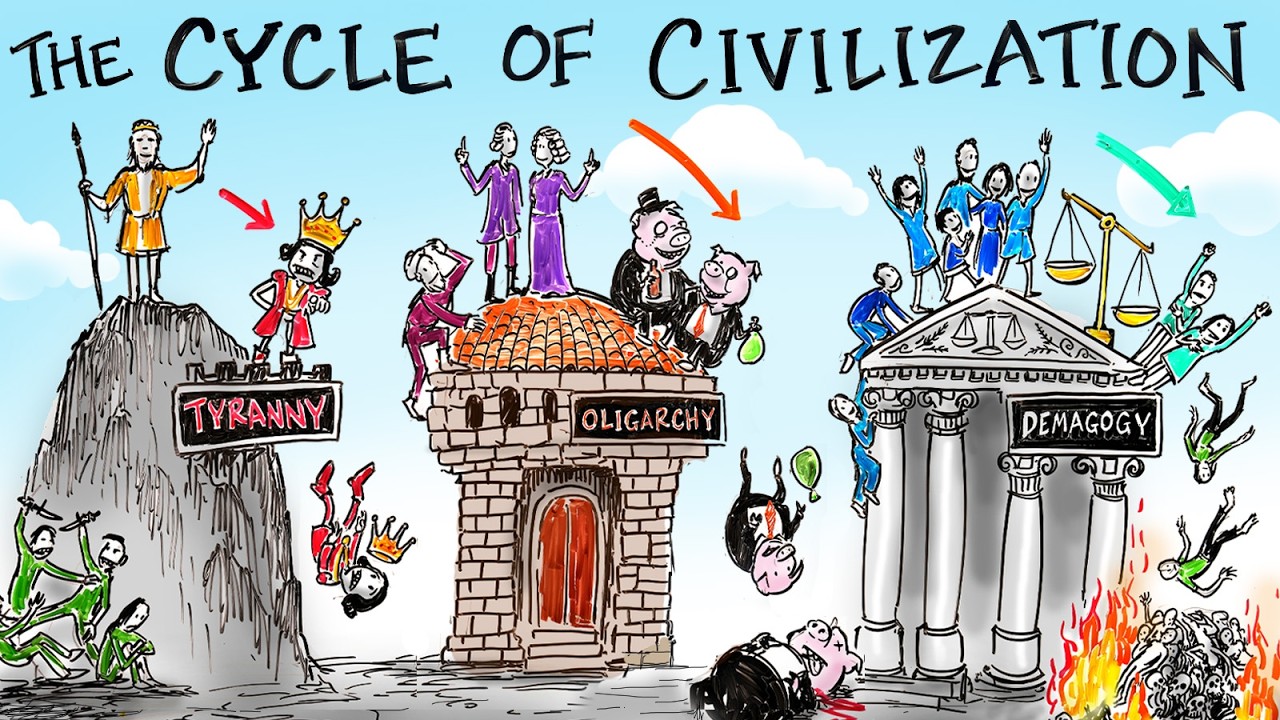
In 167 BC, a well-born Greek named Polybius watched Roman soldiers march through his home city of Megalopolis, then boarded a ship to Rome as one of a thousand high-status hostages. The question that consumed the rest of his life was not how to escape but how to explain what had just happened to the most sophisticated civilization in the ancient world. That question, asked by a captive intellectual in the second century BC, would eventually shape the founding documents of the United States.
Greg Aldrete, a history professor specializing in ancient Greece and Rome, walks through Polybius’ central argument: that civilizations are not random in their rise and fall but follow a predictable, biological cycle he called anacyclosis, a seven-stage wheel that rotates from primitive anarchy through kingship, tyranny, aristocracy, oligarchy, democracy, and mob rule, then back to the start. The logic of each transition is almost mechanical. A wise king earns loyalty; his descendants inherit power and grow arrogant; aristocrats replace the tyrant, then grow corrupt in their own right; the people revolt and build a democracy; later generations take their freedoms for granted; demagogues exploit the resulting resentment; mob rule follows; a strongman emerges. The wheel turns.
Why Athens made the theory feel inevitable
Polybius did not construct anacyclosis in the abstract. He stress-tested it against Athens, the most documented city-state available to him. The pattern held with uncomfortable precision: legendary wise kings gave way to arrogant tyrants, who were overthrown by aristocratic families, who gave way to radical democracy, which reached its peak of wealth and power in the mid-fifth century BC, only to produce the demagogues who pushed Athens into catastrophic military defeat and imperial collapse. By the time Alexander the Great’s successors carved up the Eastern Mediterranean, the wheel appeared to have circled back to monarchy. For Polybius, the question was not whether the cycle was real but whether any civilization had ever found a way off it.
The Roman answer, and why it eventually broke
Polybius believed Rome had cracked the problem. The Roman Republic, as he analyzed it, was not a pure kingship, aristocracy, or democracy but a deliberate mixture of all three. The consuls carried monarchical executive authority, the Senate held aristocratic deliberative power, and the citizen assemblies anchored democratic accountability. Critically, each branch could check the others. As Polybius put it directly: ‘whenever any one of the three branches of government becomes overbearing and displays an inclination to be contentious and encroach upon the others, the mutual interdependency of all three and the possibility of the ambitions of any one of them being checked or blocked by the others curbs this tendency.’ He called this equilibrium the secret of Roman dominance.
The Founders of the American Republic read him carefully. Thomas Jefferson considered Polybius essential enough that during the Constitutional Convention he sent a copy of his history to James Madison to study. John Adams quoted Polybius repeatedly and described his cycle theory as ‘the creed of my entire life,’ writing that ‘simple monarchy will soon mold itself into despotism, aristocracy will soon commit an oligarchy, and democracy will soon degenerate into anarchy.’
Polybius himself, writing at the height of Republican success in the second century BC, did not live to see the irony. Beginning roughly a century after his death, the Roman Republic began following the exact anacyclosis path he had mapped. Veterans, allies, and the poor grew convinced they were not sharing in Rome’s conquered wealth. Men like Marius, Sulla, Pompey, and Julius Caesar raised private armies, manipulated the assemblies, and replaced political debate with violence. A sequence of civil wars produced the first emperor, Octavian, later Augustus, and the Republic was gone.
A detail Polybius could not have known
Among the Greek thinkers who inherited and refined anacyclosis, Thomas Aquinas addressed it in the Middle Ages and Niccolo Machiavelli developed his own version of the cycle in the Discourses, a lesser-read companion to The Prince. The lineage runs unbroken from a Greek hostage in Rome through medieval theology, Renaissance political theory, Enlightenment philosophy, and into the constitutional architecture of a republic that is still functioning, in altered form, today.
The 40-volume history Polybius spent his captivity writing survives only in fragments. What remains includes his description of the Roman constitution, the section Jefferson sent to Madison, still legible after two millennia.
The original manuscript is gone. The argument is not.
 Wake up to Only Happy News!