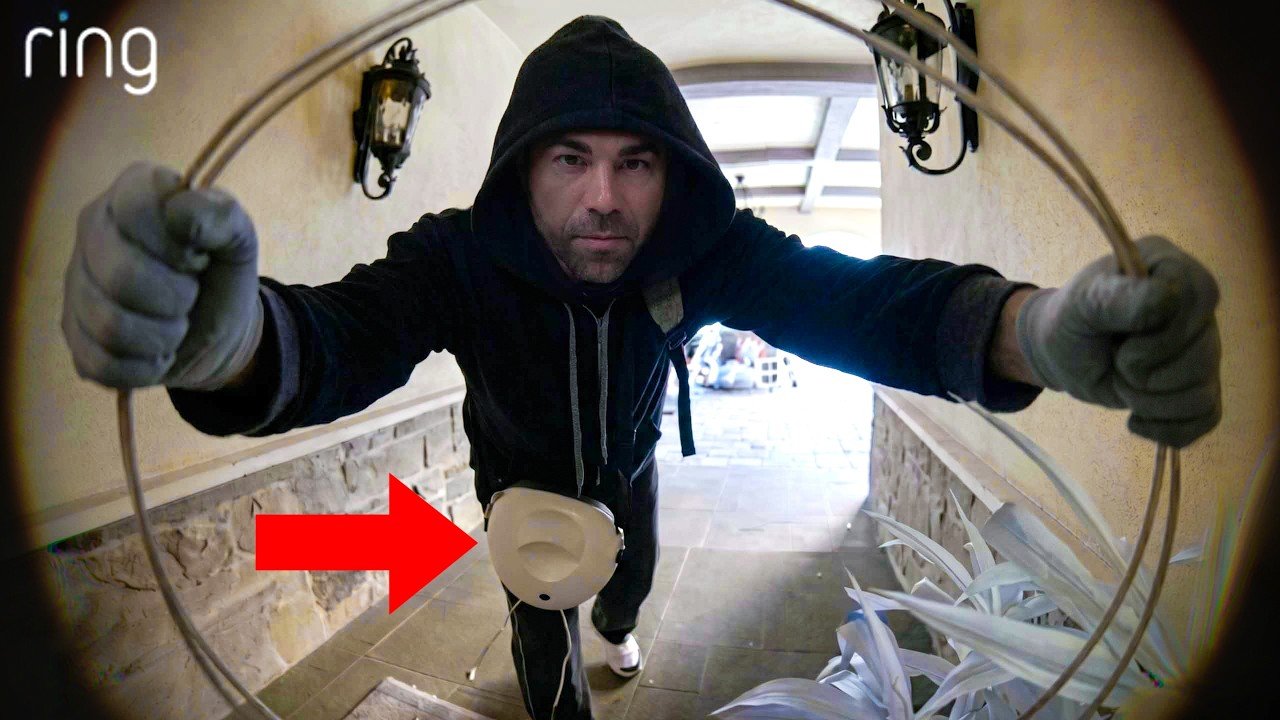
Jason the Wii was mid-stream, strapped into a VR headset, when his car disappeared from the driveway. The Twitch streamer had no idea what happened, and neither did his chat, who watched the whole thing unfold in real time. Half a million cars are stolen every year in America using the same method, and most drivers have never heard of it. The person responsible for Jason’s car turning up missing, it turned out, was Mark Rober, armed with a circuit board pulled out of a 20-year-old baby monitor and a very specific plan.
How a baby monitor became the ultimate car theft device
Modern car key fobs work on a surprisingly simple principle. A parked car broadcasts a quiet signal four times a second, asking whether its key is nearby. When the key hears that signal, it responds with a secret password, and the car unlocks and starts. The attack Rober investigated exploits exactly that handshake by using one device to pick up the car’s whisper and relay it wirelessly into the house, tricking the key fob inside into thinking the car is right there.
After tracking down the technique in online footage, where it was used to steal a car in as little as 15 seconds without triggering a single alarm, Rober went looking for the hardware. His colleague Ian navigated to an encrypted corner of the internet and found a seller named Dimmitri, who offered a relay attack device for $12,000 in Bitcoin. The ensuing negotiation, conducted over Telegram, involved Dimmitri asking Rober how many years he had spent working for the US government and demanding a ‘final answer’ before ultimately shipping the device days later with bullet-pointed instructions.
The $12,000 purchase turned out to be a massive overpay. A CT scan of the device revealed that every expensive component inside could be replicated using the transmitter board and receiver board from a circa-2004 video baby monitor, saving, as Rober put it, ‘$11,624 and keeping me off another FBI watch list.’ The rebuilt version reduced the entire process from initial approach to a running engine to roughly 10 seconds.
What actually happens to a car after it gets stolen
To find out where stolen cars end up, Rober and his team needed one genuinely stolen off the street. After Rober used the baby monitor device to lift Jason’s car and return it without telling him, the car was then rigged with 12 independent GPS trackers hidden inside various parts and left on a specific street that, according to a report from car insurance companies, had the highest auto-theft rate in all of Los Angeles. No city in America records more car thefts.
At exactly 2:15 a.m., the car was gone. The thief, however, was not a seasoned professional. Teenagers are responsible for 75 percent of all stolen cars, often joy-riding or posting on social media, and this particular thief spent the next several hours trying desperately to convince friends to get in the car with him. One declined because his mom was awake. Another was waiting for the bus and wanted nothing to do with it. The GPS trackers logged five days of movement across the city before the signal stopped at an impound lot. Of the 37 laws the thief broke, the one that ended it was a parking violation issued by a Los Angeles meter maid.
Organized crime, responsible for the remaining 25 percent of thefts, operates differently: cars either leave the country in shipping containers or cross into Mexico, or they go to chop shops disguised as legitimate auto body shops, where a stolen car can be stripped for parts in under an hour.
The penny fix that stops all of it
The defense is straightforward. A car key fob just needs to stop hearing the car’s signal, no matter how loudly a relay device broadcasts it. Step one: never leave keys near the front door. Step two: wrap the key fob in a Faraday cage, which can be a cookie tin, or a pouch made from a single penny’s worth of aluminum foil. Because metal conducts the wireless signal far more efficiently than air, the signal travels through the metal and never reaches the key inside. The same principle works on a phone: a single layer of foil with no gaps drops all calls immediately. Pre-made key fob pouches are available online for around $10, though Rober’s team tested several and found two that were complete scams and offered no protection at all.
For Kia owners with a model made between 2011 and 2022, a free software update from the dealer stops the car from starting unless the doors were recently unlocked by the key fob, closing off a separate theft method that requires only removing three screws and using the reverse end of a charging cable.
Jason the Wii, still waiting to find out the full story
A brand-new 2026 Rivian, sitting somewhere off camera, with a set of keys on a table.
Rober walked up to Jason’s front door one more time, device in hand, and explained exactly how he had done it. Jason had already sent a public tweet about the theft, genuinely believing strangers had taken his car. When Rober told him the car had then been stolen for real, and that the replacement was a 2026 Rivian he could give away to his community, Jason’s response was immediate: ‘This makes up for all of it.’ The last piece of advice Rober left him with was the simplest one: don’t leave your keys by the front door.