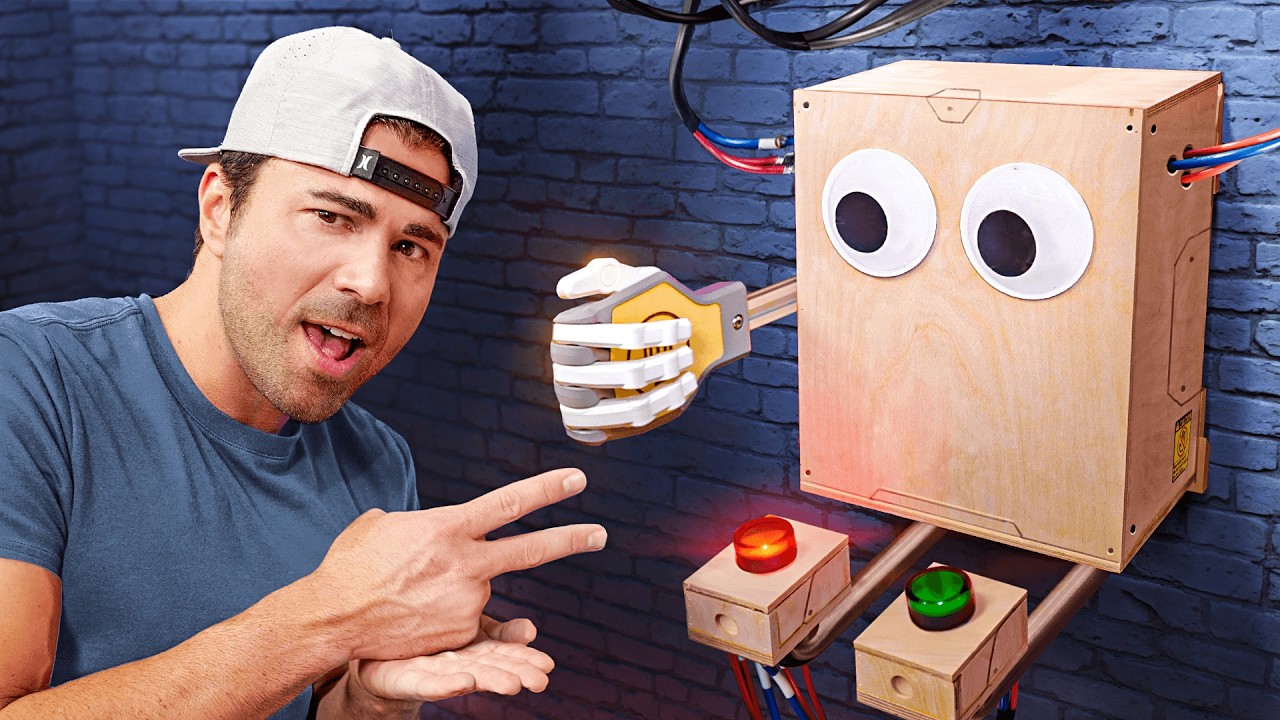
Rocky reads your fingers 100 times per second. By the time a human hand completes its throw, the robot already knows what shape is coming and has chosen the counter. Mark Rober built this machine at CrunchLabs, and the challenge is still open: the first person to beat Rocky fair and square wins a $10,000 cash briefcase. Nobody has collected it yet. Rocky is the number-one entry on a countdown of ten inventions built at CrunchLabs over the past year, and each one reaches back to a childhood frustration Rober decided, now that he is an engineer, to finally settle.
From screaming chickens to a room made of 3.5 million BBs
The countdown opens at number ten with a lunch bell that nobody at CrunchLabs will ever ignore: 22 rubber chicken heads wired to an airline pressurized at 100 psi. Squeeze a rubber chicken and it works like a kazoo, the body expanding back to shape and pulling air across a vibrating diaphragm. Hook all 22 to the same valve and the result is magnificent, terrible, impossible to miss.
Number nine is a deflagration tube demonstrated by Science Bob during platinum-ticket visits to CrunchLabs. Gas loads into a tube, ignites, and a slow wave of fire traces the full length before hitting a pocket of oxygen at the far end and producing a small, satisfying explosion.
Number eight required 3.5 million airsoft BBs poured across a floor. The logic is the same as a ball bearing: each BB rolls freely against the ground, a foot rolls freely on top of the BB, and the result is a surface that Rober described as ‘almost completely frictionless, even more slippery than ice.’ Surfing, skating, and bowling all failed to keep anyone upright until the team called in Anna, a ten-year-old skateboard competition winner. She dominated. When asked about a particular trick, she corrected the record immediately: ‘I was doing a kickflip, obviously.’
Number seven is a chair cut from one continuous sheet of plywood using a CNC router, then folded into shape by exploiting what engineers call a compliant mechanism, the same principle behind the world’s smallest Nerf gun. The design came from the BYU Compliant Mechanisms Lab.
Number six connects a vinyl tube to a subwoofer running at 30 Hz and a phone camera recording at 30 frames per second. Because the camera captures the wave at the same position every single frame, the water appears frozen in mid-air. Shift the speaker to 31 Hz and the wave appears to travel forward. Add a second speaker to introduce side-to-side motion and the two combine into a spiral. A simpler version requires only a hose, tape, and a cordless drill.
When the robot finally avenged 13 levels of childhood defeat
Number five is a Roomba fitted with a 3D-printed attachment from an acorn picker-upper, purpose-built to collect Nerf darts after battles. Number four is a pulley-operated mirror hidden behind an unmarked handle in the CrunchLabs lobby: a 6-to-1 mechanical advantage rotates the mirror 45 degrees, revealing awards displayed only for whoever stands in exactly the right spot.
Number three is Simon. Rober’s childhood record was level 13. His engineering solution adds four servo motors, four drumstick-and-rubber-hand combinations, a webcam, a Raspberry Pi running a Python script, and a rule that the robot monitors only the four small rectangular zones where the bulbs light up. When a color intensifies in any zone, the correct pad gets hit. The robot cleared all 32 levels in ten minutes. The 32-level ceiling exists, it turns out, because in 1978 when the game was manufactured, bits were expensive, and 32 is the highest number countable in binary with only five bits.
Number two is Rocky, the rock paper scissors robot. An IR hand motion detector reads finger position 100 times per second, a minicomputer identifies the incoming throw, and servo motors in a 3D-printed hand actuate the winning shape. Slow throw or fast throw, Rocky wins every time. Researchers who studied 54,000 games of rock paper scissors found that winners tend to stay with their choice and losers tend to shift forward in the rock-paper-scissors sequence, a pattern that can push human win rates to 75 percent in a best-of-20 series. Against Rocky, the win rate is 0 percent.
Number one is the infinite slinky staircase, which started as a childhood record of seven or eight steps and became a machine that, after 48 hours of continuous operation, had carried the slinky down just over 208,000 stairs. A time-of-flight proximity sensor runs a closed feedback loop that keeps the slinky centered on the staircase automatically, adjusting motor speed as the slinky’s natural pace drifts. The slinky itself holds still at the bottom when dropped from height, balanced between gravity and upward tension, until the wave propagates down and it decides, as Rober put it, ‘oh, I guess I’m supposed to fall now.’
Rocky, waiting
The $10,000 cash briefcase sits beside Rocky. The challenge is open.
The slinky is still running somewhere above 208,000 stairs, the proximity sensor holding it perfectly in the middle, the motor adjusting every few seconds to keep pace with a spring that never quite moves at the same speed twice.