
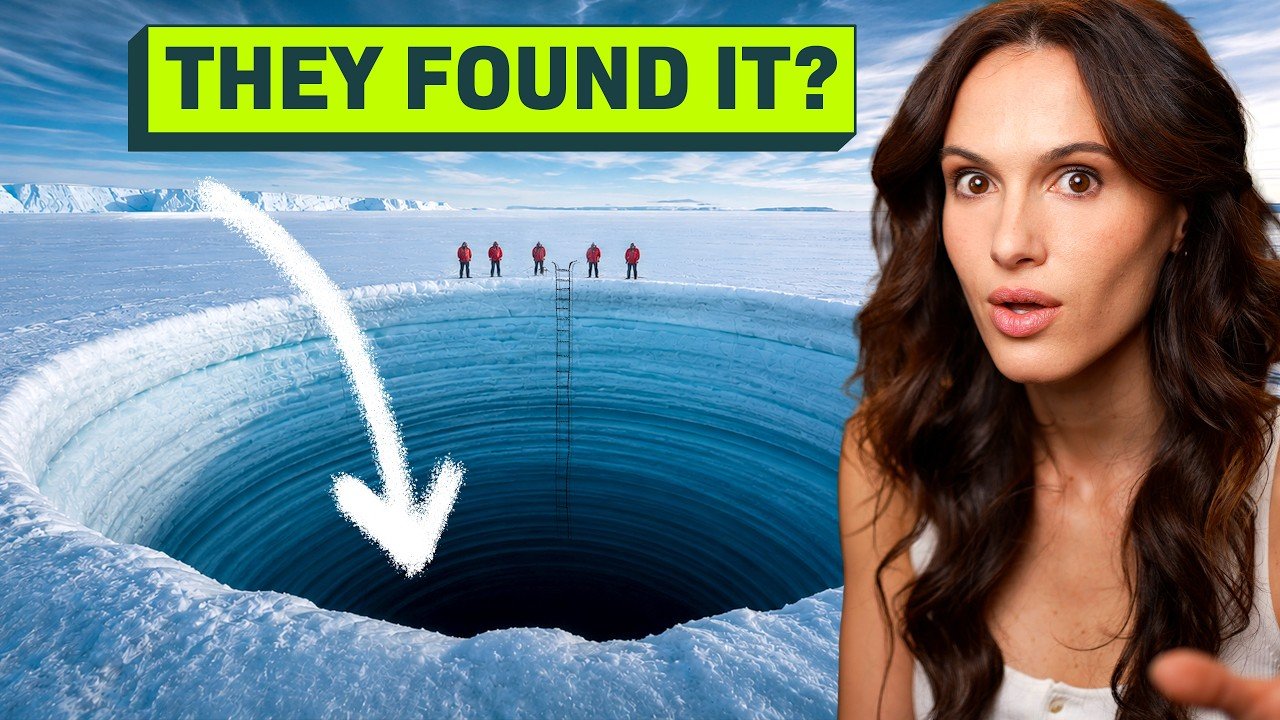
In 1970, a Soviet research team working in one of the most hostile environments on Earth made a discovery that would take decades to fully understand: something vast and liquid was hiding beneath Antarctica’s ice sheet. That finding, which emerged from early radio-echo sounding surveys conducted at the height of the Cold War, set in motion a scientific investigation that continues to reshape how researchers understand the planet’s interior, its climate history, and the boundaries of life itself.
A Hidden World Locked Beneath Miles of Ice
Cleo Abram documented the extraordinary science surrounding subglacial Lake Vostok, the largest known subglacial lake on Earth, stretching approximately 160 miles long and 30 miles wide beneath nearly 2.5 miles of Antarctic ice. The lake sits near Russia’s Vostok Station in East Antarctica, the same remote outpost that recorded the lowest natural air temperature ever measured on Earth’s surface: minus 128.6 degrees Fahrenheit in 1983. Despite those surface conditions, the lake itself remains liquid, kept from freezing by geothermal heat radiating from the Earth’s interior and insulated by the immense pressure of the overlying ice sheet.
The ice above Lake Vostok is not merely a barrier — it is also a scientific archive. Ice cores extracted from the region contain trapped air bubbles, dust particles, and chemical signatures representing hundreds of thousands of years of Earth’s atmospheric history. These cores have allowed researchers to reconstruct past climate cycles with remarkable precision, revealing the rhythm of ice ages and warming periods long before human civilization.
The Search for Life in an Isolated Ecosystem
What makes Lake Vostok particularly significant is its isolation. Scientists estimate the lake has been sealed beneath the ice for somewhere between 15 and 25 million years, cut off from sunlight, surface ecosystems, and atmospheric exchange. If microbial life exists in those waters — surviving on chemical energy rather than sunlight — it would represent one of the most extreme examples of life’s adaptability ever documented.
In 2012, a Russian drilling team breached the lake’s surface layer for the first time, reaching the water after more than two decades of drilling effort. Early analysis of refrozen lake water retrieved from the borehole suggested the presence of microbial DNA, though the scientific community has continued to scrutinize those findings carefully, distinguishing between potential contamination from drilling fluids and genuine biological signatures originating from the lake itself.
The broader significance of this research extends well beyond Antarctica. Lake Vostok has become a critical analogue for the search for life on other worlds — particularly Jupiter’s moon Europa and Saturn’s moon Enceladus, both of which are believed to harbor vast liquid water oceans beneath thick ice shells. NASA and the European Space Agency have each cited subglacial lake research as directly informing the instrument design and mission architecture for future extraterrestrial ocean exploration. If microbial life can persist for millions of years in Lake Vostok’s dark, pressurized, chemically isolated waters, the case for life elsewhere in the solar system strengthens considerably.
The Soviet team that first detected an anomaly beneath the ice in 1970 could not have known they were identifying what would become one of the most scientifically consequential bodies of water on Earth — a hidden ocean that connects polar geology, climate science, and the search for life across the solar system into a single, remarkable inquiry.