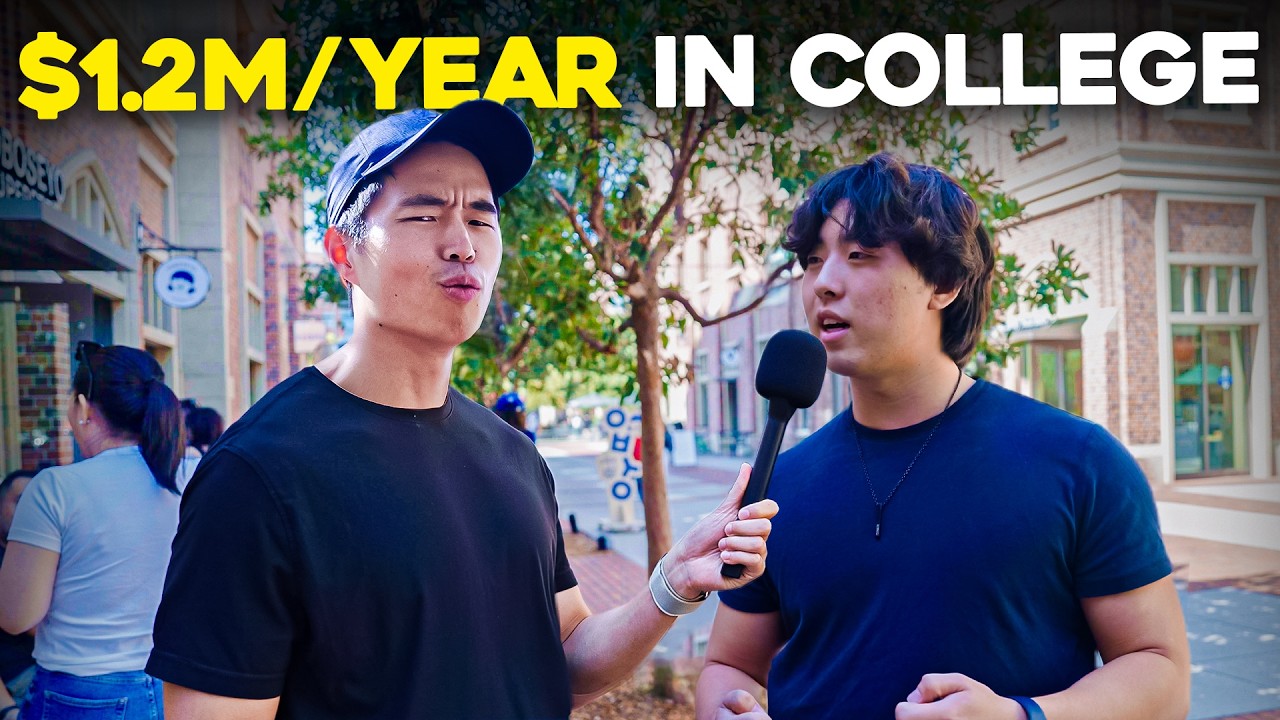
Daniel Hong runs a nine-person media operation from his dorm at the University of Southern California, paying out roughly $18,000 to $20,000 a month in team salaries before pocketing the rest. That detail alone reframes the standard picture of the broke college student, but USC’s campus turns out to be full of them: 18- and 20-year-olds running startups, shooting brand campaigns, and building YouTube empires while navigating a school that runs about $96,000 a year all in. Charlie Chang walked the campus asking students a simple question: how do you actually make money here?
From cold pitches to the White House press pool
Ethan Chang, 20, picked up a camera in seventh or eighth grade and never really put it down. Today he earns four to five thousand dollars a month as a travel filmmaker and photographer, shooting user-generated content for brands worldwide and reinvesting a good portion of it back into camera gear, travel, and skydiving. He has logged around 140 jumps and describes the drop zone as the one place where client deadlines and homework simply stop existing. His most unusual booking came when he and another videographer were flown out to shoot content for Joe Biden’s campaign, navigating Secret Service clearance to go backstage and document how the operation ran. He got to roughly three or four thousand dollars in a single shooting day. His pricing strategy was refreshingly direct: he asked other photographers and videographers around his skill level what they charged and matched the rate.
Ana, a 20-year-old freshman majoring in art, technology, and the business of innovation, came to campus with a business already running. Her app, Tra, is a social marketplace for shopping advice: users post a request for a product, set a bounty, and the community competes to find the best match. Tra takes a cut of the transaction. The platform has crossed 40,000 users, and her content across Instagram, YouTube, and TikTok has accumulated over 300 million views. She took two gap years before enrolling and was four weeks into her freshman year when she spoke with Chang. On the daily grind of startup life, she offered a frame that stuck: ‘building a startup is kind of like being Sisyphus, you feel like you’re rolling a big rock up the hill and every once in a while it rolls back over you.’
The YouTuber averaging 100K a month and why he is still in class
Daniel Hong’s three gaming channels, built around Minecraft, Roblox, and kids content under the name Kory, carry a combined subscriber base of roughly two million across the three properties. He posts three videos a day, every day, with a team that includes editors, thumbnail makers, voice actors, on-screen talent, and an operations manager. His CPM runs around $11 to $12, translating to roughly $5 per thousand views in actual revenue. After team costs of $18,000 to $20,000 a month, he takes home around $80,000. His mother handles the financial side of the company, including taxes. He started building the team seriously in junior year of high school and has not missed three daily uploads in seven or eight months.
Annie Long, 18, has been running her YouTube channel since she was eight years old, inspired by watching creators like Ryan Higa and Bethany Mota. Her business, Annie Long Media, covers personal development, lifestyle, personal finance, and faith content. She earned six figures in her best year, though in the 12 months leading up to the conversation she had deliberately pulled back to protect her health, landing in five-figure territory. Her largest single brand deal came in at $15,000. She tithes 10 percent of both her business and personal income to her church and pays herself roughly 50 percent of what flows into her business account, saving 40 percent of the rest.
The student who works 40 hours a week and takes 19 units
Sims, 18, joined a Los Angeles startup called Curate as a software engineer after a connection through his grandfather linked him to the founders, who were recent Stanford graduates. He disliked coding daily, switched to business development, and now works 40 hours a week as the company’s business development director at $21 an hour while carrying 19 units and being a former valedictorian with a 4.65 weighted GPA from high school. He also captained his varsity swim team. On campus, Maximus, a sophomore business major, works Live Events in the school’s auditorium and ballroom at $20.80 an hour, paying around $6,000 a semester for a room in the USC Village. Ayanna Gonzalez, 19, tutors elementary school kids in math through a work-study program, earning $200 every two weeks for roughly 10 hours of remote work per week. Ryan, 20, a dance major, holds two on-campus jobs inside the Kaufman dance department, bringing in roughly $17.50 and $15 an hour respectively, using the income to cover $800-a-month rent plus utilities and just over $100 a month in groceries.
Ethan Chang’s skydiving rig, mid-reinvestment
Somewhere in Ethan Chang’s gear closet sits a Blackmagic 6K camera body, a Canon 5D for stills, a parachute, and a helmet, all purchased out of the same monthly income stream. The rig, he noted, runs about $1,500 for the body alone before you start adding accessories.
The picture that emerges from USC’s walkways is not one of inherited advantage or lucky timing. Sims showed up having already spent a year and a half inside a real startup. Ana closed the door on gap-year freedom to bet on a community of peers with big ideas. Daniel built a company in high school because, as his parents reasoned, if he was going to be playing video games all day, he might as well make something of it. The drop zone, the brand deal inbox, the 9 a.m. to 11 p.m. meeting calendar: all of it runs alongside a class schedule that starts at noon.