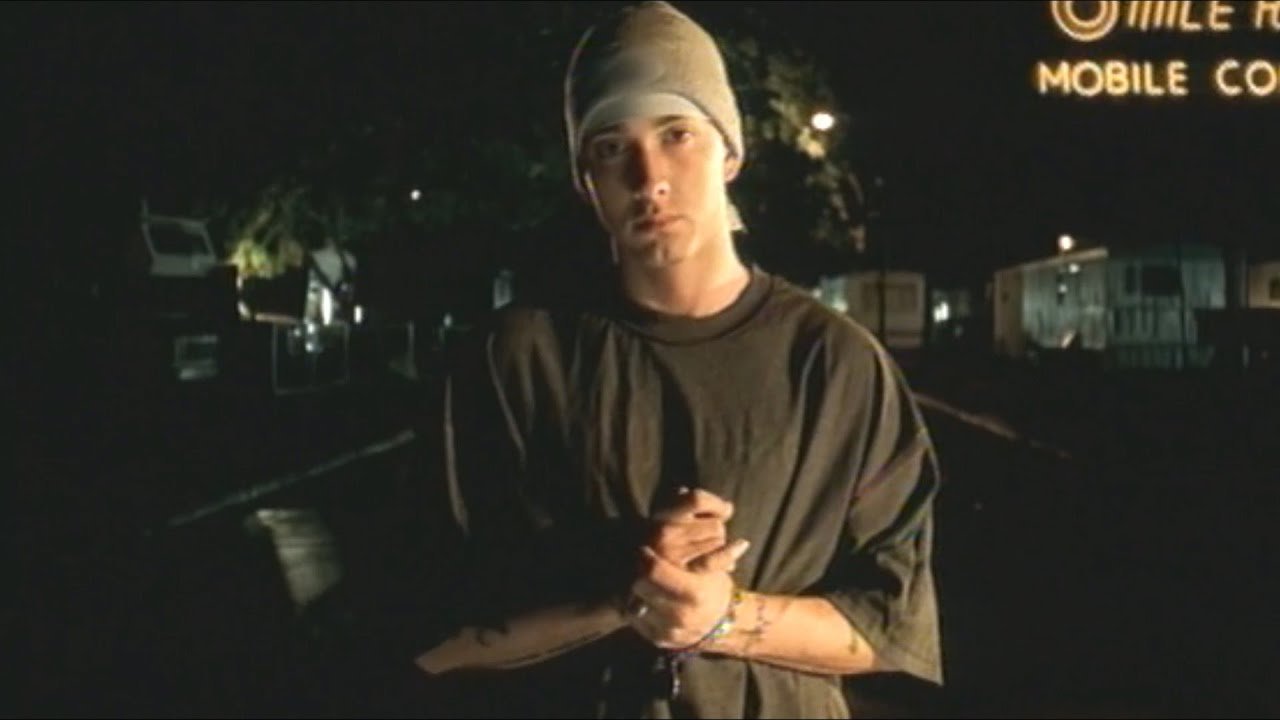
Before Eminem throws a single verse, he asks a question that has outlasted the genre, the film, and the decade that produced them. One shot, one opportunity: as he puts it, would you capture it, or just let it slip? And then, without waiting for an answer, he shows you what it costs to stand at the moment of answer: a body coming apart under pressure, every physical system betraying its owner before a single word has been performed. That image is specific and unglamorous, and it is the whole truth of the song. Not the battle. The door. The only door that was open.
This is a survival story told through a microphone. The stage is the escape hatch. The performance and the poverty are welded together, and that fusion is why the song has outlasted its genre and found new audiences in every decade since. The mic is not the destination. It is the way out of the trailer.
The choke, and what it actually costs
The character at the center of 8 Mile is B-Rabbit, a semi-autobiographical self-portrait Eminem drew in 2002. From the first verse, the fiction gets thin. Rabbit’s fear on that opening stage is not dramatic texture: it is the terror of someone watching the only exit close. He stands before the crowd and the stage goes wrong. Everything he has prepared dissolves at the exact moment it is called upon.
What the song does that almost no anthem does is refuse to skip past the humiliation. There is no quick cut to the comeback. The body is a traitor. The moment vanishes. And what Eminem renders in that opening is something every person who has ever stood in front of their own impossible moment recognizes immediately: the cold knowledge that the chance is slipping, and the legs are still locked.
The fear is not stage fright. It is the terror of blowing the only exit.
The stakes (and why they hit harder now)
The account Eminem draws is not a movie’s version of hardship. Marshall Mathers grew up moving constantly between Missouri and Detroit, raised in poverty by a mother who rarely held a job more than a few months, one of the only white families on a working-class, primarily Black block, beaten as a kid, an outsider on every side. When his daughter Hailie was born on Christmas Day 1995, he was washing dishes sixty hours a week at a diner for minimum wage while the house was being robbed. The government assistance that barely covered the basics. The wage that did not reach the bills. The conflict at home. He goes home to a mobile home in what the lyric names Salem’s Lot, a reference that carries the specific, worn-out texture of a place you need to escape, not merely leave.
The third verse of ‘Lose Yourself’ is not a character’s backstory. It is autobiography, and it carries the desperation of a man who understood the math: the alternative to the music was a cage or a grave. He frames success not as ambition but as the only remaining option that is not ruin.
And then the song turns the camera and shows what even winning that bet costs. The road takes him everywhere except home, and what he loses in the process is something no performance can replace: the years, the proximity, the shape of a life he is no longer present for. It is a rare piece of popular music that treats ambition as genuinely double-edged rather than simply heroic.
What makes the song reach past its era is that the math still holds. In the second verse, as Eminem raps about moving toward “a new world order,” he means a world being remade, reinvented, where the rules that governed one generation have been retired before the next has found its footing. That feeling is not historical. In an economy being remade in real time, the song’s desperation has found new trailers to live in. [OHN covers the forces reshaping that world in its Happy AI and Innovation sections.] The one-shot urgency, the window that opens for exactly one moment and not another: Eminem wrote that in 2002, and it has not stopped being true.
The move that won the battle and the life
By the third verse, the mask tears. Eminem steps out of the Rabbit fiction and speaks plainly as himself: no character, no protective fiction, no distance between the story and the man. That is the pivot that makes the song something more than a film tie-in. It collapses the gap between the stage and the street, between the art and the autobiography.
The climactic battle in 8 Mile carries the same logic. Facing an opponent who looks untouchable, Rabbit goes first. He owns every shameful thing about himself: the trailer, the poverty, every humiliation, before his opponent can reach for any of it. He names the bottom out loud and dares it to shame him. Then he turns the light on his opponent and finds a fraud behind the armor. His opponent stands silent, hands the mic back, and walks off. The choke that opened the film has become someone else’s.
That is the move the whole song was rehearsing. Not the performance. Not the comeback. The decision to hold the truth up first, before anyone can weaponize it. Eminem won the battle exactly the way he won his life: by owning the bottom instead of hiding it. Authenticity is not a vulnerability in this song. It is the weapon.
The answer, and what he did with it
The hook is a rallying cry, but it is also a survival instruction. As Eminem drives home: this opportunity comes once in a lifetime. The entire architecture of the song has been building toward a single demand: now. Not when the fear is gone. Not when the body cooperates. Now, while the stage is wrong and the mouth is failing and the door is still cracked open.
He returned to the work. That is what the song demands, and it is what the man who wrote it did.
After the film, after the awards, after the world learned Marshall Mathers by name, Eminem wrote a letter to Afeni Shakur, Tupac’s mother, and asked to produce her late son’s music. She agreed. He remixed unreleased recordings, shaped them into an album, and sent Tupac’s voice into a world that had lost him. The album debuted at number one on the Billboard 200. The man who had scraped together minimum wage to feed his daughter used the platform music gave him to lift a fallen genius and comfort a grieving mother. The receiver became the giver.
As Eminem says at the song’s close, in the only moment where the voice goes quiet and plain: you can do anything you set your mind to. That is not a platitude. It is the only thing a man who actually did it is entitled to say.
The sweater, still damp
It is sitting there at the opening of the song, before the chorus is earned, before the comeback is written, before anything has been proven. The unglamorous image that started everything is still there: a body at its limit, in a moment where quitting would be the easiest thing in the world.
He went back anyway. The chance does not circle back, and standing still is its own kind of failure. He made it all the way out. And then he reached back down. That hand reaching back is why this is Happy Music. And it is also, quietly, what this publication is trying to do.