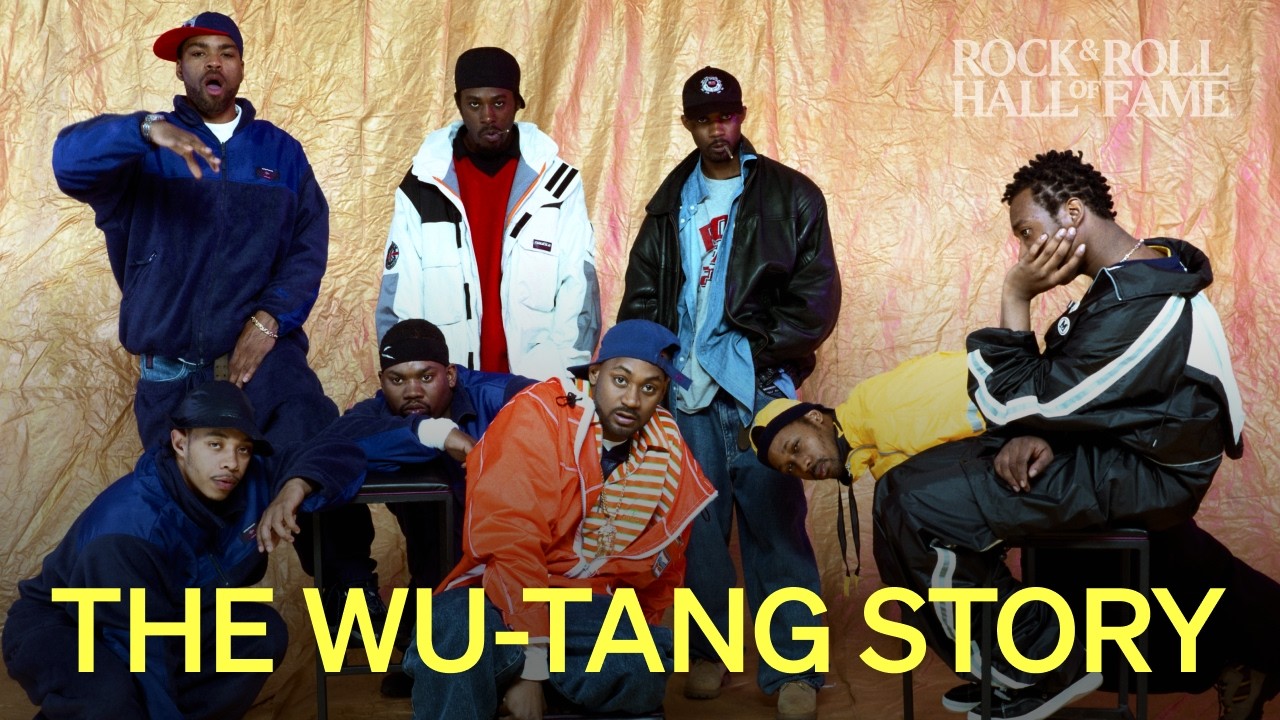
Robert Diggs, Gary Grice, and Russell Jones grew up on Staten Island, cousins from Park Hill and Stapleton who spent years losing sleep over rap battles, recording demos that went nowhere, and chasing something none of them could quite name yet. What they built would become one of the most studied, imitated, and genuinely irreplaceable forces in music history. The Wu-Tang Clan did not just make records. They redesigned the architecture of how a group could exist, compete, and endure.
Nine voices, one sound nobody had heard before
In the early 1990s, RZA had a vision that cut against every industry instinct of the era. Instead of centering a group around one dominant voice, he assembled nine distinct performers and let each one be fully themselves. Method Man brought effortless charisma. GZA delivered razor-sharp lyricism. Old Dirty Bastard was, by any standard, wild and unpredictable. Raekwon painted cinematic street stories. Ghostface Killah was gritty and vivid. Inspectah Deck landed some of the group’s most iconic verses. U-God brought a booming, commanding presence. Masta Killa’s deliberate style rounded the collective out. And close friend Cappadonna, not part of the original lineup, was embedded in the family from the beginning and would prove essential to the Wu-Tang story as it grew.
RZA described his production method in plain terms: ‘He let everybody get on it and then I rebuild the track around everybody.’ The result was a sound assembled from kung fu films, soul records, comic books, and New York street life. Dusty soul samples. Hard-hitting drums. Eerie piano loops. It was unlike anything on the radio.
In 1993, ‘Enter the Wu-Tang (36 Chambers)’ landed and permanently altered the genre. Tracks like ‘Protect Ya Neck,’ ‘C.R.E.A.M.,’ and ‘Method Man’ introduced nine MCs who all sounded like stars. The record was enough on its own. But RZA’s most consequential move came after the album.
The business model that changed how artists think about ownership
RZA negotiated a structure that was virtually unheard of at the time: each member could sign solo deals with different labels while remaining part of Wu-Tang as a collective. It rewired how artists thought about independence, ownership, and the relationship between individual ambition and group loyalty.
What followed was one of the most remarkable solo runs in hip-hop history. Method Man’s ‘Tical.’ GZA’s ‘Liquid Swords.’ Raekwon’s ‘Only Built 4 Cuban Linx…’ Ghostface Killah’s ‘Ironman.’ ODB’s ‘Return to the 36 Chambers.’ RZA released under his own name while continuing to produce across the catalog. Every solo record expanded the Wu-Tang universe while making the collective stronger rather than pulling it apart.
Over the decades, the group kept recording together even as every member built careers across music, film, and business. Even after the loss of Ol’ Dirty Bastard in 2004, the influence kept compounding. The production style, the independent business model, the iconography, the mythology, all of it kept spreading.
A line on the wall from Stapleton
Somewhere in the group’s early years, there were just three cousins from Staten Island and a circle of local MCs making demos and going nowhere fast.
From that starting point, nine individuals who each could have anchored a group alone chose to stay bound to something bigger, and proved that individuality, held together rather than flattened, could become an unstoppable force.