
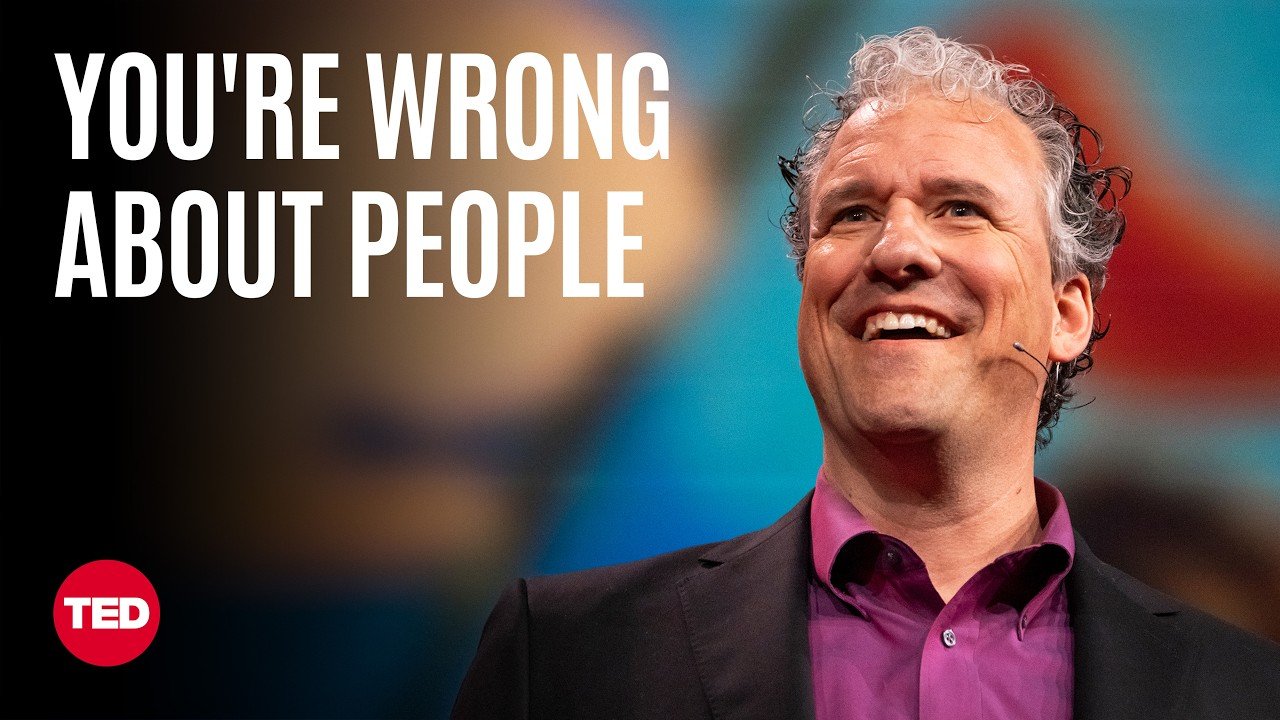
One morning on a Chicago commuter train, behavioral scientist Nicholas Epley sat down next to a woman wearing what he later described as a striking red hat – and made a decision that would redirect his entire career. Instead of scrolling his phone in silence, as every other passenger around him had chosen to do, Epley turned to the woman and introduced himself. The conversation that followed changed everything.
The Red Hat, the Greeting, and the Research That Followed
Epley, a professor of behavioral science at the University of Chicago, had spent years running experiments on other people. That morning, he ran one on himself. He greeted the woman seated next to him – a stranger approximately 15 to 20 years his senior – with a simple comment about her red hat. She turned toward him, broke into a wide smile, and within moments the two were sharing stories about their families, their work, and their hopes for the future. When Epley rose to exit the train 30 minutes later, she stopped him. ‘Thank you so much for taking the time to talk with me this morning,’ she said.
The contrast between what Epley had feared – awkwardness, rejection, social intrusion – and what actually unfolded was so striking that he resolved to study it systematically. Over the years that followed, Epley and his collaborators conducted more than 100 experiments involving over 30,000 participants of varying ages and backgrounds. The finding was consistent across every context: people dramatically underestimate how positively others respond to social outreach.
In one foundational study, TED documented, Epley’s team returned to the same commuter rail line and recruited two groups of riders. The first group was asked to predict whether they would feel happier staying in self-imposed isolation or striking up a conversation with the person seated beside them. Nearly all predicted isolation would be more pleasant. The second group was randomly assigned to either stay silent or actually speak to their seatmate. Those who were instructed to connect reported significantly more enjoyable commutes than those who remained alone – the exact opposite of what the first group had forecast.
More Than 4,500 Deep Conversations – and One Personal Decision
The research expanded well beyond small talk. Epley’s team facilitated deep conversations between strangers involving questions such as ‘What are you most grateful for in your life?’ and ‘When was the last time you cried in front of another person?’ More than 4,500 participants engaged in these exchanges. In every case, the conversations went substantially better than participants had anticipated – including conversations between people on opposing sides of politically divisive issues.
The same pattern emerged outside conversation entirely. When participants were asked to deliver a compliment to a friend, the friend felt more uplifted than the giver had predicted. When people expressed gratitude to someone they loved, the recipient felt better than the expresser had forecast. Pessimistic expectations about social outreach, Epley’s data showed, are not merely inaccurate – they are systematically reversed.
The research eventually informed one of the most significant personal choices of Epley’s life. After he and his wife Jane lost a daughter named Sophie – three months into the pregnancy, following a diagnosis of Down syndrome – they faced a profound decision. Epley recalled his first instinct as doubt. His second instinct, he said, was to turn to his data. Drawing on thousands of data points showing that people consistently underestimate the joy of connection, he and Jane adopted a two-year-old girl named Lindsey from China, born with Down syndrome and a persistent smile despite a difficult early start. ‘She has been bringing love and smiles into our lives ever since,’ Epley reported.
The broader scientific weight of Epley’s work rests on decades of social psychology research confirming that human beings are, at their biological core, social animals – yet modern environments increasingly reward avoidance. His laboratory findings align with longitudinal studies, including the Harvard Study of Adult Development, which tracked participants for over 80 years and found that the quality of social relationships was the single strongest predictor of health and happiness in later life. Epley’s contribution is the precise measurement of the gap between what people expect from connection and what they actually experience – a gap that, left unchallenged, becomes self-fulfilling.
Epley’s commuter train experiment, born from a red hat and a nervous introduction, has since become a template for understanding why socially wired humans so routinely choose silence – and exactly what it costs them when they do.
 Wake up to Only Happy News!