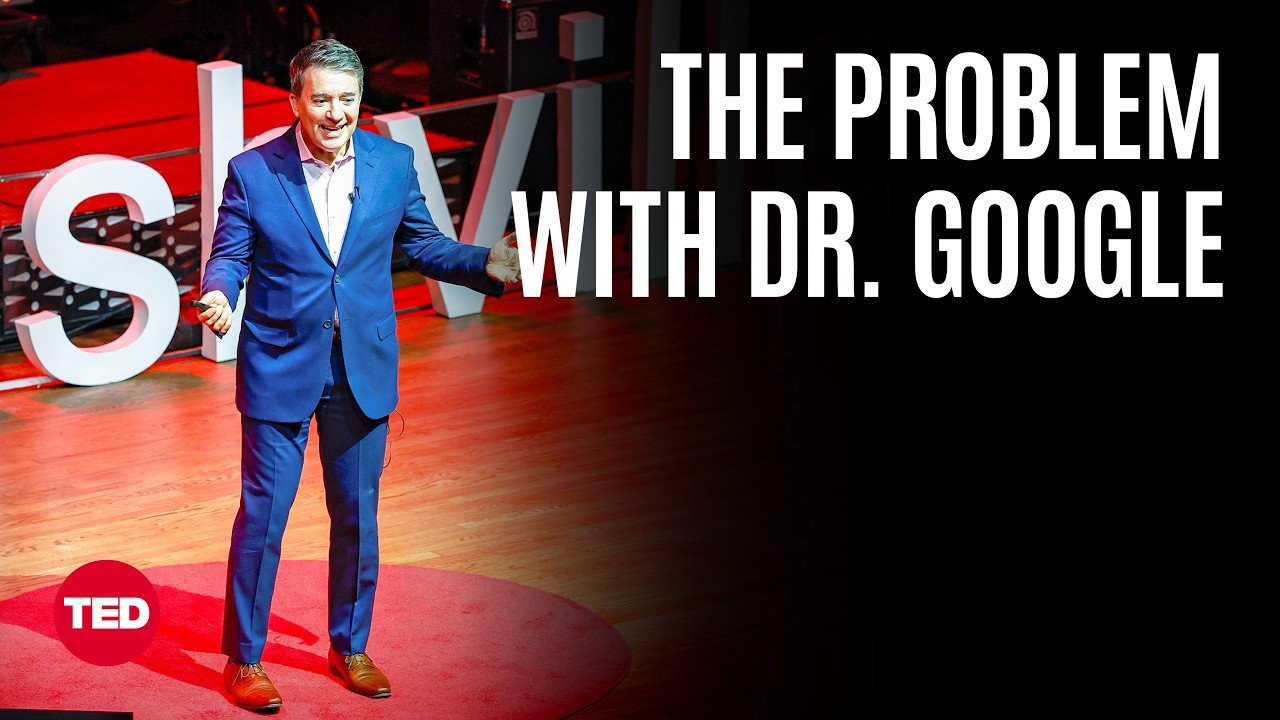
A billion health searches hit the internet every single day – nine zeros, climbing higher – and most of them end the same way: the person searching walks away more anxious than when they started. That’s the opening problem John Whyte, a physician and former chief medical officer at WebMD, laid out for a TED audience, and the rest of his talk is a practical guide to breaking the cycle.
Whyte moves through three clear lanes: why the information overload backfires, how algorithms quietly warp what people read, and what a smarter search habit actually looks like.
When Online Research Burns More Than It Helps
Whyte opened with a patient he called Mary – a woman who came in with cerumen impaction, a clogged ear canal packed with wax. Mary had read online that hearing loss can lead to dementia, so a single day of muffled sound sent her down a research spiral. She also found that hydrogen peroxide mixed with water is a reasonable home remedy – which is largely accurate. Where things went sideways: she microwaved the solution before pouring it into her ear, leaving her with a burned, inflamed ear canal.
‘Why?’ Whyte asked her directly. Her answer: ‘I read it online. And I thought it wouldn’t hurt. But it did.’
The medical term for this pattern used to be hypochondria. Whyte uses a newer label – cyberchondria – to describe the habit of treating every symptom search as a worst-case-scenario investigation. He illustrated it with his own 12-year-old son, who developed a blister from ill-fitting Kobe cleats that wasn’t healing properly. After a trip to urgent care, the boy told his father the prescribed antibiotic might not cover MRSA – and he was right. The culture came back positive the next day, and the antibiotic had to be changed.
Whyte’s point isn’t that online research is always wrong. Sometimes it’s exactly right. The gap between accurate information and useful knowledge, though, is where the danger lives.
The Algorithm Problem Nobody Talks About at the Doctor’s Office
Whyte turned the lens on himself to explain how even trained physicians get pulled into bad information loops. His Instagram feed, shaped by his interest in wellness content, began surfacing cardiologists arguing that statins are unnecessary – and that the drugs may actually increase dementia risk rather than lower it. Whyte has been on a statin for over two decades. He knows the clinical data. And still, repeated exposure to the same contrarian message made him second-guess his own prescription.
Digging deeper, he found that several of those physicians were selling alternative products. Some had licensing problems. The algorithm hadn’t flagged any of that – it just kept amplifying voices that matched what he’d already clicked on.
This is the core mechanical issue: search engines and social feeds are built to give people more of what they already believe, not more of what is accurate. That loop can make fringe medical claims look like consensus.
Whyte’s suggested fix draws a direct comparison to financial decision-making. Most people don’t hand retirement savings to a social media influencer with two million followers who promises 50x returns in six months. They check credentials, look for corroboration, and ask someone with actual expertise whether the math makes sense. Whyte argues health decisions deserve the same skepticism – especially since the stakes are higher.
The Engagement Strategy
Whyte’s TED talk arrives at a moment when health misinformation travels faster than corrections can follow. The practical checklist he offers – verify the messenger’s credentials, cross-check the information, test whether it sounds plausible, then bring it to a clinician you trust – mirrors how media literacy researchers recommend people evaluate news. The underlying dynamic is the same: platforms profit from engagement, not accuracy, so the content that generates the strongest emotional reaction gets the widest reach. Health anxiety is a powerful engagement driver, which means the information most likely to go viral is often the information least likely to be useful.
Mary’s burned ear canal is what happens at the individual level when that gap goes unaddressed. Whyte’s billion-searches-a-day figure is what it looks like at scale.
The same curiosity that sends someone online at 2 a.m. to research a headache is, in Whyte’s framing, a genuine asset – as long as the search ends with a conversation rather than a diagnosis.
 Wake up to Only Happy News!