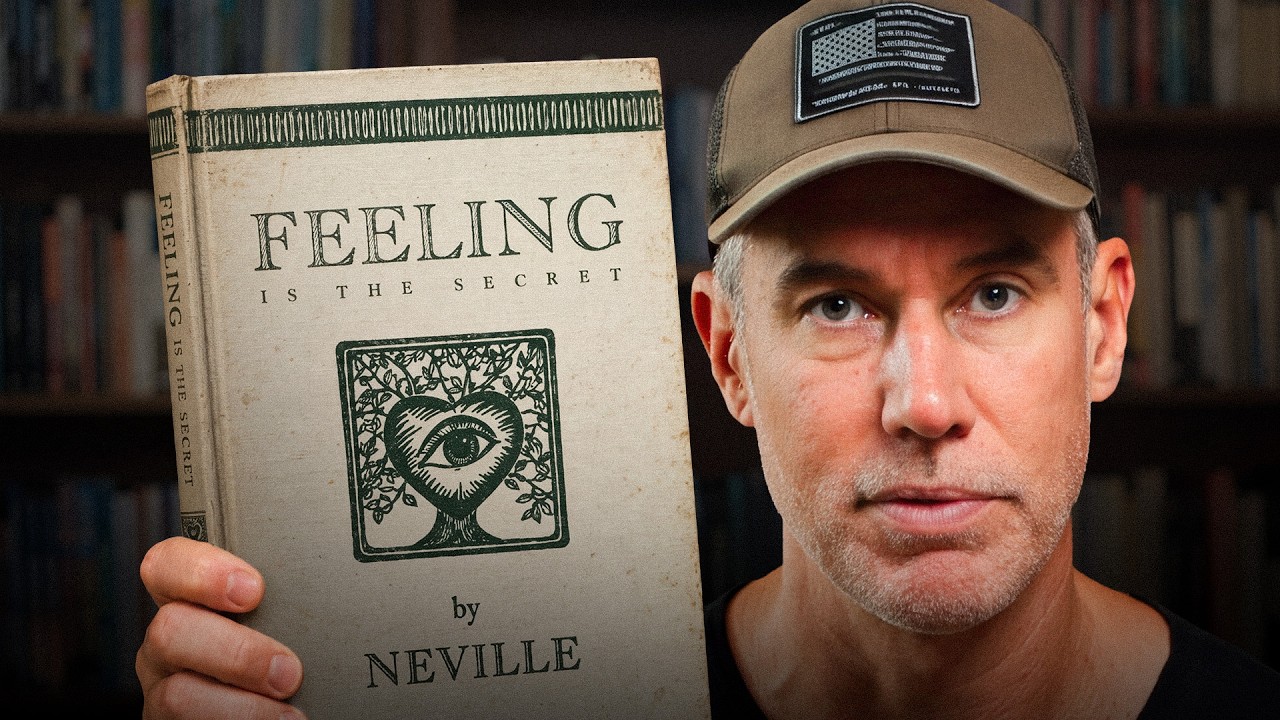
More than 80 years ago, a dancer from Barbados began circulating an idea so quietly radical that it still unsettles people who first encounter it: the life you experience is shaped by what you accept as true within yourself. His name was Neville Goddard, and in 1944 he compressed that philosophy into a slim book called ‘Feeling is the Secret.’ Most readers grasp the concept immediately and then spend years getting the practice exactly wrong. David Bayer, who has spent considerable time studying Goddard’s work, breaks down where people go wrong and why one counterintuitive move changes everything.
The gap between excitement and acceptance
Goddard’s central claim rests on a specific relationship between the conscious and subconscious mind. The conscious mind entertains ideas and chooses focus. The subconscious mind either accepts or rejects those impressions and then brings accepted ones into material reality. The bridge between the two is feeling, but not the kind most people chase.
The common mistake is trying to manufacture emotion. People attempt to turn up what Bayer calls ‘the emotional volume,’ generating gratitude or excitement at high intensity, hoping sheer feeling will tip something over into reality. The problem is that you can feel intensely excited about a desired outcome while the deeper signal running underneath is that the thing is still far away, still difficult, still meant for other people. That deeper signal, not the surface excitement, is what the subconscious actually receives.
The feeling Goddard is pointing toward is closer to the quiet, unexamined certainty you have about things you already own. Bayer put it plainly: ‘The person who has a thing doesn’t try hard to get it.’ If you have a relationship you value, you do not spend an hour each morning feeling like you have it. You simply have it. There is no resistance, no doubt, no effort, because the fact is settled in your nervous system. That settled quality is the target state.
Bayer’s own illustration is direct. For a long stretch he wanted a relationship and worked hard to feel as though he were already in one, writing about it daily, running deliberate visualizations. The effort produced frustration. Then he stopped trying. Within a week, he met the person he would eventually call the woman of his dreams. The effortlessness was not coincidence, in his reading: it was the absence of the signal that said the thing was still missing.
Sleep, the fourth dimension, and why creation is already finished
Goddard’s practical instruction centers on the threshold between waking and sleep. As the body relaxes and attention drifts from the room, he recommends holding one inquiry: ‘How would I feel if this were already resolved?’ Not solving the situation mentally, not rehearsing conversations or action plans, but resting inside the experience of completion. Bayer connects this to research on alpha and theta wave states, which make the subconscious more receptive during that specific transition.
The deeper scaffolding Goddard supplies in a later book, ‘Out of This World,’ is what Bayer calls the fourth-dimensional concept. Alongside the material world detected by the five senses, Goddard argues there is a parallel fabric of potential where all possibilities exist simultaneously and where, in his framing, ‘creation is already finished.’ The dream home, the solvent business, the wanted relationship, all already exist in this field. The work is not to create them but to align thought, emotion, and identity with the version of yourself who already has them, so that reality, in time, catches up.
Bayer frames his personal equation as desire plus non-resistance equals desired result. The resistance he is naming is specific: limiting beliefs, urgency, the feeling that the thing is absent. Remove those and the desired outcome, he argues, arrives consistently and predictably.
For anyone who has ever felt as though embodying a wish fulfilled was simply pretending, Goddard offers one reframe: imagining something is not fabricating it. It is tuning into a field where the thing already exists. ‘I’m pretending,’ Bayer said of his own practice. ‘I’m tending in advance to the reality I’m creating.’
The man who stopped obsessing
Bayer still keeps the moment he gave up on forced manifestation close to the surface of the story he tells about his own life. There is no dramatic resolution in the telling, just a tired person who stopped working at something, and then something arrived.
The white-sand beaches of a distant destination did not deliver this philosophy. A dancer from Barbados, writing in 1944, distilled it into four short chapters, and the question it leaves anyone who reads it is the same one Bayer spent years sitting with: not whether to feel, but how to stop trying so hard to feel it.
 Wake up to Only Happy News!