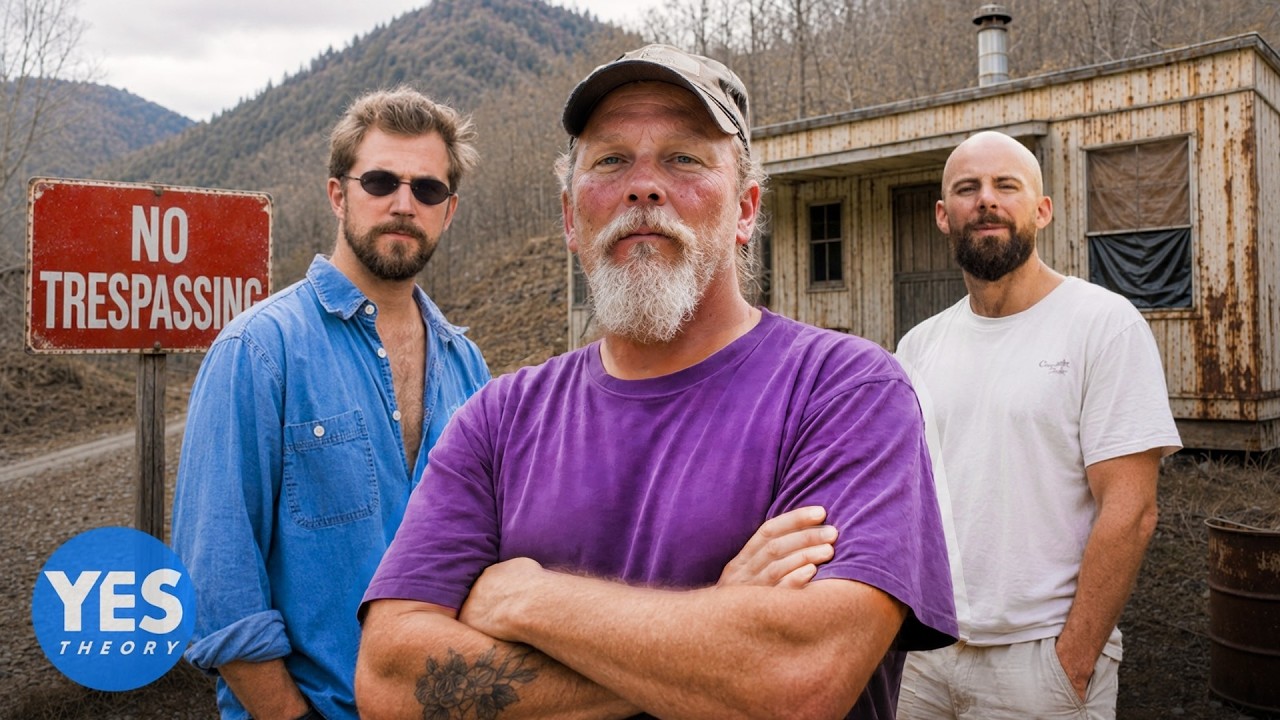
Donald was sitting alone on a bench in Keystone, West Virginia, when a car from Buffalo pulled up beside him. McDowell County had once been home to nearly 98,000 people. On the day Donald met his new friends, roughly 16,000 remained. The question of who stays in a place like this, and why, turned out to have a far more complicated answer than any abandoned building could give.
The journey into McDowell County began with an abandoned high school spotted along the road, its empty hallways a first signal of what the coal heritage road would keep showing: a region that powered the American industrial revolution and then got left holding the bill. Stefan, the trip’s organizer, had recruited Kate, a West Virginia musician whose career had recently taken off, to join the group for three days of driving through some of the region’s poorest towns, with Welch as the final destination.
The town that coal built, and left behind
The first stop was Bramble, locally remembered as the town of millionaires, where coal mine owners built lavish homes around 1910 while the industry was at full roar. The houses are still standing, unusually well-preserved for a county in long decline. Just down the road, the contrast was immediate. In Pocahontas, a local woman named Debbie stood outside the 1895 opera house, which once hosted Broadway shows and vaudeville acts, and described the town’s condition in three plain words: ‘We don’t have a bank. We don’t have a doctor. We don’t have nothing.’ She mentioned a mine explosion buried in a nearby cemetery. 113 or 114 miners. She said she was born here and planned to stay until she died.
At an abandoned coal processing facility outside Keystone, a coal train rolled past while the group stood among tens of millions of dollars of frozen equipment. McDowell County’s population had peaked around 1950 at roughly 98,000 people. It now sits at about 16,000, a decline of more than 90 percent. The company store system that once controlled miners’ wages through company credits, owning their housing, their churches, their schools, and the gear they needed to do the job, meant that generations of families never really held their own money at all.
Inside what had been Keystone’s civic center, the group met a woman who had worked at the United Nations in New York before retiring and coming back to try to restore the town to a better state than what it was left in. She refused a formal title. Her father and grandfather had both worked the mines, and her father died in one. Asked what she wanted the rest of America to understand about the region, she said: ‘That we survive. Incorporate the negative to never repeat it and incorporate the positive to enhance and grow with it.’
The day Donald came along for the ride
Clarence Johnson, who had spent his whole life in the area and still worked in mining equipment, put the economic shift plainly: work is going down and prices are going up. But it was Donald, sitting alone on that bench in Keystone, who became the center of the trip’s final day.
Donald had grown up in a coal camp house, the kind built identically row after row for railroad and mine workers. His father died at 60 from black lung after 32 years underground. He had lost his twin brother to murder, joined a motorcycle gang out of grief, and was shot leaving a bar on a night he described without self-pity. The amputation that followed eventually slowed him down. He credited a stepdaughter, whose name carries both his name and his late brother’s, Andy Dawn, as the reason he found steadiness. She is, he said, ‘the air I breathe.’
The next morning the group picked Donald up and drove him to a lake in the mountains where he had held family reunions as a boy. The last time he had been there was two years earlier, with his sister Jan, who died of stage four pancreatic cancer at 54. They cooked a barbecue. Donald said a grace. Then he talked about Jan for a long time.
Before the day ended, Stefan told Donald the trip had been sponsored by the group themselves, and they handed him 3,200 dollars in cash, asking him to do something good with his family.
Donald sang a few bars of ‘Amazing Grace’ near the water, quietly and without being asked.
A bench in Keystone, the morning before
Donald on the bench, alone, before the car arrived. He had sat there and, by his own account, asked for someone to show up.
He said he was a loner. He said he normally kept things inside. He said he could not explain why he trusted four strangers enough to get in the car, except that it felt like an answer to a question he had just asked out loud to himself.
 Wake up to Only Happy News!