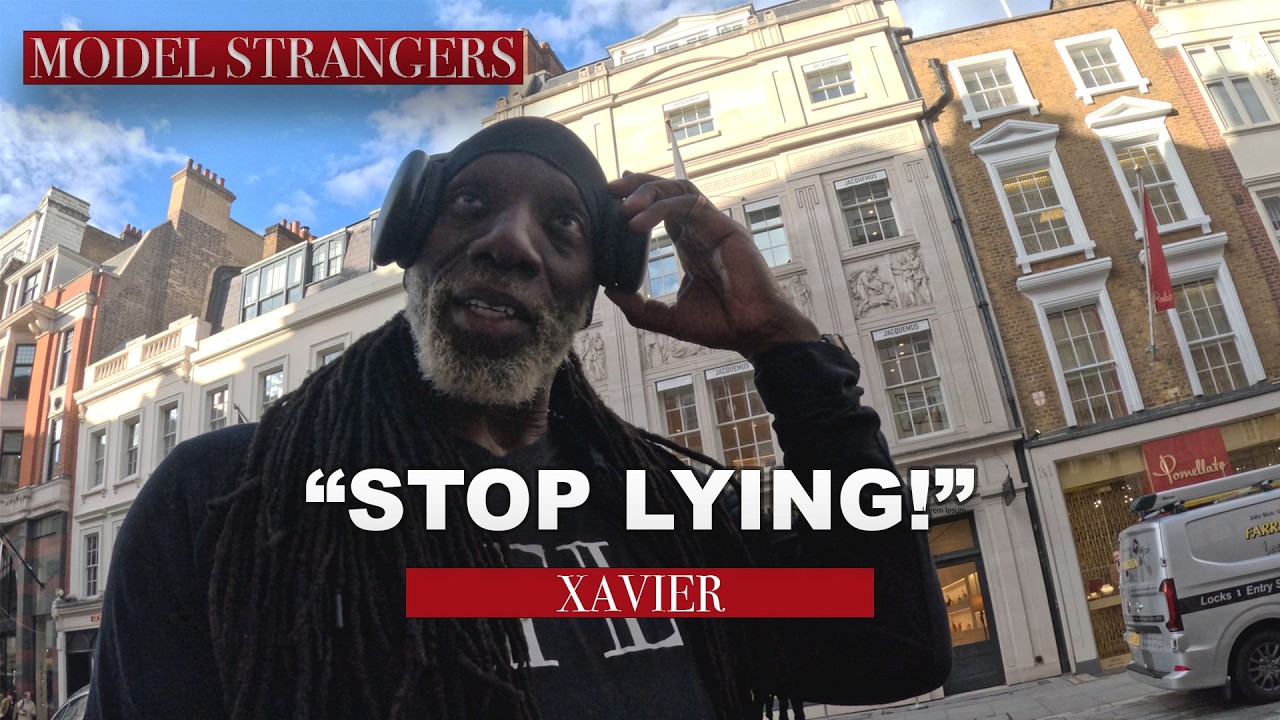
Zavier was on a casual stroll through London’s West End, somewhere he does not come to often, just watching architecture and people, when a portrait photographer stepped into his path and said he had an amazing look. Zavier checked the stranger’s energy, decided it was good, and said yes. What followed was not really a photo session. It was a conversation about loneliness, daydreaming, regret, and what it actually means to choose to live, one that neither man had planned and both clearly needed.
The intersection of two strangers on a London street might sound like a small thing, but what Zavier said over the next few minutes holds a particular weight for anyone who has ever felt isolated inside a crowded life, or paralysed by the fear that they have not yet become who they were supposed to be.
Alone is not the same as lonely
Zavier comes from a huge family, five older brothers, Jamaican heritage, a lifetime in London. And yet he spends a lot of time alone. He is clear that this is not a problem to solve. ‘I’m over myself,’ he said. ‘I’m not lonely. I am alone sometimes.’ He uses that solitude to create, to evolve, to imagine. He pointed back to something most adults quietly stopped doing: daydreaming. As children, they would stare out the classroom window and let their minds build anything. As adults, that same unstructured mental space gets filled with worry instead. He made the distinction simply. The body does not know the difference between a thought and an event; it just responds. So the thought you give it is the only choice you actually control.
His point about loneliness cuts even sharper. There are people surrounded by others who feel profoundly alone, and people who sit in solitude who feel none of it. The difference, in his telling, is whether you have made your own company worth keeping. ‘Make that a happy place,’ he said, ‘or make that even an interesting place.’ Once you do, the loneliness starts to disappear because you are no longer performing for an audience you have not yet convinced yourself.
Setting a timer on the hard stuff
The photographer pressed him on regret, on the social pressure of timelines and milestones. Zavier did not dismiss the question. He acknowledged that bad things happen, that depression and stress and anxiety are real. His approach is not to deny them but to sit in them consciously, briefly, and then move. ‘I’ll set a timer on it,’ he said. ‘And then I’m like, okay, I’m bored now. Let’s go and do something else.’ That day, instead of going straight home, he went for a stroll.
His mother, who has since passed, left him a line he has carried his whole life: ‘I don’t mind dying as long as I live first.’
The photographer, for his part, admitted he is always bracing for rejection when he approaches strangers, always preparing for the worst. Zavier turned that around on him immediately. He pointed out that nine times out of ten it goes fine, and still the one bad outcome is the one that gets held onto. ‘You’re always scanning for danger,’ Zavier said. ‘And the minute you start challenging that narrative, the narrative starts to disappear.’
The man who chose the human queue
At the airport recently, Zavier was directed toward the automated check-in machine. He declined and asked to speak to a person instead. The staff member looked at him like he had said something strange.
Zavier walked away from the portrait session the same way he arrived: alone, unhurried, and entirely himself. The photographer had come looking for an interesting face. He found considerably more.