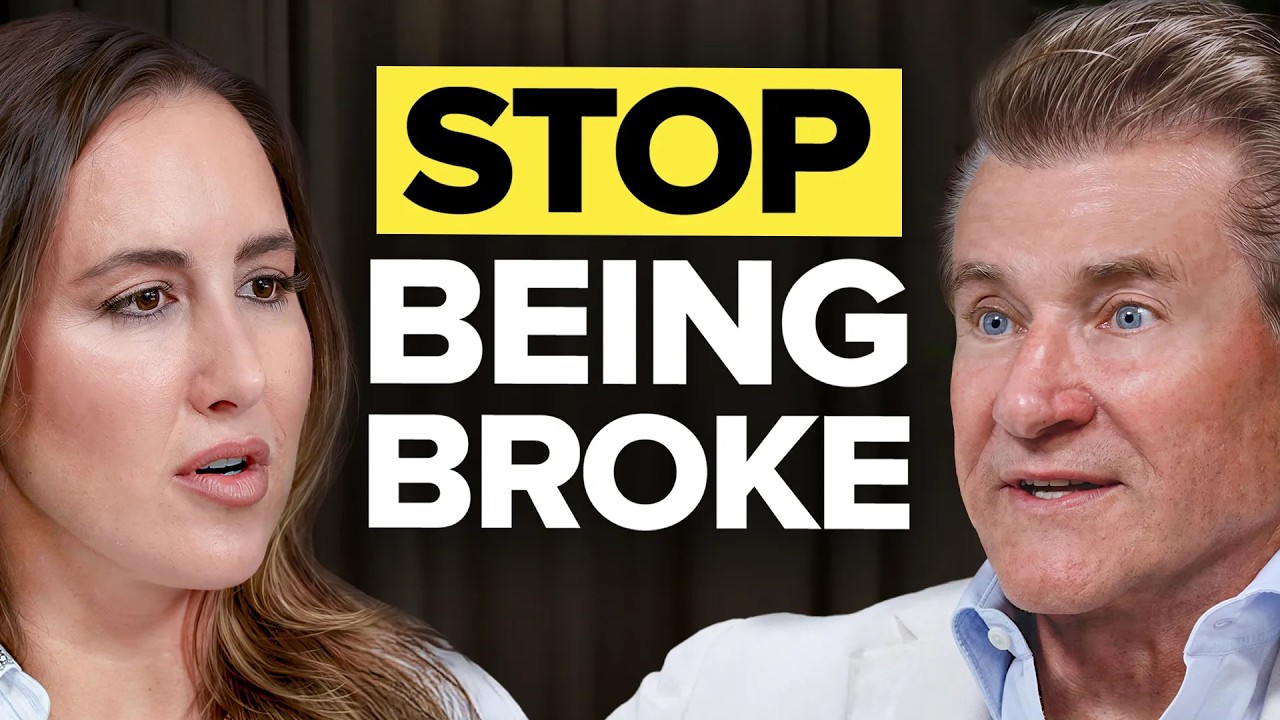
Robert Herjavec‘s parents arrived in North America at 37 years old, with one suitcase, no money, and no contacts in a country where they knew no one. They had left jail behind and crossed on a boat. For Robert, that image never left. ‘What am I going to do with my life?’ he told Codie Sanchez during a candid conversation in San Diego. ‘Just get by? I was the only kid who felt that if I didn’t do something, it would justify their sacrifice.’ That pressure, that specific and personal pressure, is where one of Shark Tank’s longest-running sharks says the real engine of ambition lives. Not in a slogan. Not in a vision board. In a story specific enough to survive a dark night of the soul.
The conversation spans sales, leadership, deal structure, and the fear that quietly keeps most people exactly where they are. What emerges is less a highlights reel and more a working manual, assembled over decades of building, buying, and selling companies that eventually pushed past $400 million in annual revenue, all without a single dollar of outside capital raised.
Why fear of hard work is actually fear of something else
When Sanchez asked what stops most people from breaking out of broke, Herjavec answered immediately: fear. Not laziness, exactly, though he acknowledged that plays a role too. The more precise diagnosis is fear of irrelevance. ‘It’s not even fear of hard work,’ Sanchez offered. ‘It’s fear of what if I’m giving up my life for something that never actually happens.’ Herjavec agreed without hesitation.
His illustration was personal and unglamorous. He spent ten years working toward a Ferrari, and when he finally got one, it was old, barely functional, and nowhere close to the cars he admired. The decade of grind never discouraged him from continuing. The reason, he explained, was that his goal was never really the car. It was the proof. Proof to himself, and implicitly to his parents, that the sacrifice had not been wasted.
For the days when continuing feels impossible, he described a trick rooted in his running habit. He runs daily, hates almost every mile of it, and during long runs of ten to fifteen miles, reaches a point where he slows to a crawl rather than walk. At that moment, he asks himself one internal question: ‘Are you a loser? Are you a quitter?’ The answer, he said, moves his legs forward every time. ‘I will my legs fall off before I stop.’
The leadership mistake that quietly destroys great companies
Herjavec is blunt about the phrase he finds most damaging in business culture: ‘We’re like a family here.’ He called it, plainly, nonsense. ‘There are things I would do for my kids and put up with from my wife that if you worked for me, I would fire you tomorrow.’ His preferred frame is a team of people who respect each other toward a common mission. He has worked with his closest professional collaborator across three companies over 35 years and has shared dinner with him perhaps twice.
The A player versus B player distinction follows the same logic. A players, in his telling, have high signal-to-noise communication, follow through on commitments, proactively flag delays rather than disappear, and actually enjoy hard problems, not just tolerate them. ‘B players wallow in misery,’ he said. ‘Adaptability is the ability to wallow quickly and move on.’ He credited Barbara Corcoran with the sharpest version of this idea: the difference between successful people and others is not that they avoid bad days. It is how long they allow themselves to stay in them.
On deals, the story that stands out is his first acquisition. He had agreed to buy a small business for $600,000, showed up the next day, and told the seller he did not have the money. Rather than walk away, he proposed a structured earnout: $100,000 at closing, another $100,000 at 60 days, a third at year’s end, and the remaining $300,000 paid over two years. The seller accepted. Herjavec went on to buy 13 or 14 businesses inside his tech company using variations of the same method. The lesson he distilled from it: ‘Money is not holding you back. Your lack of knowledge is holding you back.’
His single most valuable lesson from the years without money was urgency. When competitors mailed or emailed quotes, he hand-delivered them the same afternoon. When customers told him not to bother dropping by, he dropped by anyway. Eighty percent of the time, he said, they came out to say hello. Later, once the company scaled past the point where that pace was sustainable, he had to learn the companion lesson: ‘Urgency gets you out of poverty. Patience gets you to wealth.’
The one suitcase
Somewhere in the conversation, the image of that single suitcase came back around. One case, two adults, a country that owed them nothing.
Herjavec’s father, who had been jailed roughly 25 times under communism for saying the wrong thing in a bar, eventually offered his own definition of capitalism: a capitalist is somebody who owns more than one Cadillac. Robert Herjavec built companies worth hundreds of millions of dollars and kept every point of equity he could, for as long as he could, before selling. He would tell a 25-year-old today to spend their next decade building genuine expertise in a field still young enough to reward it, to take no job for money alone, and to carry as few obligations as possible so the bigger risks remain reachable. The suitcase, apparently, is still the starting point.