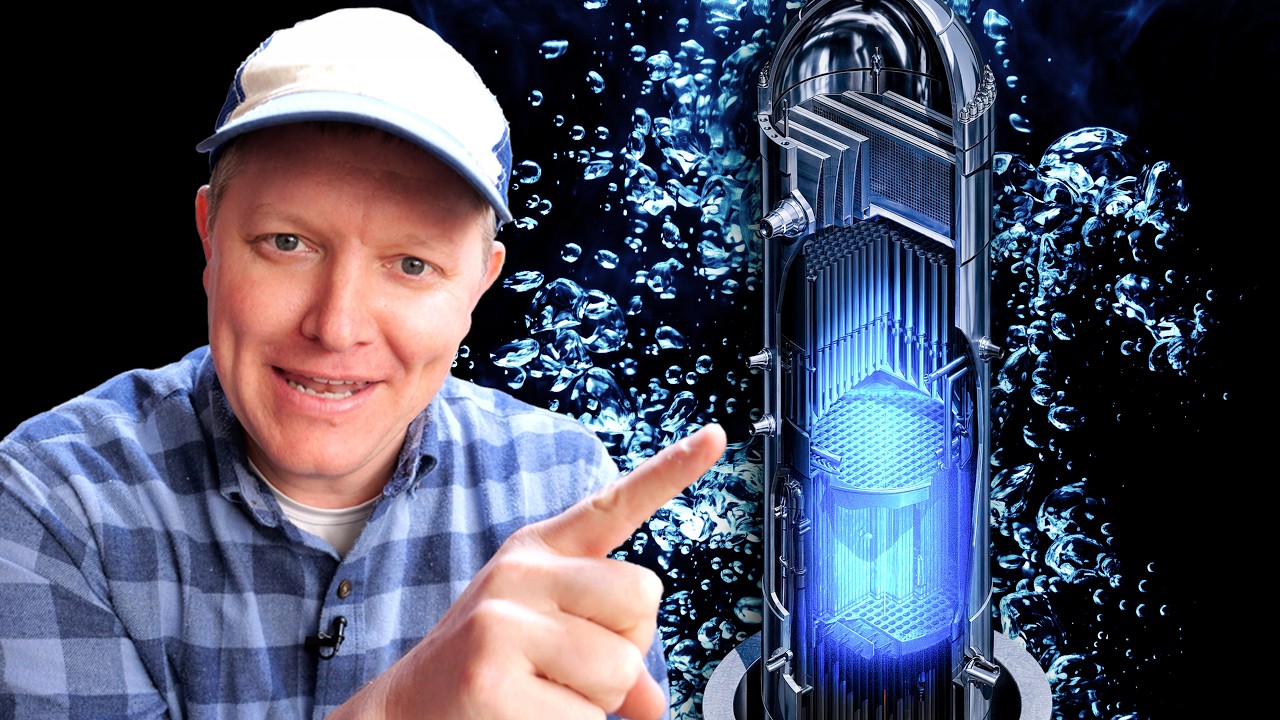
Deep inside the training center at Browns Ferry Nuclear Power Plant in Alabama, a decades-old physical model sits on a table, its gray cylindrical reactor vessel surrounded by components that look almost too small to matter. Bill Ball, who handles instrumentation at the plant, lifts the reactor vessel head clean off the model and sets it aside. What is revealed inside changes how a person thinks about nuclear power entirely. This is not a story about glowing green rods and catastrophic melt-throughs. It is a story about an engineering system so carefully thought out that it is, in Bill’s words, always trying to shut itself down.
A pressure cooker the size of a building
Browns Ferry runs three Boiling Water Reactors, and the name is exactly what it sounds like. Unlike a Pressurized Water Reactor, which keeps its primary loop below the boiling point and uses a secondary heat exchanger to generate steam, a Boiling Water Reactor lets the water boil directly inside the reactor vessel. That steam travels straight to the turbine, condenses back into water, and returns to start again.
The reactor vessel itself operates at around 1,000 pounds per square inch during normal conditions and is engineered to handle up to approximately 1,250 pounds per square inch. Hundreds of bolts ring the reactor vessel head, each one critical to maintaining that pressure boundary. Destin Sandlin, who guided the deep dive into the plant’s internals alongside Bill, paused on those bolts during the tour: ‘Out of all the things in mechanical engineering that I studied, one of the things that I respect the most is the simple threaded bolt.’
Inside the vessel, 764 fuel bundles sit arranged in the core. Each bundle contains fuel rods made of uranium oxide pellets sealed inside zircaloy cladding. Four bundles cluster together into a fuel assembly, and between every four-bundle assembly sits a control rod blade shaped like a cross when viewed from above. The cross shape is deliberate: it maximizes the surface area available to absorb neutrons, because the control rods are made primarily of boron, and boron is a powerful neutron absorber. One uranium oxide pellet holds the same energy as one ton of coal.
Why hotter water actually slows the whole thing down
The genuinely surprising engineering lives in what Bill called the negative temperature coefficient of reactivity. As the water inside the reactor heats up, its density drops. The water molecules spread apart. Neutrons flying out of fissioning uranium atoms need to be slowed down by colliding with those water molecules before they can trigger another fission event. Fewer molecules in close proximity means fewer collisions, which means fewer thermalized neutrons, which means fewer reactions, which means power output drops.
Bill walked through what this looks like inside the water column itself. At the bottom of the core, cool liquid water thermalizes neutrons efficiently and the reaction runs strong. Midway up, the water is partially boiling and the thermalization rate is mixed. At the top, where the water has become mostly steam, fast neutrons zip past without slowing down and barely interact with the fuel at all. If the reactor were somehow driven to boil all its water at once, the reactivity would collapse on its own. The runaway scenario that sounds catastrophic actually contains a built-in brake.
Control rods add a second layer of control. They are held in their withdrawn position by pressurized air acting on scram solenoid pilot valves. If air pressure drops, if instrumentation detects a non-conservative power reading, if anything falls outside its permitted range, the valves release, and the control rods insert automatically. Bill described the operating philosophy plainly: running the reactor is a privilege the system grants only when every condition is met. ‘Mother may I, mother may I?’ and if anything goes wrong, permission is withdrawn.
The containment layers stack five deep: the fuel pellet itself, the zircaloy cladding, the reactor pressure vessel, the primary steel and concrete containment structure, and the wet well torus below, which suppresses steam surges and holds emergency cooling water in reserve. The dry well between the vessel and the outer containment is kept at a slight positive pressure and filled with nitrogen to eliminate any possibility of an explosive gas buildup.
The model on the table
The physical training center mock-up that Bill used to walk through all of this was built sometime in the 1970s or 1980s, well before 3D printers existed. It comes apart in layers: steam dryer, moisture separator, core plate, top guide, fuel bundles. Bill handles the pieces with the casual confidence of someone who has explained this hundreds of times, setting each section aside to reveal what sits beneath it.
Sandlin described water in a nuclear reactor as functioning like a boiling pressure cooker, the steam not at 212 degrees Fahrenheit but at a much higher temperature driven by the pressure inside. The vessel contains it. The bolts hold the lid. The water does the moderating, the cooling, and the self-correcting, all at once.
That 1970s model, its paint worn from years of handling, still shows every component in exact spatial relationship to every other one.