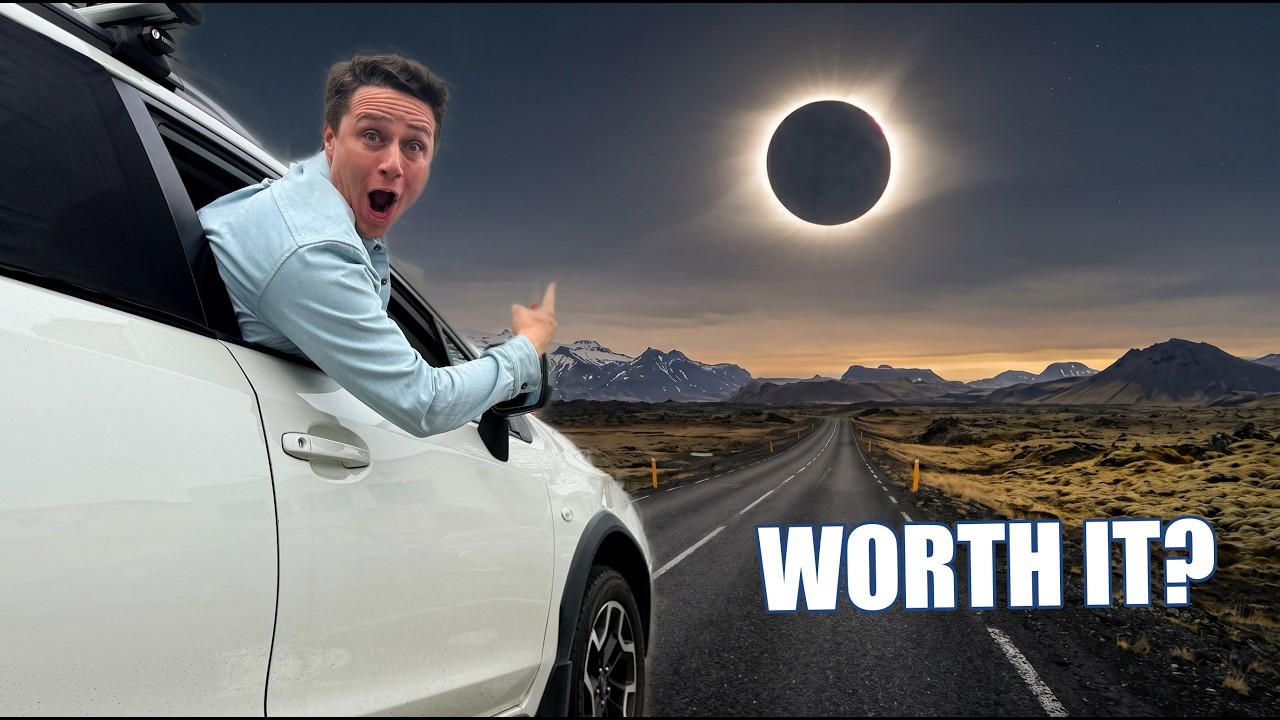
Riley held out a pair of eclipse glasses in the grey Icelandic wind, having ordered them months earlier the moment the trip was booked. That kind of preparation matters when you have flown halfway around the world and driven 4.5 hours through fjords, gravel roads, and sideways rain to stand in a quiet corner of northern Iceland, praying for one gap in the clouds. What Mike and Riley were chasing was not just a solar eclipse but a specific cosmic accident: the moment the moon perfectly blocks the sun and the world goes dark in the middle of the afternoon. Whether any of that would actually be visible was, by this point, genuinely uncertain.
When the forecast turned against them
The morning started in Reykjavik, where the plan was straightforward enough. The solar eclipse was scheduled to reach totality at 5:45 p.m. local time, and the city should have been a fine place to watch it. It was not. Cloud cover had moved in overnight, and rain was coming. Yesterday, by cruel contrast, Iceland had sat under clear blue sky across the entire country. Today was different.
The only viable option according to the radar apps Riley was running was a narrow sliver of predicted clear sky several hours north. So they left Reykjavik behind, glimpsing only a single church before the city disappeared in the grey. The drive took them through fjords and along cliff roads above the water, through lava fields left over from old volcanic eruptions, and eventually onto 150 kilometres of gravel road that the car was not designed for. They were far from alone. Gas stations that might see a handful of cars on a typical day were packed, every driver running the same radar, chasing the same sliver.
At the first stop, Riley pulled up the cloud map and the news was not good. The predicted clear zone had shrunk. ‘We’ve got to go north,’ someone said, staring at the screen. So they went north.
Totality, through one small window
They found a beach-side spot behind a mountain with a clear line of sight to where the sun would set during the eclipse, laid out a position in the grass, and waited. Then it started raining there too, harder than before, with a forecast for heavier rain precisely at totality. They got back in the car. ‘I don’t care about the start,’ Mike said. ‘I care about the moment of totality.’
Another hour and a half further north, they stopped where the sky looked marginally better. There was no one else around. It was not raining. There was a patch of open sky, small but real.
The partial phase began. Through brief breaks in the cloud, the dark disc of the moon was visibly crossing the face of the sun. Then the clouds closed again. ‘Was that our eclipse?’ Mike asked. Riley checked the apps.
Then a second gap opened and they ran for it. The eclipse was almost perfectly aligned. They had it for seconds before the clouds swallowed it again. Seventeen minutes to totality.
What happened next did not require a clear sky at all. The shadow of the moon arrived moving at 2,735 kilometres an hour, faster than a supersonic aircraft crossing the earth. The light did not fade the way it does at dusk. It dropped, almost instantly, into something close to midnight. The birds stopped making sense of it. A sunrise was already beginning to glow in the distance as the shadow raced past. ‘It’s like someone’s fading the lights back up,’ Riley said.
Mike put it plainly afterward: ‘Holy cow, I am hooked on eclipses.’
A hot dog and a patch of sky
Somewhere between the gravel road and the final pivot north, they had stopped at a roadside store selling eclipse merchandise and Iceland’s apparently famous hot dogs. The sign read ‘the world’s most famous Icelandic hot dog.’ Riley confirmed it tasted like a hot dog.
The darkness lasted 1 minute and 45 seconds. The ring of light around the moon stayed hidden behind cloud. But the speed of the darkness, an expedited sunset followed immediately by a forced sunrise, turned out to be its own phenomenon, one that neither of them had planned for and that no radar app had promised.
Back in Reykjavik, the city had been cloudy all day. That church near the capital was essentially all they ever saw of it.
 Wake up to Only Happy News!