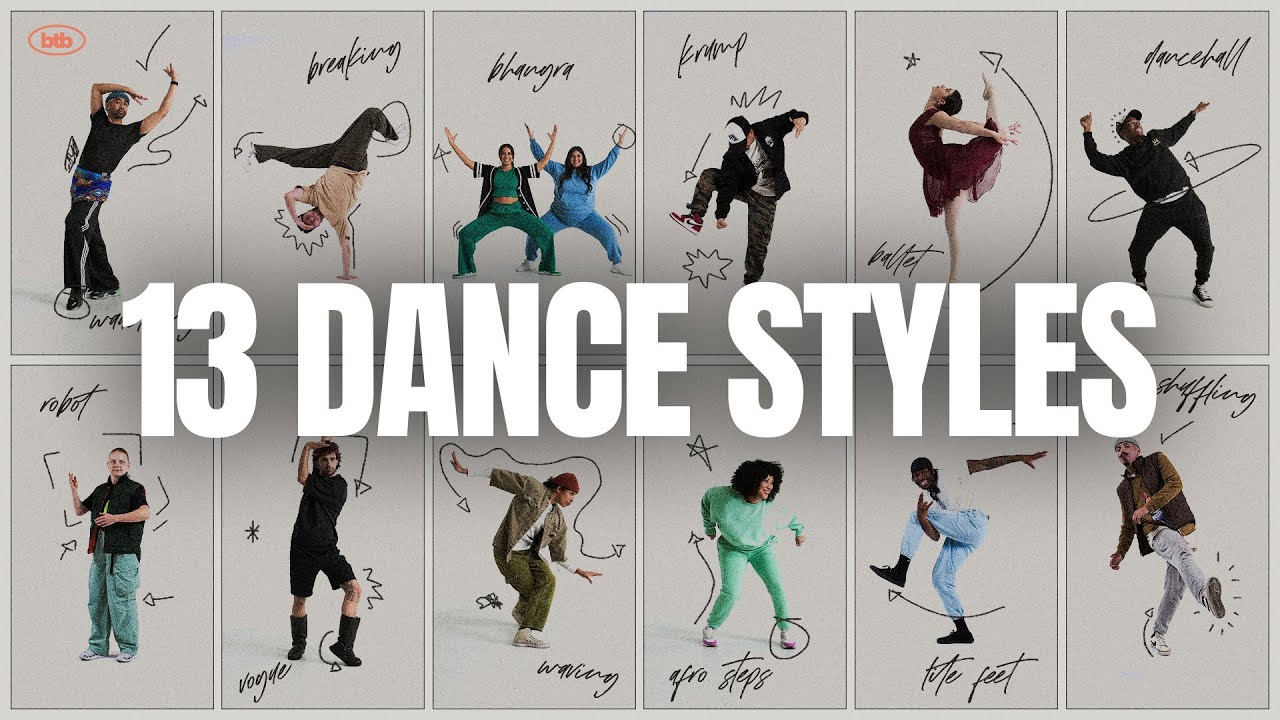
Rob Wilson, known as ShortCircuit, starts where Lite Feet itself started: a halftime performance at Rucker Park in Harlem, around 2004 and 2005, where a dancer named Al B. threw down a move that would become known as the Harlem Shake. Not a meme. The actual Harlem Shake. That single moment is the origin point for a guided tour through 13 distinct dance styles, each explained by a practitioner who carries the culture personally, not academically. The result is one of the most grounded introductions to street, club, and folk dance forms available anywhere.
Where each style actually comes from
Lite Feet was named by an MC called A.G., the Voice of Harlem, who also assembled the first Lite Feet crew. Its foundation moves include the Harlem Shake, the Bad One, the Tone Wop, which ShortCircuit describes as the source of your groove, and the Tic Tac Toe, where dancers tap their own bodies to make audible noise. The Lock In happens on the 8th count, every time, no exceptions.
Shuffling traces back to Melbourne, Australia, in the early 1990s underground rave scene, and instructor Andrew Furr puts the learning curve in plain terms: master the Running Man and you are already 75 percent of the way there. The key is staying close to the ground and never lifting both feet at once.
Breaking, explained by Luis Prado, was born at 1520 Sedgwick Avenue in the Bronx, New York, during the 1970s. He quotes fellow practitioner Eddie Stiles directly: footwork is the blueprint for breaking. The style moves through Top Rock, Go Downs, Footwork, Freezes, Power Moves, and Burns, which Prado describes as an invitation the other dancer can accept or not, however they want.
Jaja Vankova Armstrong traces Robot back to mimes of the 1920s and to Robert Shields, then to Michael Jackson performing on Soul Train with the Jackson 5. She notes that the word robot itself did not exist until Czech playwright Karel Capek coined it in a 1920s play titled R.U.R., standing for Rozum’s Universal Robot.
Krump instructor Sherwin Salonga, known as Beast, names the five original creators and pioneers: Tatais, Big Mijo, Lil C, Ms. Prissy, and Slayer. He calls them Mount Buckmore. His own Krump character is Beast, and he dances it accordingly.
Dancehall, presented by Tango Litas, points to Gerald Levy, also known as Bogo, Mr. Wacky, and, as Tango puts it, ‘the man, the history, and the dance,’ as the figure most responsible for the style’s popularity in the 1990s. Bhangra instructors Shivani and Chhaya explain that the dance comes from the state of Punjab in India, was historically performed during harvest season, and hinges on a quality called Nakhra, which loosely translates to cute, witty, or cheeky.
Ballet instructor Brittany Cavaco traces the form to Renaissance-era Italy and credits Catherine de Medici, a Florentine noblewoman who became Queen of France, with much of ballet’s lasting cultural reach.
The styles born from survival and community
Waving instructor John Gifted dates the form to the late 1960s and early 1970s, originally used as a transition between popping movements. He walks through arm waves, tidal waves, and a variant called King Cobra, which emerged after its creator Daryl Johnson watched Boogaloo Sam perform a circular chest motion in 1979.
Vogue, explained by Gravity Jacobs, emerged in the 1980s ballroom scene and was created by LGBTQ Black and Latinx people dancing in underground clubs in New York as a way to escape, create, and find a community. Lindiwe Rose narrows Afro Dance specifically to South African Amapiano, a genre born in the early 2010s from a fusion of Kwaito, South African house music, jazz, and Bacardi music, where posture is drawn from Pantsula culture, meaning to walk with protruded buttocks.
Whacking was created in Los Angeles in the 1970s by young gay men who frequented clubs including Gino’s and Paradise Ballroom, with competitions and themes facilitated by a DJ named Michelangelo. Instructor Fred Mayer notes that Whacking grew from an earlier style called Punking, and that the two common spellings, Waacking with two A’s and Whacking with an H, each carry their own distinct histories and community context.
Dennis closes the session with Locking, and his introduction is quietly extraordinary: the dance was created in 1970 by a gentleman from South Central Los Angeles. That gentleman, he says, is my father, Don ‘Campbellock’ Campbell. The Lock itself happened by accident when Don was being shown a dance called the Robot Shuffle in the cafeteria of LA Trade Tech College and executed it so poorly he created something new. The Points move, one of Locking’s signatures, came from a night when a group of women were laughing at Don on the dance floor. He stopped, pointed at one of them, and her friends started laughing at her instead.
Don Campbell’s accidental invention
The Points gesture, born from a single moment of being made fun of in a nightclub, became one of Locking’s most recognizable moves. Dennis describes it plainly as an acknowledgment of the people, places, and things around me. His father’s original name for the style was the Campbell Lock, a name that held until 1974 when a dispute with a record company forced a change.
Somewhere in the cafeteria of LA Trade Tech College in 1970, a man danced so badly at a dance he was being taught that he accidentally invented one. That accidental lock is still being taught, still being performed, and still carries his name inside it.