A sea container buried under a backyard in Prescott, Arizona is quietly doing something the surfing industry has spent hundreds of millions of dollars trying to do with far more complicated machinery. The technology is almost offensively simple. Air goes into a chamber. Water comes out. The timing changes. A wave peels down the line. The question nobody in the surf industry seems to want to answer is why a dad, his kids, and a friend figured this out first, and why it costs a fraction of what everyone else is spending.
Wave Source, the small operation behind this private test pool, built its reputation the hard way. Last summer, footage of the brown-watered, backyard wave pool spread across the internet and left the surf world equal parts baffled and obsessed. The water was murky, sure. Arizona monsoon season had been one of the roughest on record, and the original filtration system couldn’t keep up with the haboobs and the dust. But the wave was undeniably real. This year, the crew came back to prove it wasn’t a fluke.
Forty feet of new wall and a wave that finally stays big
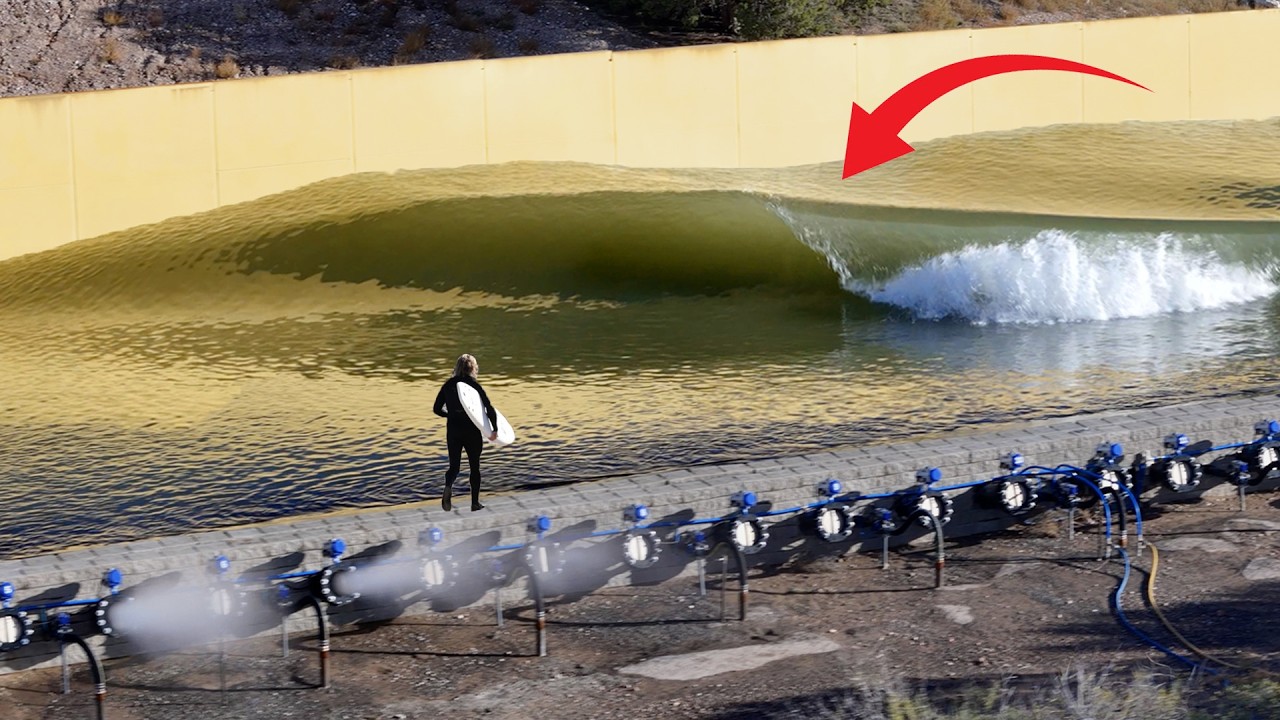
The upgrade list reads like a lesson learned the hard way. The team pre-fabricated 40 additional feet of wall at a new facility in Texas and welded it in at first light. The problem the extension solves is specific: when the original wall ended, the wave wrapped around the edge and died immediately. Riders were getting cut off. The new panels push the ride further down the pool and help the wave stand up longer before it finishes. Alongside the wall extension, the crew tore out the original filtration system and replaced it with an industrial-grade unit. If the monsoons stay manageable, the water should run clear. Beyond those changes, the bottom geometry toward the far end of the pool was reshaped to create a reef effect, and new walkways were added for safer entry and exit.
The pool filled up this week and fired on the first try. Within 15 minutes of arriving, surfer and Wave Source collaborator Ben Gravy had already programmed a new wave on the updated software system, a left-hander he named the peeler. ‘I could not believe it. I’m like a little immune to it by now, this being my third time here,’ he admitted, ‘but then every now and then you just sit there and think, what the hell is happening? How are we doing this right now?’
Blowing air through a flute and surfing the drop
The founder Tony spent 20 minutes one afternoon trying to find the right analogy for how the technology actually works. He landed on a flute. Blow air through the instrument, open a valve at a different moment, get a completely different note. In this pool, pressurized air is pumped into sealed chambers running the full length of the pool floor. The air holds the water up. When a chamber releases, the water drops into the gap. The wave is the sequence of those drops firing in order, and the rider is surfing down into the falling water as it chases its own level. No paddles, no pistons, no hydraulic rams. Tony’s own description cuts to it cleanly: the machine is for the most part immaterial. What matters is the economics of producing the wave.
The claim Wave Source makes on that front is significant. Their patented drop-in technology is engineered to use less than 50 percent of the energy of conventional wave pool systems. There are no moving parts and zero mechanical movement, which reduces both maintenance costs and power draw. Tony also noted the company wants to offer free surf sessions on an inside sandbar so beginners can catch their first wave without paying a premium, and then position itself as the low-price leader for expert-level waves from there. The pitch is direct: less than 1 percent of the 350 million people in the United States surf, and the barrier has always been access and cost.
Plans for expansion are already moving. The team has been negotiating on four or five properties in Florida, though groundwater requirements are complicating those talks. More concretely, Wave Source recently acquired a 50-acre resort in Texas, an existing property with an RV park, a 10-acre lake split into two stocked sections, a sandy beach, and caretaker quarters. Partial funding is in place, and the team is actively looking for investment partners.
The napkin drawing that became a peeling barrel
Tony is not shy about where this started. A drawing on a napkin at a lunch table in a roadside diner. His background is manufacturing, not wave science, and his original goal was simply to make waves economically in his own shop. He called his birthday a big one this year, let a friend guess 40, and laughed along without correcting anyone. The point was clear: he is ready to hand this technology off and let it grow. ‘I want this to get out of the house,’ he said. ‘Let it grow up. Time to go to college.’
In two days on a software system he had never touched before, Gravy created peeling waves, turn waves, barreling waves, and air sections, all from a buried sea container in someone’s backyard in Prescott, Arizona.
The pool, sitting still for a moment, holding water
A newly filled pool, water flat and clear, with 40 feet of freshly welded wall casting a straight shadow across the bottom.
That first wave Tony called the peeler was still in the software system when the crew left. Nobody had deleted it.
 Wake up to Only Happy News!