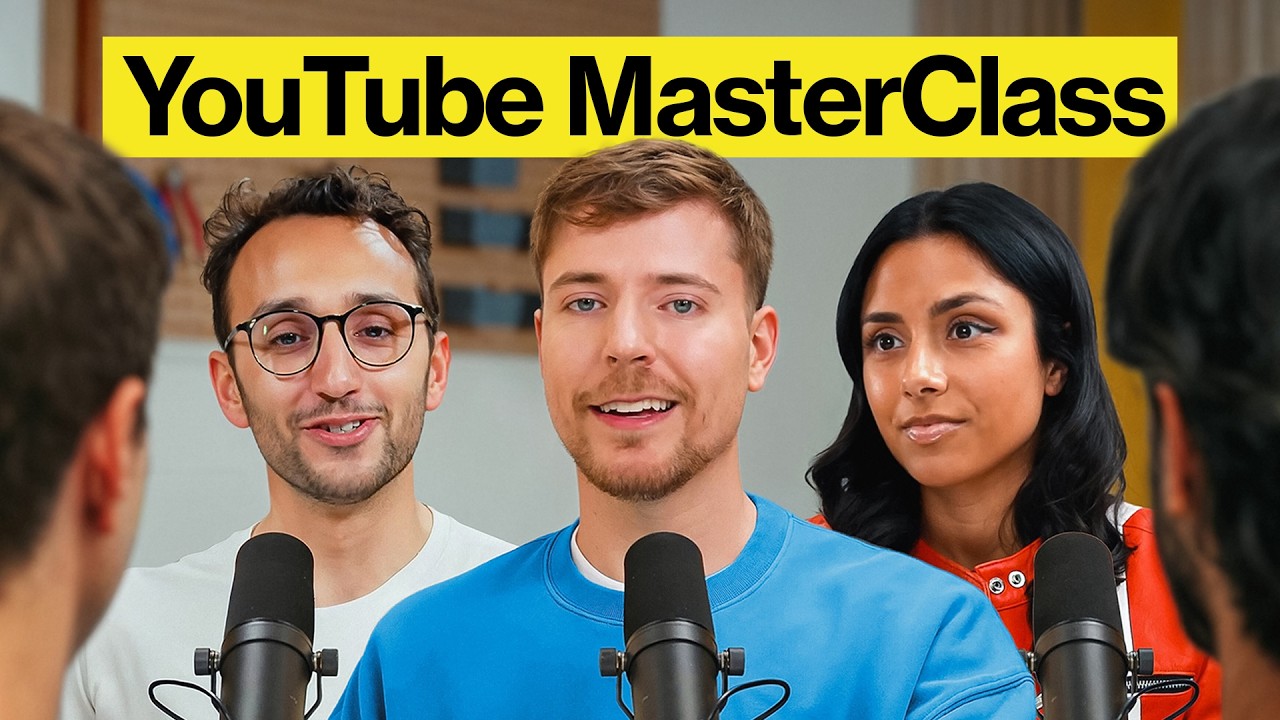
In the next 60 seconds, more than 2,500 videos will be uploaded to YouTube. That is over 2 million a day, and every single one of them is competing for a click on a platform where nobody is forced to watch anything. Over the past decade, Colin and Samir have sat with hundreds of professional creators and pulled out the frameworks that actually separate channels that grow from channels that stall.
The click is a decision, and most creators ignore that
Unlike TikTok, which feeds content directly to passive scrollers, YouTube long-form still requires a viewer to make a deliberate choice. That single distinction shapes everything, and it starts before a single frame of footage rolls.
Ian Lur, an astrophotography creator in Colin and Samir’s accelerator program, was producing technically solid videos sitting at 2,000 to 3,000 views each. The fix was not the camera work. The team told him to spend more time on ideation, to study formats working in other niches, and to build what they call CCN fit: a video that hits the core audience, the casual audience, and the new audience at the same time. He shifted from spending roughly 5 percent of his effort on idea, title, and thumbnail to around 30 percent. The video he made next, comparing astrophotography results across different levels of time investment, reached a million views and hit 270 times his average viewership.
The same principle showed up with a creator named Tim Gabe. A single thumbnail adjustment on his six UI hacks video, maybe 30 to 40 percent better by the team’s estimate, produced 40 times more views per day. As Colin put it: ‘those little differences can just have such outsized returns, which breaks my brain sometimes.’
Structure the video before you shoot it
Professional script writer George Blackman, whose framework appears in Colin and Samir’s YouTube Growth Playbook course, reduces good video structure to a single rhythm: raise a problem, resolve it, immediately raise another. The enemy is not slow editing. It is the gap between problems, the moment when the brain wanders and the homepage is one click away.
For longer videos, the same principle scales up. A side story introduced mid-video re-engages an audience that a single throughline cannot hold across 15 or 20 minutes. The Try Guys’ approach runs on a formal three-act structure with a low point before the final reveal, but they learned one hard rule from retention data: once the big reveal lands, the video is over. Thirty seconds, and people are gone.
Creator Cleo Abram described her own shift in thumbnail thinking as going from trying to put the whole video into a single image to trusting the curiosity gap. She settled on a rule of three things per thumbnail, drawn from studying how Tom Scott pairs titles with images of himself in action, an arrow pointing at something specific. ‘There’s a certain amount of creative confidence it takes to make something that doesn’t try to be everything,’ she said.
One moment on a sensory deprivation tank
Cleo Abram spent three hours in a sensory deprivation tank for one video. An hour in, lights off. By hour three, earplugs in, floating in total silence, she found herself crying over a memory of her grandmother and a nap they shared in the summer of 2008. She nearly said nothing about it to her editor Zach. He told her to keep it in. The comment section filled with readers sharing the last time they felt still.
The channel is a resume no creator controls. A brand, a potential subscriber, or a collaborator clicks one video and that one video decides everything. The goal, as the conversation kept circling back to, is making sure every single upload is one worth being found.