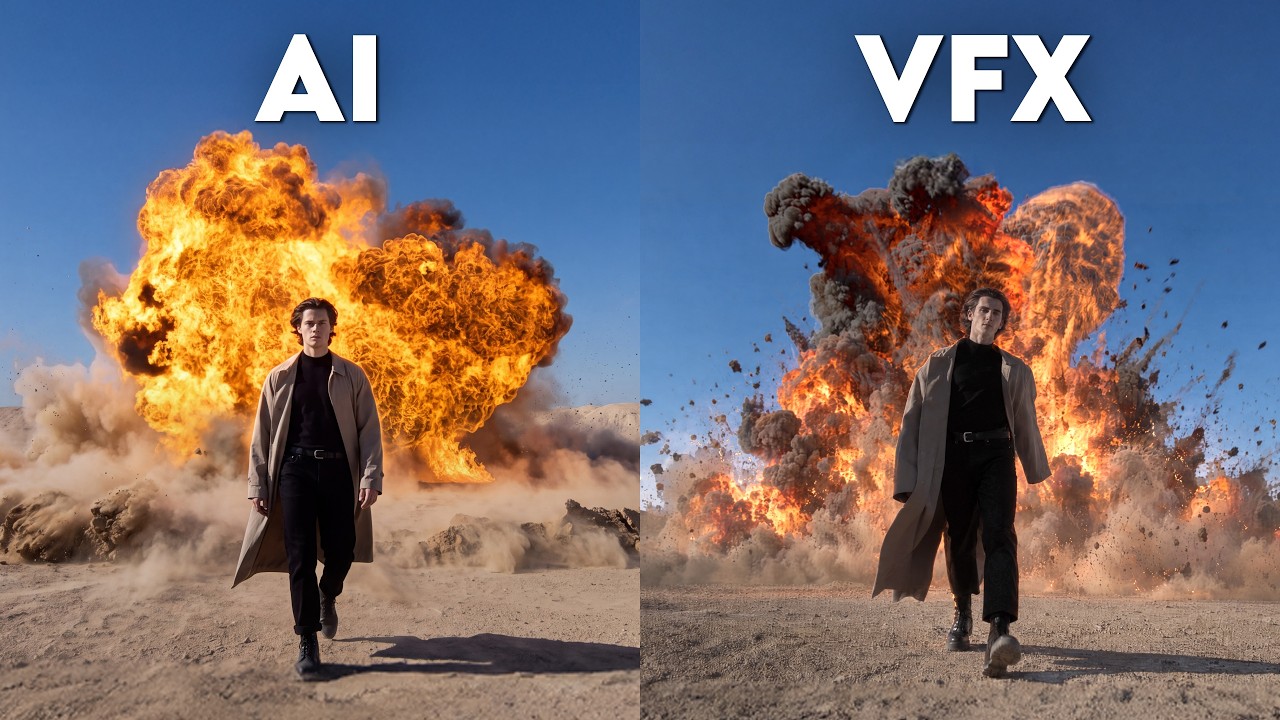
Erik, a working VFX artist with Hollywood studio credits, fired up a machine with 384 gigabytes of RAM and set it to work simulating a tank explosion frame by frame. The question was not whether he could pull it off. The question was whether an AI pipeline built around GPT-6 Astra and a video-to-video generation model could match him, and whether his mother-in-law could tell the difference.
Building the explosion the old way
The starting point was a shot submitted by a creator named Ebra Art: a walk-away explosion scene assembled from 2D assets that read flat and weightless. Erik decided to go full 3D. He tracked the original footage, sourced a 3D tank model close enough to the reference, positioned it behind the actors, and then spent serious time studying real footage of a car detonating to match the physics. Metal fracturing simulations came first, with a collision sphere expanding from the center of the tank to drive the breakup. A separate hood piece was isolated and launched into the air with its own simulation, trailing fire from a particle-based fuel source. The buoyancy setting, which controls how fast a volume of gas rises, got cranked up to match the reference explosion’s fast-climbing fireball. Then the render failed. ‘I have 384 GB of memory, which with today’s prices makes me one of the richest men alive,’ Erik noted, ‘but nonetheless, the simulation fails.’ He dialed quality back just enough for the machine to hold on, assembled the explosion pass, shadow pass, and ground-lighting pass in DaVinci, rotoscoped the actors to keep them in front of the CG layers, and layered in a 2D debris asset, a dust wave rolling toward the camera, lens dirt, spark burst, and repeated rounds of camera shake. His wife Maria’s early verdict, that she preferred the original, pushed him through another full revision pass.
The second project was a superhero short from Harry Jones, featuring laser eyes, an evaporating chicken, and a leaping takeoff. Erik converted the 60-frames-per-second footage to 24 frames per second and added motion-blur calculated from the direction and speed of movement on each frame, which immediately pushed the clip toward a cinematic register. The laser eyes were built from isolated, high-contrast eye mattes turned red with glow layers, real lens flares repositioned and tinted to match, streaking flares, and lens dirt. For the chicken, he converted it into a 3D model using an AI tool, then drove the feathers outward in an explosion simulation, layered in burning steel wool on impact, spark hits, smoke, and a cloned-out ash pile Harry had helpfully captured on set as a clean plate. The takeoff shot was finished with rotoscoping, motion-blur-matched jump animation, practical dirt and grass blast assets, and an AI-generated impact crater.
What the AI pipeline did differently
Hicksfield, an AI company brought in as a partner under strict conditions, including no say over the editorial direction and no protection from honest critique, ran its own version of both sequences. GPT-6 Astra received a text prompt, analyzed the clips, formed a plan, and used Seance 2.5 in a video-to-video mode to regenerate the footage while preserving Harry’s original motion. Astra reviewed its own outputs, flagged problems, and re-ran the generation multiple times before marking a result as complete.
When Erik’s mother-in-law Megan sat down to watch all three versions side by side without labels, she correctly identified the beginner shot, Erik’s work, and the AI output across both sequences. Her read on the AI explosion was specific: ‘the quality and the way it explodes, like the way the clouds go inwards at the end. That’s not how explosions work.’ She noted that the AI fire in the chicken sequence looked like a 2D element dropped in from behind the subject’s head, and that the grass was completely unaffected by the takeoff shockwave before it simply cut to black. Erik acknowledged the AI had genuine strengths: a convincing ground-level shockwave on the tank shot, and some control over broad atmospheric effects that would take significant manual time to build. But his conclusion matched Megan’s instinct. ‘I feel like the VFX just feels a lot more physically real because I am simulating a real explosion,’ he said, ‘whereas they’re just kind of guessing based on a bunch of other explosions.’
The tank, still cooling
Somewhere in the render queue, the separated hood piece Erik pulled off the tank and sent tumbling through the air is still on fire.
The color grade, the grain, and the motion blur did what no generation pass replicated. The shots felt like film because someone had watched a real car explode and built backward from that.