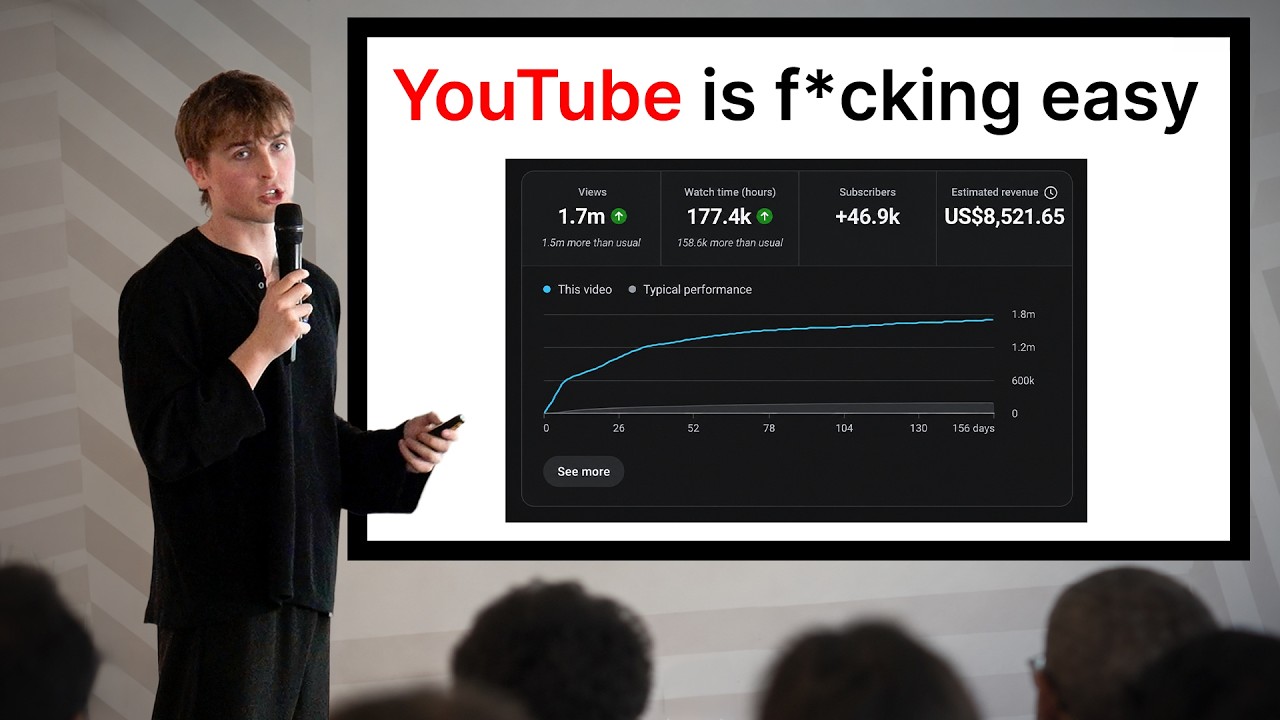
At 10 years old, Jake Trinder posted his first YouTube video, a bottle flip challenge and a clip of his mom falling on the floor. Twelve years later, he runs more than a hundred YouTube channels, including Gary Vaynerchuk’s, and has built his YouTube agency to $500,000 a month. The methods behind those numbers are not intuitive, and most business owners are making the exact mistakes that guarantee their videos stay invisible.
Why making useful videos is not enough
The first and most common error is assuming that knowing your audience means knowing what they will watch. It does not. Before Glen Coco, a client who started from zero brand recognition, produced their first video, the team validated that actual demand existed on YouTube for the specific subject and specific language they planned to use. Their first video made $100,000 in the first 30 days. Their first 12 videos generated a million dollars in six months.
The validation process Trinder calls ‘depth first search’ works like a web crawler applied to a niche. You start with a seed list of keywords generated by an AI tool, push those terms onto a search stack, find the outlier videos for each term, open the channels those videos live on, record every standout performer, follow the recommendations, and exhaust each branch before returning to the next keyword. The output is a demand map of everything the target market actually chooses to watch, not what a business owner guesses they need.
The insulin case makes the principle sharp. A doctor who specializes in insulin wanted to talk about insulin. Her audience, women pursuing fat loss, did not care about insulin. The team bridged the gap with a title built around a proven YouTube format: ‘If you don’t understand insulin, you don’t understand fat loss.’ The unfamiliar mechanism gave a new reason to click. The outcome the audience already wanted gave the idea its demand. Result: 230,000 views, 14 new clients, and more than $50,000 net profit in her first month.
The winner-take-all click and what happens the moment after
A thumbnail is processed before a title is read. The thumbnail for the visceral fat video used a red highlight block behind white text, a visual transformation, and the doctor in medical scrubs, each element doing distinct work: attention, promised outcome, and instant authority. Only after that does the title qualify the exact promise.
Once a viewer clicks, three questions run in sequence: am I getting what I clicked for, can this person actually deliver it, is the rest worth my time. Trinder frames the answer as ‘promise, proof, plan.’ Reaffirm what they clicked for. Give the sharpest possible reason to trust you on that specific topic. Then show the viewer exactly where the video is going, in enough detail that they mentally commit to staying.
Viewer satisfaction, Trinder is direct about this, is the only metric worth optimizing. Not click-through rate. Not retention as decoration. ‘The goal of every video is viewer satisfaction, not retention,’ he put it plainly, and every other number flows from that one.
The call to action follows the same logic. When Trinder’s team built a video for Instantly AI around a 10-hour business challenge, the product’s pre-warmed domains feature was not announced; it appeared as the only tool that could solve the challenge’s time constraint at the exact moment the constraint appeared. Viewers called it the best advertisement they had ever seen. One comment, which collected 360 likes, read: ‘Did not realize I was watching an ad until 14:49.’
The one Gary Vee video that started a feedback loop
Gary Vaynerchuk’s channel was averaging 10,000 to 20,000 views per video. The first video Trinder’s team produced for him hit 300,000 views. That single data point became the input for the next decision, not a template to copy but a signal to interrogate: why did this work, and what has not been tried yet.
The answer led to a video built around Gary’s thesis on interest media, packaged in a format Trinder invented by combining two existing ‘shift’ formats and testing it first in the LinkedIn niche. That video crossed 400,000 views shortly after posting, against a channel baseline of 10,000.
Every upload, Trinder argues, should make the next decision better. Track views, leads, qualified calls, customers, and revenue. After each upload, run a bottleneck analysis and find where the drop-off happened. Fix that stage. Repeat.
Sam’s Google Sheet that closed a $16,000 deal
A client teaching Facebook ad strategy gave viewers a continuously updated creative library as a lead magnet inside a video built around the best ad strategy for 2026. The library was what serious viewers wanted next after understanding the strategy. Another creator, Ryan Dice, did the same thing with a simple Google Sheet scorecard to accompany a video about running a business in one hour per week. Trinder, watching as an ordinary viewer, fell into the funnel and paid $16,000.
The video does not have to make the sale. It has to make the next useful step obvious.
The format Jake Trinder used first in the LinkedIn niche
A title structure Trinder invented, ‘The new era of [thing] has just begun,’ started as a 20,000-to-30,000-view outlier in the LinkedIn space. Someone else applied it to startup funding and reached hundreds of thousands of views. The format then spread widely. The underlying psychology, urgency around a shift already in motion, is what made it portable across niches. Finding that psychology inside a format, and understanding why it meshes with a specific audience’s behavior, is what separates a reliable doubling-down from blind imitation.
Back on that first YouTube channel at age 10, the bottle flip video went nowhere. The process of figuring out why has been running ever since.