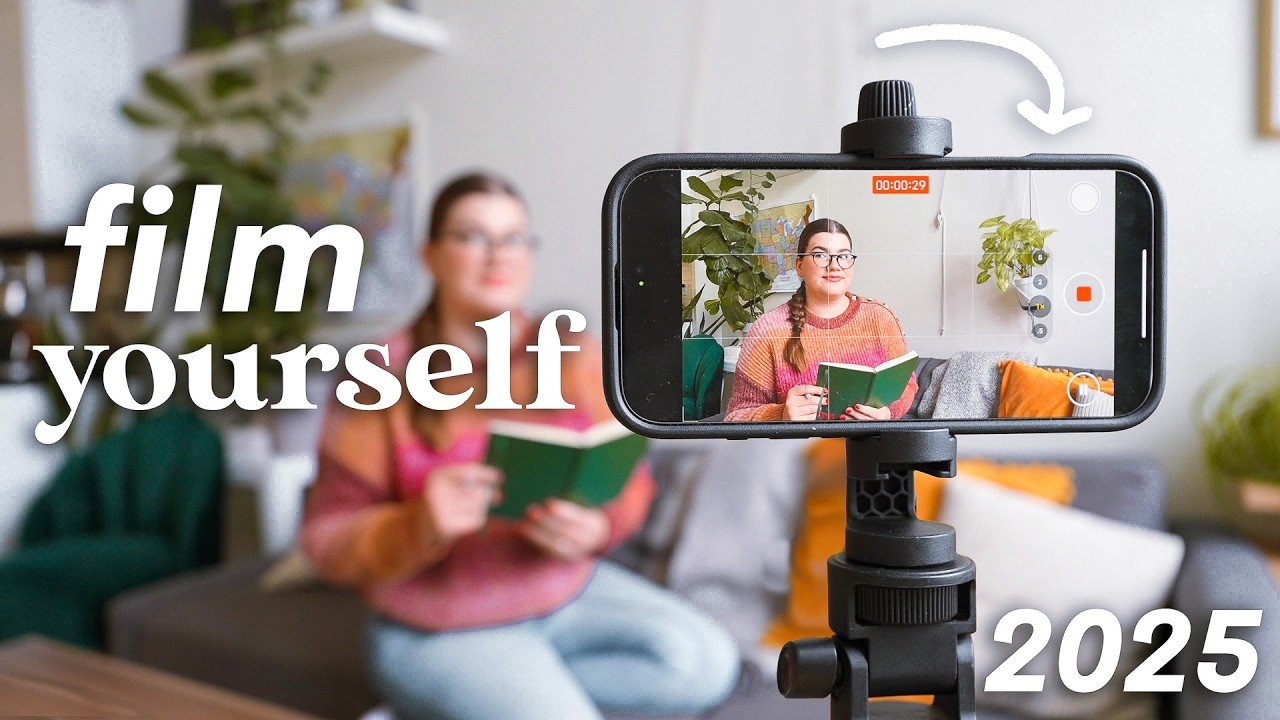
Katie Steckly is mid-sprint between couch and tripod, sweaty, on her fifth test clip, and entirely alone. That scene, repeated across more than a decade of solo filming, is also the whole point. Most YouTube creators assume great footage requires a crew. Steckly’s argument, built from over 10 years of self-directed production, is that one person, a phone, and a tripod can produce genuinely cinematic results if they know the right sequence.
Two ways to frame a shot when you are the subject
The first method requires nothing but patience. Steckly calls it guess and check: set up the tripod where you think you want it, press record, step into the frame for two seconds, then walk back and review the clip. Adjust. Repeat. It sounds slow, but she notes that the more you do it, the fewer test shots you need before the frame looks right.
The second method is faster but requires an Apple Watch. Opening the camera app on the watch mirrors exactly what the phone lens sees, so a creator can walk into the frame, glance at their wrist, make adjustments while standing in position, and then press record directly from the watch without touching the phone at all. No pile of discarded test clips, no guessing.
For anyone wanting movement rather than locked-off shots, Steckly covered the Insta360 Flow 2 Pro, a mobile gimbal that tracks a subject’s face automatically through a direct Apple integration, no dedicated app required. A single tap via NFC connects the phone, and pressing the trigger button on the gimbal starts face-tracking inside the standard camera app. Steckly pointed out a detail that solves a genuine frustration: the gimbal has a small built-in selfie mirror specifically for creators who like to film with the wide 0.5 lens, where the phone screen faces away and framing becomes a guessing game. ‘I’m a huge fan of filming with the .5 lens,’ she said, ‘and obviously when you do that you can’t see the screen of your phone, so it’s hard to know if you’re in frame, and this little selfie mirror solves that problem.’
The four-shot formula that builds a story
Having the tools matters less than knowing what to film. Steckly’s four-category framework gives solo creators a mental checklist: establishing, detail, human interaction, and vlog.
An establishing shot is a wide frame that tells the viewer where they are, whether that is a lake, a bathroom doorway, or a cafe exterior. Detail shots pull closer to communicate texture: a skincare product line-up, a coffee cup, a close-up of a faucet being turned on. Human interaction shots put the creator inside the scene showing a genuine reaction, a first sip, a skincare step actually in progress, the kind of footage that makes a viewer feel present rather than informed. Vlog clips, the fourth type, are direct-to-camera moments where the creator speaks about how they feel rather than describing what is visually already obvious in the surrounding footage. Steckly is direct about why beginners skip this last type: talking to your phone unprompted is not natural, and establishing shots are simply easier to reach for.
A tripod waiting for the next adjustment
The tripod Steckly keeps repositioning throughout sits extended at an angle, its legs spread on a hard floor, the phone mounted and pointing at an empty couch.
For any creator willing to treat the process as two jobs running in sequence rather than at once, the gap between selfie footage and something genuinely watchable turns out to be narrower than it looks. Steckly put it plainly: once you start seeing the results of that visual variety, you will never want to go back to talking-head-only footage again.