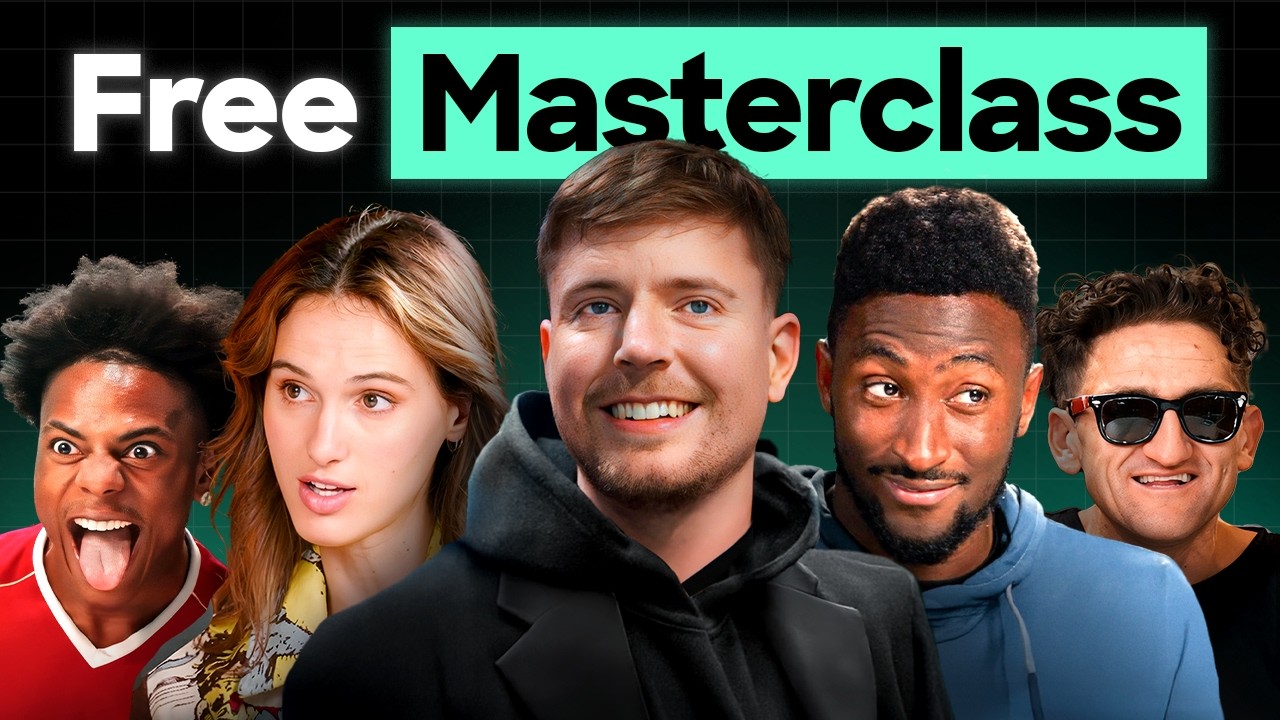
Casey Neistat uploaded a vlog every single day for 800 days straight, and there were dozens of nights when he sat down to edit and discovered he had no audio at all. He did not miss the deadline. He put text on screen, explained the problem to his audience, and shipped it anyway. That instinct, to create relentlessly and publicly even when the work feels embarrassing, turns out to be the hidden engine behind careers that outlast algorithms. Jon Youshaei spent 15 years inside and around YouTube, first as an employee, then as a creator, racking up interviews with the platform’s biggest names, and what emerged from all of those conversations is less a set of rules than a way of seeing the work.
Why most video ideas should never become videos
The first filter Youshaei learned came from journalist and creator Johnny Harris, who told him that of a million stories worth reporting, only 900 belong on video. Harris calls the deciding factor a visual anchor: something you can see that proves a point no sentence ever could. While covering the migration crisis at the Colombia-Venezuela border, Harris found a street vendor sculpting baskets and swans from Venezuelan bolivars rendered worthless by hyperinflation. Nobody needed to understand macroeconomics to grasp that something had gone terribly wrong. The money itself was the story.
For creators who are not flying to South America, Youshaei offers a practical shortcut he calls the napkin test, borrowed from a conversation with fast-growing creator Cleo Abram: if you are explaining your video idea to a friend over coffee and you need to draw something on a napkin, pull out your phone, or say ‘like this’ while pointing at something, you have a video. If the explanation works fine in plain sentences, write an article instead. Reddit, filtered by a niche subreddit and sorted by ‘top, all time,’ gives creators a pre-vetted library of visual anchors that hundreds of thousands of people have already upvoted as interesting.
The outlier method MrBeast actually uses
Jimmy Donaldson broke down his process for finding ideas that scale, and it starts with watching what works across completely unrelated formats. ‘If I see something going viral across multiple formats all across YouTube, it’s like okay, that seems to be something people really like,’ he explained during Youshaei’s interview with him. His ‘dollar versus’ series grew from noticing that BuzzFeed, beauty channels, and gaming channels were all running cheap-versus-expensive comparisons and every one of them performed. He took the skeleton and built something bigger.
The process for finding your own outliers is straightforward: search three to four words from your niche on YouTube, apply the search filter for view count, then check the subscriber count of each top-performing channel. Any video with more than five times the views of the channel’s subscriber base is an outlier worth studying. The goal is not to copy it but to do what designer Virgil Abloh described as the 3% tweak, changing just enough to make it yours. Zach King, now past 40 million subscribers, studies the physical comedy of Buster Keaton from the 1920s because almost no other creator is looking that far back.
The Mozart problem
The tip Youshaei calls the most personal involves the French painter Claude Monet, who once spent three years on a series of paintings and then, noticing slight imperfections in the corners, took a butcher knife and destroyed every canvas. Scholars estimate he slashed through more than 3.4 million dollars worth of art that night.
Youshaei recognizes the pattern. In his first year on YouTube he uploaded six videos total, saving and resaving files as ‘final, then final underscore final, then final but actually,’ never quite pulling the trigger. Mozart, by contrast, made over 600 compositions before dying at 35, far more than contemporaries who lived longer and averaged around 150. Most of those 600 are forgotten. The masterpieces survived because Mozart kept working. Casey Neistat has posted seven videos in the past year and told Youshaei it is genuinely harder now that there is no daily deadline, no fire. As Neistat put it, Parkinson’s law is real: ‘I haven’t posted a video in eight months. There’s no rush.’ Youshaei’s channel has now published over 270 videos totaling more than 340 million views, and he traces the shift to one decision: stop being Monet, ship the thing.
The night Casey had no audio and posted anyway
On one of those 800 consecutive upload days, Neistat finished shooting, sat down to edit, and found silence where the audio track should have been. The microphone had not been plugged in. He cut to himself sitting in the kitchen, typed what had happened on screen, made it work, and published before midnight.
That video exists. Whatever he might have made on a night with perfect audio and no pressure does not.
Youshaei’s central argument is that the only thing worse than something imperfect is something that never gets released, and the interviews he gathered over 15 years, with Donaldson, Neistat, Marquez Brownlee, Liza Koshy, Zach King, Dr. Mike, and many others, keep arriving at the same uncomfortable proof: the creators still standing are the ones who published before they were ready, studied what was already working, and stayed sharp doing the real work when the camera was off.