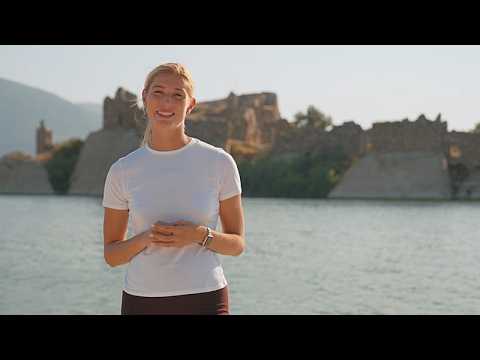
Lily Dawes is standing inside a centuries-old moat, now dry stone underfoot, as a local guide explains how the wall above once separated life from death for the Knights of St. John. Bodrum, on Turkey’s southwestern Aegean coast, carries more than three thousand years of history in its rock and salt air, and for travelers willing to look past the marina bars, that history is everywhere: in a crusader castle, in half-million-year-old olive trees, and in a lakeside temple built for a mythological shepherd who caught the eye of the moon goddess.
Five nations, one castle, and 3,000-year-old glass from the seafloor
Bodrum Castle, known formally as St. Peter’s Castle, rises directly from the harbor and sets the tone for everything that follows. Its construction by the Knights of St. John drew builders and soldiers from across medieval Europe, and the architecture still shows it. ‘I always call this one earlier EU,’ said the guide, Stuart, walking Dawes through the complex, ‘because we have French, Italian, German, Spanish, and English towers.’ Five distinct towers, five different national styles, one fortification.
The castle’s deepest surprise is underground, or rather underwater in origin. The Bodrum Museum of Underwater Archaeology, housed inside the castle walls, displays cargo recovered from ancient shipwrecks, including a haul of glass pieces dated to roughly 3,000 years ago. The temperature in that room is kept constant to preserve them. Alongside the glass are amphorae once used to carry olive oil, sailors’ tools, weapons, coins, and jewelry: a complete material picture of Aegean trade routes that no longer exist.
Up on the hillside above the harbor, a row of windmills reinforces how long human hands have worked this landscape. The oldest among them is about 350 years old, the youngest around 250. They ground wheat for sailors’ bread until electricity arrived in the 1920s, then stopped. Now they stand as landmarks, turning slowly in the Aegean wind with nothing left to mill.
A million olive trees, sixty kilos per liter, and sarma by the sea
Just north of the city, near the village of Senköy, the landscape gives way to an organic olive farm where the numbers become almost absurd. The village has a population of around 300 people and roughly one million olive trees. Some of those trees are believed to be up to 500 years old, their trunks twisted into shapes that look nothing like a cultivated orchard.
Local producer Noyan walked Dawes through the harvest logic: it takes approximately 60 kilos of olives to press a single liter of oil, which explains why the October picking season is an all-hands event. The tasting that followed at Noyan’s home covered fruitiness, bitterness, and pungency across several varieties, with one oil delivering clear notes of nuts and black pepper.
Then came the kitchen. The two of them made sarma, the classic Turkish stuffed grape leaves, filling them with bulgur wheat, herbs, spices, onions, garlic, homemade vegetable paste, and generous olive oil before rolling them into preserved grape leaves and zucchini blossoms. They simmered gently, then ate outside. ‘Smelling amazing, looking amazing,’ Dawes said, lifting the first one.
A boat trip along the Aegean revealed caves and clear water in the ancient region of Caria, once a center of civilizations stretching south of Ephesus. Then the terrain shifted to Lake Bafa, where e-bikes made the rocky shoreline passable and the ruins of the ancient port city of Heraclea came into view: city walls that once ran two kilometers around the mountain, from the 4th century BC, built to move olives and goods down to a harbor that the lake itself used to be.
The temple nobody planned to stop at
Deep in the cycle trail along Lake Bafa, the guide paused beside a structure few visitors reach: a temple thought to be dedicated to the local shepherd Endymion, the figure in the myth that has the moon goddess falling in love with him. ‘A love story,’ the guide said. ‘That’s a pretty amazing temple for a love story,’ Dawes replied.
The Six Senses Kaplankaya resort, set between the hills and the sea just north of Bodrum, provided the counterbalance to all that history: a sports scientist running body composition tests and blood pressure checks, a hammam, and a garden growing produce for the kitchen. Fresh fish and hummus eaten overlooking the Aegean made a quiet argument that the coastline itself is the amenity.
Bodrum Castle is still standing watch over the harbor, the same view the Knights had when they named their city after a saint and built five towers for five nations, never quite agreeing on a single home country but agreeing, apparently, on where to put the walls.
 Wake up to Only Happy News!