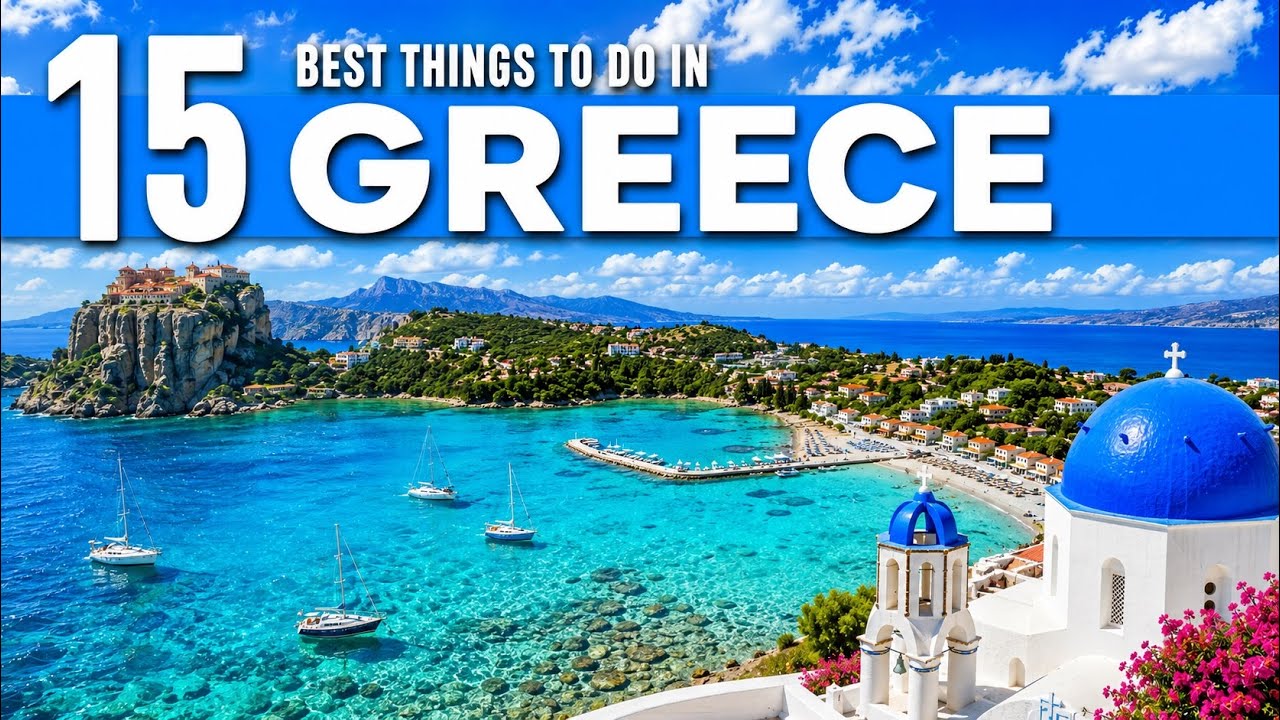
The ferry pulls away from one island and another appears on the horizon, white buildings stacked against volcanic cliffs or limestone ridges, and somewhere in that crossing the question stops being whether Greece is worth it and starts being how to fit enough of it into a single trip. Greece has roughly 6,000 islands, 227 of them inhabited, and choosing wrong means spending your two weeks somewhere that looked better in the thumbnail. Island Hopper TV spent real time on the ground across the Aegean and Ionian Seas, drove the tight roads, ate the souvlaki, and came back with a guide built on personal experience rather than brochure copy.
The volcanic islands everyone goes to first
Santorini is the starting point for most people, and it earns the attention. Formed by one of the largest volcanic eruptions in recorded history, around 1600 BC, the eruption left behind a caldera ringed by dramatic cliffs. The villages of Oia and Fira sit along those cliffs, and the blue-domed churches and restaurant terraces facing the water are exactly what you have seen in every Greece photo ever taken. The island’s permanent population sits at around 15,000 to 16,000, though on any given day the tourist count dwarfs that.
Mykonos, a short ferry ride away, runs on a different energy. The roads are tight, tighter even than Santorini’s, and a rental car is still the best way to move around. The caldera views do not exist here, but Little Venice delivers its own version of picturesque: waterfront restaurants, white buildings, and five windmills sitting just above it all. At sunset, that strip of coastline comes alive in a way that justifies the ferry ticket on its own. According to Greek mythology, Mykonos was named after Mykons, a grandson of the god Apollo, and the island’s large rocks are said to be the petrified bodies of giants that Hercules defeated here.
Crete operates at a different scale entirely. The largest Greek island and the fifth largest in the Mediterranean, it stretches 260 km from east to west and is home to around 630,000 people. The Venetian harbor at Chania, Balos Lagoon, and the sheer breadth of terrain across the island mean a rental car is not optional, it is essential. Zeus, king of all Greek gods, was said to have been born in a cave on Crete.
The islands most people skip that are worth rerouting for
Milos, with only about 5,000 permanent residents, was a personal standout. It is volcanic, covered in an unusual pale-colored rock, and packed with colorful sea cliffs, sea caves, hot springs, and over 70 beaches. There is effectively no public transport, which keeps crowds down and rewards anyone who shows up with a rental car. As Island Hopper TV put it plainly about Milos: ‘I would say this was one of my favorite places that I visited while I was here in Greece. I would say this one’s still kind of like a hidden gem.’
Ios sits in a different category. Known as a party island, it draws university students from the UK, Ireland, and across Europe to beach clubs including one called Pathos along the Kolymbathes stretch of coast. But the island also holds Homer’s tomb, where the legendary poet credited with writing the Iliad and the Odyssey is buried. The capital is Chora, the swimming and water sports hub is Mylopotas, and the combination of ultra-relaxation and proper nightlife is rare even by island standards.
PAros, positioned between Mykonos and Naxos, is easy to underestimate. It is a natural stopover on the ferry routes, and a full exploration by rental car takes six to eight hours before catching the 6:00 p.m. ferry onward. No overnight stay required.
Beyond the islands
Athens functions best as an entry point. One to two days covers the Acropolis, a handful of museums, and a plate of souvlaki, which is the traditional Greek street food worth tracking down. Meteora, about 350 km northwest of Athens, is another story: monasteries perched on sandstone pillars 400 m above the valley floor, first settled by monks around the 11th century, and now a UNESCO World Heritage Site. The train from Athens to the nearby town of Kalambaka takes four hours each way, which makes an overnight stay the practical call.
Up in northern Greece, Thessaloniki holds 15 UNESCO-listed Byzantine monuments and a waterfront promenade anchored by the White Tower, built by the Ottomans in the 15th century and now a museum with views across the city. Further into the mountains, the Vikos Gorge in the Zagori region holds a Guinness World Record for one of the deepest gorges relative to its width. Its cliffs reach 1,000 m on each side, and it is among the greenest landscapes anywhere in the country.
The car at the end of the day
A rental car, luggage stored in the trunk, parked above a beach somewhere on Milos with 70 others stretching in every direction.
For a 14-day trip, seven to ten islands including Athens and Meteora is achievable. The ferries connect them all, and the islands are where most of the ancient history actually lives, not just the views.