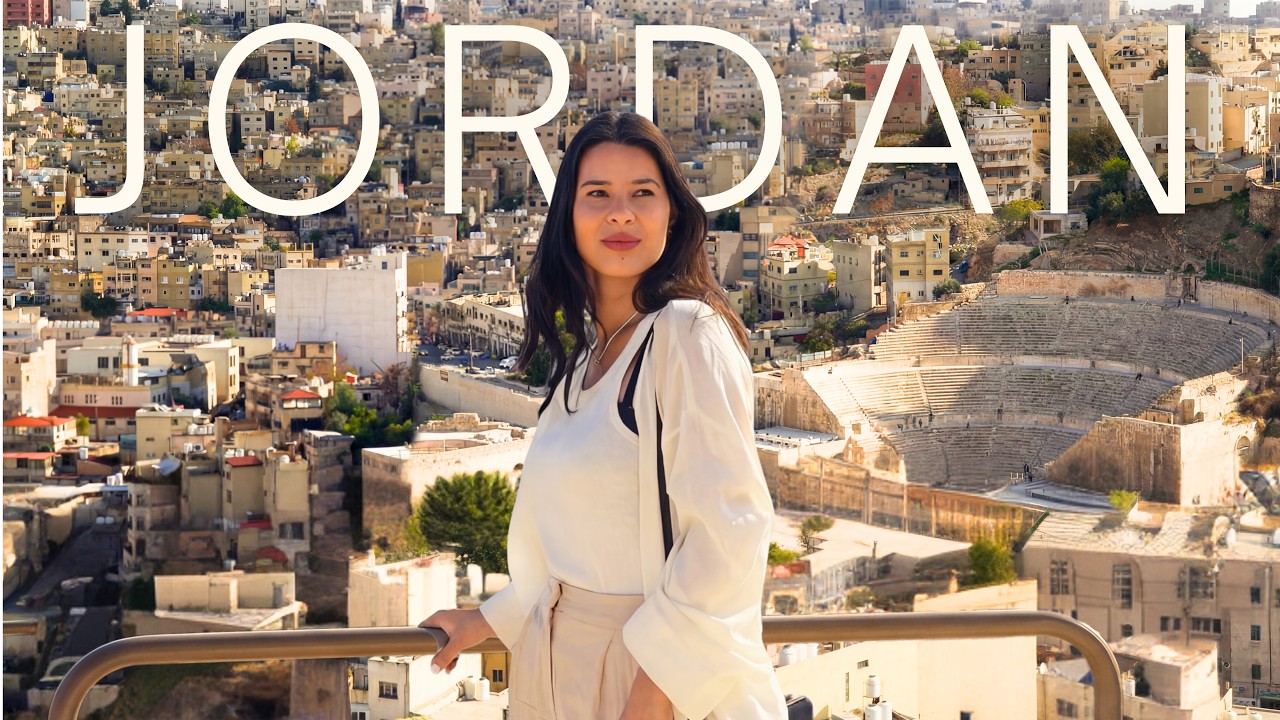
In the old downtown of Amman, a restaurant called Asham has been serving falafel and hummus from the same address since 1956, and on the morning Malini Angelica walked through its door, the line for kunafa stretched out onto the street. Jordan sits at the meeting point of Asia, Africa, and Europe, and for anyone who has only ever seen it as a dateline in a news report, the reality of the place lands as a genuine surprise. This is a country where two-thousand-year-old Roman columns still stand in the northern desert, where Bedouin families live within walking distance of one of the ancient world’s great carved cities, and where camels wander onto the highway close enough to eat bread through a car window.
Amman on a weekday morning
Arabian Wanderers driver Ty collected Angelica from the airport and delivered her directly into the thick of downtown Amman. The streets there carry what she described as a European and Arabian vibe together, not unlike Naples or Sicily, busy and market-driven but threaded through with old coffee shops, lottery stalls, and secondhand bookshops. At Asham, a local handed over a plate of falafel and explained the distinction between hummus, made from chickpeas, and ful, made from kidney beans. Both, he noted with some pride, were very protein. A few streets over, a queue had formed for kunafa, a warm dessert of white cheese, syrup, and a spongy dough layer that Angelica called ‘not too cheesy, super sweet, spongy, syrupy.’ Jordan produces thousands of olive trees and presses its own olive oil, a detail that caught her off guard entirely. The Amman Citadel, perched above the city on one of its famous seven hills, layers Bronze Age remains beneath Umayyad palace walls beneath Roman ruins, all of it audible at the right moment when the call to prayer rolls across the rooftops below. From the citadel’s edge, the ancient Roman amphitheater is visible in the valley, and beyond it the city spreads into glass-fronted towers. Amman was decorated for Christmas during her visit, a reflection of the country’s sizable Christian population living alongside its Muslim majority without friction, a civic fact she found worth naming plainly.
Jerash, Petra, and Wadi Rum in sequence
North of the capital, the Greco-Roman city of Jerash reached its peak under Emperor Hadrian in the second and early third centuries and is intact enough to be called the Pompeii of the Middle East. Its oval forum, colonnaded main road, and amphitheater are all still standing. Angelica stood in the amphitheater and said she could almost imagine someone there reciting poetry.
Petra, accessed through a narrow sandstone canyon, dates to around 300 BC. The Treasury, its most photographed structure, is actually the mausoleum of a Nabataean king, its columns blending Nabataean carving with Roman and Greek architectural influence. Angelica climbed roughly 900 steps beyond it to reach the Monastery, which she judged might be even more impressive. Along the trail she stopped to speak with a Bedouin man whose family has lived in the desert surrounding Petra across generations. He introduced his daughter, Essia.
South of Petra, Wadi Rum’s red rock formations and sand dunes have stood in for Mars in major film productions, and the landscape earns the comparison without any cinematic help. The Hijaz Railway, built in the early twentieth century to carry Ottoman troops and Muslim pilgrims from Damascus to Mecca, once cut through this same desert. Angelica took a jeep ride across the dunes that became, by her own account, quite dangerous, then climbed a sandune to a filming location used for The Martian. She ended that afternoon on a camel, her first time on one, watching the sun drop between distant mountains. ‘It is actually a lot more chilled out than being on the jeep,’ she noted.
A bakery four years into its trade
Before leaving Petra, Angelica stopped at a small family bakery that makes its bread the traditional way, pressing and rolling dough by hand on a flat stone surface. The shop had been open for four years. A woman there rolled the dough without comment, passed over a warm piece, and then brought out Bedouin tea alongside it. Angelica drank it and said nothing for a moment.
From the sand of Wadi Rum to that quiet bakery near Petra, Jordan moved at a pace that kept catching Angelica off guard, generous and unhurried in a way she had not anticipated from a country she had mostly known by its headlines.