Michelle Khare stood at the top of a long dirt track in the mountains of Nikko, Japan, reins held in one hand, a bow across her lap, and a horse named Cody shifting restlessly beneath her in the January cold. Less than 20 foreigners have ever attempted what she was about to do at the end of a single week of training. The question of whether any of them had enough time to prepare is almost beside the point. The better question is what a week inside one of the world’s oldest living martial traditions actually costs you.
Eight centuries of etiquette, and she had to start somewhere
The Ogasawara school in Nikko traces its lineage back more than 800 years. The Ogasawara family served as instructors to generations of shoguns, teaching the samurai class not only archery and mounted archery but also the complete system of bodily conduct known as reijo: which foot you enter a room on, which hand lifts which utensil, how deeply you bow, how you walk across ice-cold floors in socks because that is what samurai wore. Ogasawara Sensei, the current headmaster and a deeply revered figure, agreed to oversee Khare’s final graded performance of Yabusame, the Shinto ritual of mounted archery dating to the 13th century in which a rider gallops a straight track and breaks wooden targets with arrows.
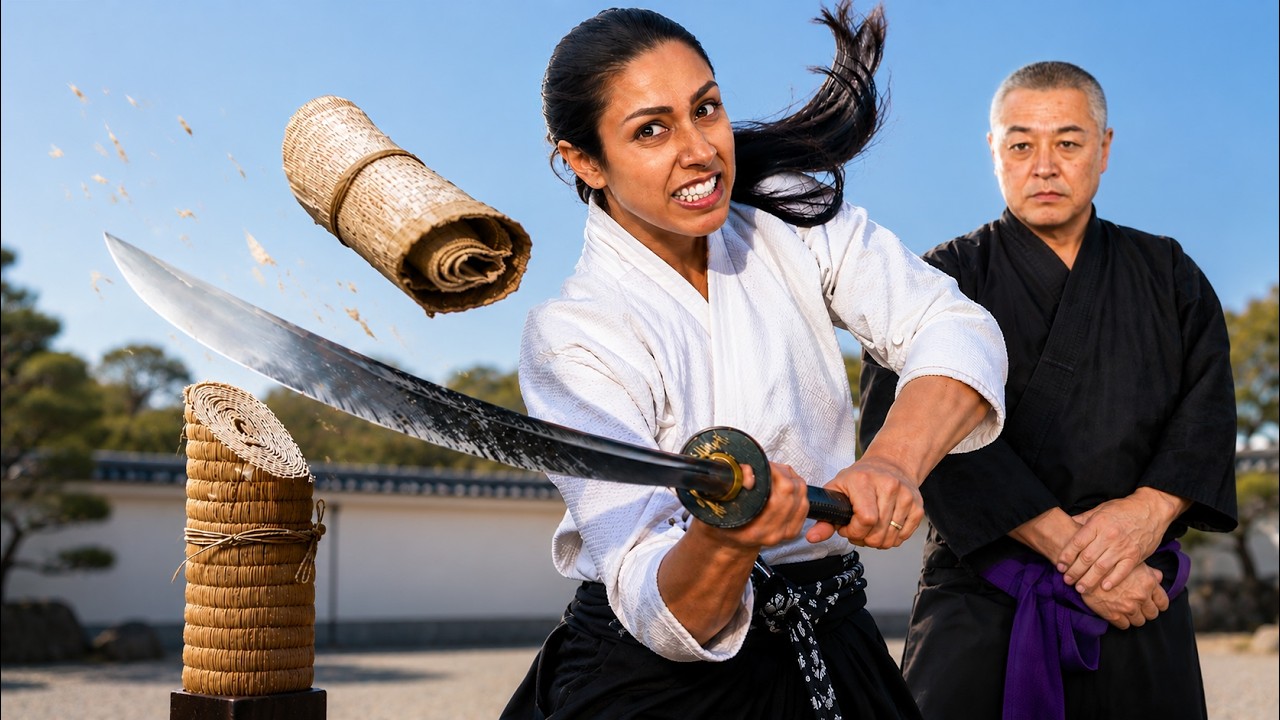
Before any of that, she traveled separately to the 400-year-old Asayama Ichiden Ryu to study under swordsman Seiki Sensei, a man who has trained since the age of three, roughly 50 years of continuous practice. Her first lesson was an immediate sparring session against him with zero experience. ‘The moment you face him,’ said Shogo, the 22nd headmaster of Shindo who trained alongside her, ‘you feel those decades of training and you feel like a tiny ant trying to fight an elephant or something.’ She spent hours that day learning only how to draw and sheath the katana, a form of swordsmanship called Iaido whose sole purpose, historically, was to end a fight in a single motion. By the end of the week she was cutting through a full-size rolled tatami mat with a real carbon steel blade, and Seiki Sensei could read the quality of her movement from the cross-section the cut left behind.
The form is the result, not a shortcut to it
The horseback work was managed by Michael, a 12-year member of the Ogasawara school, who put the danger plainly: ‘People can lose their life. People have lost their life performing. Absolutely.’ Khare had completed four weeks of riding preparation back in the United States before arriving, but the Japanese stirrup, which resembles a small sled and requires the foot to sit at roughly 45 degrees with half the foot hanging off the edge, made everything she had learned feel foreign. The practice of rajo, standing in the stirrups with knees open and the spine perfectly level so the rider appears to glide on a flying carpet, demanded every muscle in her body at once. She described the rare moments when she got it right as feeling like floating.
Her final Yabusame runs took place in gusting mountain wind that sent the bow sideways in her hands. She had three attempts to complete a full ritual run, hitting two targets at full gallop while Ogasawara Sensei watched. Michael’s instruction stayed with her through all three: focus on the form, not on hitting the target, and the result will follow. After her runs, when she told Michael she felt she had done better the day before, he allowed that it had been ‘a very proud moment.’ Then immediately walked it back. ‘I think it was a decent job,’ he said. ‘It wasn’t bad. It was okay.’
A saddlebag full of something harder to name
A tea ceremony held partway through the week illuminated something the archery and swordsmanship could not quite reach. Shogo described the ceremony as a way to connect not only with other people but with nature itself, which he said samurai considered a form of the divine: ‘Everything can be gods basically.’ Khare admitted afterward that working with nature, not the cold or the wind as obstacles but as elements to absorb and move through, was the part of the week she had never anticipated.
At the end of her final day, Michael told her she was invited back.
‘We’re bros for life,’ he said.
She asked how to say that in Japanese. He thought about it, offered ‘soulmate,’ then suggested they keep ‘bros for life’ in English.
Cody the horse, who had spooked under her during an early canter on the track and sent her heart into her throat, stood quiet at the end of the run.