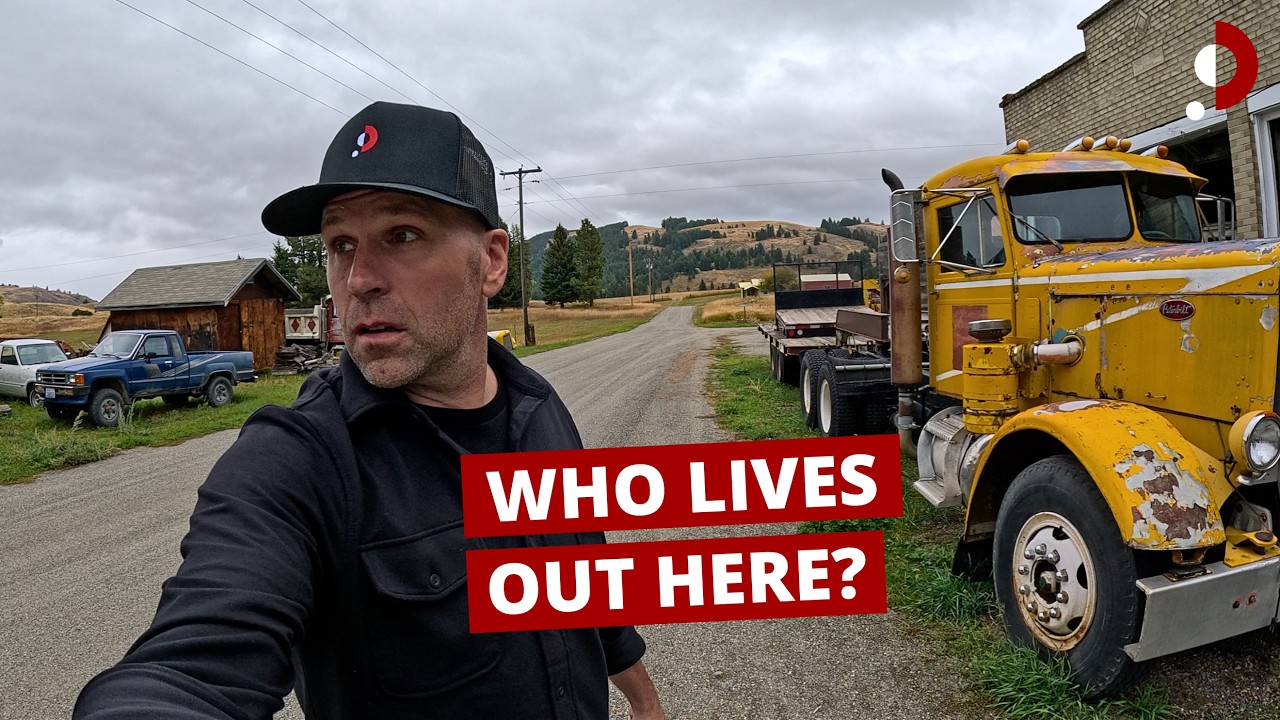
Joel Cretz has been ranching 1,400 deeded acres near the Canadian border in northeastern Washington since 1990, and by his own count he has not made a dime the whole time. Mountain lions took eight colts last year alone, a loss he put at somewhere in the vicinity of 50 to 60 thousand dollars. Diesel prices have turned routine tractor work into a financial calculation. And yet when Peter Santenello rolled up to the Promised Land Ranch after 8.5 hours of driving through some of the most remote terrain in the continental United States, Cretz did not hesitate to show him the winter range, the old homesteader’s cabin, and the 140 horses still loose on the land. This corner of Washington, pressed hard against the Canadian border in Okanogan County, the second-poorest county in the state by land area’s own telling, runs on that kind of stubbornness.
The road that makes you work for it
Santenello started the day in Winthrop, the one tourist town on the itinerary, where log-built facades and a pioneer museum trace the region’s mining and logging past. Interpretive panels inside noted that at least 24 one-room schoolhouses were built between 1890 and 1940, most on donated land, with donated timber and labor, and that the buildings rarely stood empty between terms: they hosted church services, card games, town meetings, and dance parties. From Winthrop he crossed into the rain shadow east of the Cascades and dropped down into Omak, where a man named Stson, raised on both sides of the Colville Reservation boundary, laid out the economic mechanics of fee land, tribal land, and what it means to live in a county where gas for a regular vehicle was running $5.39 and diesel $7.49. A rancher at a pull-off put the math plainly: hay that once cost $100 a ton had climbed to $375.
North of Omak the pavement gave way to primitive roads with no warning signs, the GPS dot stopped moving, and Santenello took at least one wrong turn that ended at a stranger’s front door before finally arriving at the ghost town of Molson. The site preserves the original Molson State Bank, a caged teller window still intact, the old Halls Safe Company safe set into the back wall, and a compressor from a former meat market. At its peak the town reached 700 residents and was the largest railroad freight shipper between Orville and Spokane. A founding plaque noted it was started as a mining and townsite venture by the Molsons of Montreal, Quebec. Santenello walked it alone. There was not one other soul in sight.
Where the border is a farmer’s fence
A few miles north of Molson, a roadside marker read ‘Canada 150 ft.’ The boundary itself was a single barbed wire farm fence, unmarked and unguarded in any visible way. Santenello crossed and recrossed it on foot. Near the spot he found a historical marker for the old Sidley townsite, where a customs collector in 1889 ran an international general store, saloon, and blacksmith shop that served both sides of the line. Bootlegging tightened the border around 1916, the marker noted; before that, some said the boundary line did not make much difference in those days.
In Chesaw, population spread across the hills at perhaps 4,000 people with acres between them, the mercantile had closed May 31st after its longtime owners Mary and Leslie decided they were simply done. A woman at the adjacent tavern described Sunday evenings when locals pack in to find the oldest songs on the jukebox and try to outdo each other. The Fourth of July rodeo draws thousands from around the country; because there are no hotels, the surrounding fields open for camping and RVs, and the grandstands fill once a year before going quiet again.
Back at the Promised Land Ranch, Cretz, who spent 20 years as a Washington State House of Representatives member before returning to the land full time, put the region’s situation in a single word. Asked about the overall economic health of the area, he answered: ‘Dismal.’ He walked Santenello past a lightning-struck ponderosa that corkscrewed its own bark off a century ago and somehow stayed alive, and past brood mares carrying foals that would eventually sell across the country and into Europe, found through Facebook rather than a flyer at the feed store.
A massage therapist Santenello had met earlier in the day in a small downtown, a man named Eric who relocated from Kentucky a decade ago, offered the clearest distillation of what holds the place together. He described a moment early in his practice when a local rancher and a ‘beloved original hippie’ ran into each other in a hallway and embraced without hesitation. ‘This is an area where people can disagree and still care for one another,’ he said. ‘It’s like it used to be.’
140 horses and a wolf at the gate
Cretz keeps a Central Asian Shepherd as what he called his ‘wolf welcoming committee,’ a breed from countries that end in Stan, built for a thousand years to guard herds. The dog carries a bite pressure of around 6,500 PSI, roughly in the same range as the wolves that have followed Cretz’s horses across his land. Whether the dog could actually stop one, Cretz admitted, he genuinely does not know.
The foals that do survive ship out through social media. Joel Cretz Promised Land Ranch on Facebook has 35,000 followers. Where a feed-store flyer once moved horses locally, a photo now moves them to Europe. The dog watches the tree line. The horses paw through two or three feet of winter snow on their own. And somewhere below, a 150-foot fence line marks the start of a country that stretches for hundreds of miles north from exactly this point.
 Wake up to Only Happy News!