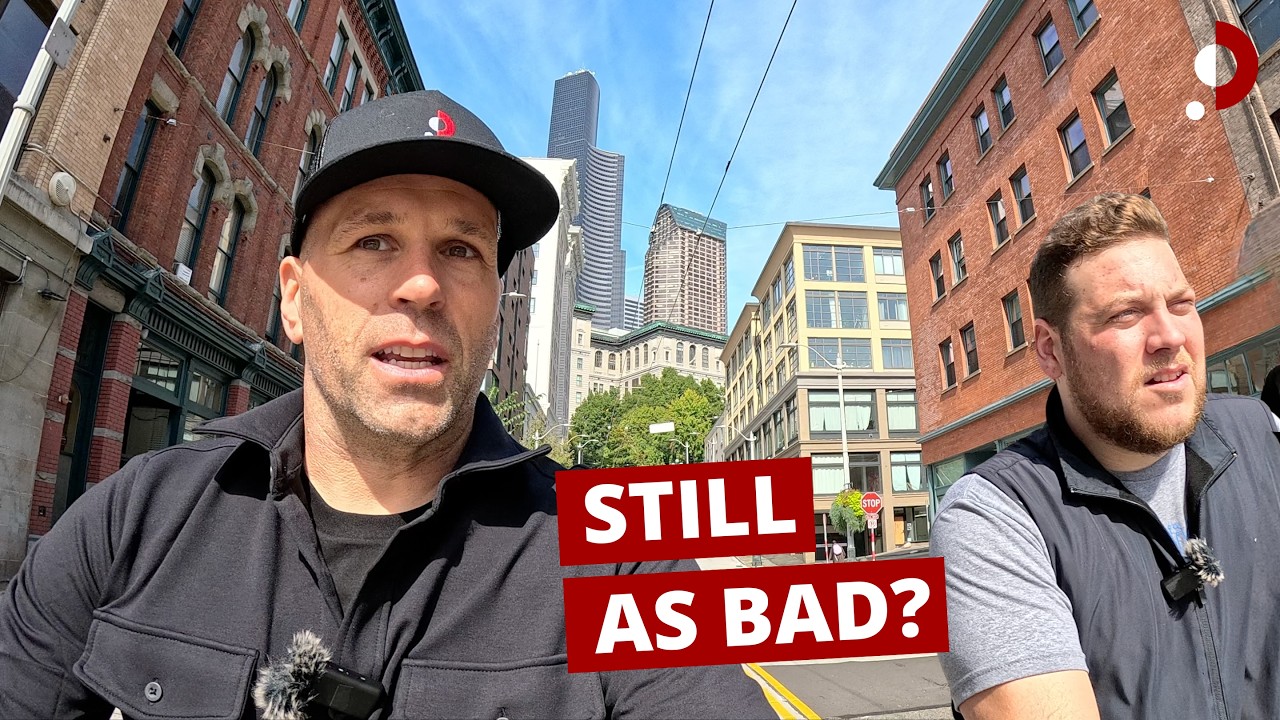
Joshua grew up right up the street from Third Avenue, and he said it plainly: ‘I’m tired of it. I want to see the change in the city.’ He is young, employed, and not asking for much, just the ability to walk to a park without stepping around someone mid-overdose. That tension, between a city of genuine, staggering beauty and one visibly struggling to hold itself together, is what travel creator Peter Santenello and his local guide Daniel set out to map in a single long day on foot, bike, electric scooter, and everything in between. What they found was not a fallen city or a thriving one. It was both, sometimes within the same block.
From cobblestones and Olympic Mountain views to the street the locals call the Blade
The day begins in Queen Anne, where Daniel points out the Seattle version of old money: red brick houses with separate garages underneath, all stacked on a hill with a sight line to the Olympic Mountains and their glaciers in the distance. The cobblestones here, Daniel says, have probably been in place since the beginning. The city’s founding story moves fast: logging town, fishing port, staging ground for the Alaska gold rush, Boeing country after World War II, and now a technology hub anchored by Amazon’s campus, which occupies a large stretch running down from lower Queen Anne through South Lake Union. Daniel, who grew up watching that stretch turn from what he describes as ‘actually disgusting’ into a clean, security-patrolled corridor, credits Amazon directly: ‘Without Amazon, this place is struggling right now.’ One detail worth noting for visitors: the Lime electric bikes operate across a 25-mile radius, and riders who carry an EBT card can scan it to ride for nearly nothing.
Three minutes on a scooter from the tourist-thick lanes of Pike Place Market, where fresh king crab, salmon, and lobster tails sit on ice and fish-throwers work the crowd, the mood shifts. Third Avenue, which locals have taken to calling the Blade, runs through the Central Business District, where the downtown vacancy rate stands at around 36 percent according to the real estate firm Colliers. Boarded storefronts and buildings fronted with metal cages line both sides. An emergency services crew working the sidewalk explains they are running two shifts, with roughly three crews on at any given time. They cannot speak on the record. One of them confirms that fentanyl remains the dominant story. The cleanup worker who is loading a bike trailer nearby offers a blunter assessment: a $1 pill of fentanyl is more accessible right now than crack, cocaine, heroin, or cannabis ever were at their peaks, and he has watched a young man go from walking to a wheelchair in three weeks.
Capitol Hill, recovery stories, and a jerk chicken cart that should not be as good as it is
Capitol Hill is louder and livelier: Dick’s Drive-In for burgers and milkshakes, Victorian houses mixed into newer construction, and Cal Anderson Park, which was the center of the autonomous zone occupation in 2020. The precinct that was burned out during that period is still there, and access for journalists without an approved media unit is politely declined at the intercom. Near the park bathrooms, which a woman rates ‘a one or a two’ on cleanliness, two people in recovery share their stories without prompting. One woman, originally from Yakima, called her dad after 12 years and told him she was done and ready to be picked up. She found Key Recovery, stayed two years, and now works and applies for better jobs inside the city. The other has 11 months clean and says he made the decision himself after reaching a point he describes as his worst. Both are skeptical of city programs that distribute pipes and foil as harm-reduction tools: ‘You’re just paralyzing yourself because it’s there. You’re not progressing. You’re dormant.’
A few blocks away, a Jamaican-run cart called Mom and Dad’s Dirt Spot is serving jerk chicken with an oxtail rice that Santenello calls one of the best things he eats all day. The owners had silverware, chargers, and a gas can stolen recently. They are still there, still cooking.
The day closes on the lake among the houseboats, roughly 600 of them, no new permits allowed. Lorraine and Toby, real estate brokers with Compass on Pike Street who live in a houseboat Toby designed himself, invite the crew down the dock ramp and into a home built on logs that date, by their understanding, to the 1920s. Lorraine explains the logs do not rot as long as they stay fully submerged. They cook dinner on the dock most summer nights. On January 1st, the whole houseboat community jumps into the water together.
The painting that almost went to a dump
On the upper floor of the houseboat, a large painting rescued by Toby’s father Ned Lumpkin from a hotel that was being demolished hangs on the wall. It was headed to a landfill.
Joshua, who remembers Third Avenue being nice when he was a kid and says it all changed sharply after 2020, is still showing up to work and still waiting for the city to catch up with him. The Space Needle, which Daniel explains was built for the World’s Fair as a vision of what the future was supposed to look like, stands a few blocks from where he grew up. He put it exactly right when he described it: ‘Like the Jetsons.’