
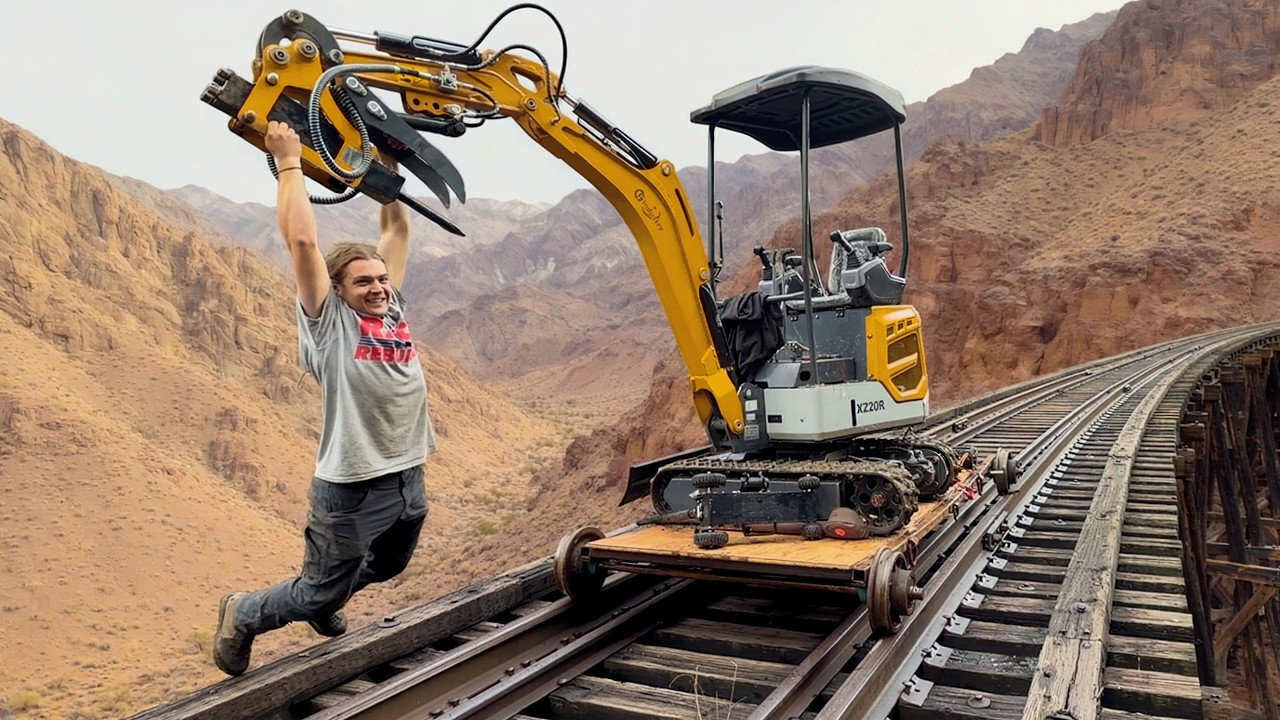
Matt Spears was already deep in the mountains, balanced on an abandoned railroad trestle, when the plan became clear: a Chinese mini excavator on a homemade rail cart, powered by an electric motor running on 100-year-old rail wheels, was going to clear the path to the world’s largest wooden railroad trestle. For anyone who has ever looked at a crumbling piece of industrial history and wondered how close you could actually get, this trip answers that question the hard way. Spears had driven across the country to join YouTubers Preston Goes and Merlin, the latter bringing his own rail buggy, and together the three-man crew set out across a desert railroad that most people do not know exists.
Sand dunes, derailments, and a tunnel with telegraph hooks still on the walls
The first day was not gentle. A sand dune had completely buried a section of track, requiring everyone to dig by hand before the machines could pass. The rails themselves were badly warped in stretches, and Preston’s truck derailed repeatedly. Spears, following too close, had no time to stop and rolled straight into Preston’s rig at low speed. Everything inside flew, and a drink came down the windshield. ‘That was the slowest, scariest crash,’ Spears said afterward, still laughing. The machine Spears built weighs at least 3,000 pounds, and when his own wheels started lifting off the crooked track, the whole crew had to lift Preston’s lighter truck back onto the rails by hand before inching the excavator through the same bad section.
The railroad itself kept delivering. A series of seven bridges called the Seven Sisters ran along the face of a cliff where, instead of blasting into the mountainside, the original builders simply cantilevered trestles off the rock. Merlin pointed out telegraph wire loops still visible inside one of the tunnels, the original copper wire running from pole to pole and through the mountain, a detail that places the entire structure somewhere around a century old. By nightfall the crew had not yet reached the famous rock slide. They camped at the mouth of a collapsed tunnel, the rockfall blocking the path to the trestle visible just behind their tents.
Rock popping at dawn, then 186 feet above the canyon floor
Morning revealed the full obstacle: a service road around the collapsed Tunnel 16, choked with boulders ranging from loose debris to a single rock the size of a small car. Spears used a rock-popping system, drilling holes, inserting charges, and in one case filling the hole with water before firing, since water does not compress and splits the rock far more cleanly. ‘Those charges and that little mini X, we wouldn’t be here without it,’ Merlin said as the path opened up piece by piece.
When the trestle finally came into view, the crew stopped talking. The structure is 186 feet tall at its peak, the rails stamped 1928, and it was originally built because the tunnel that preceded it collapsed in an earthquake. Preston fell off the track on the crossing and had to be guided back on. The rail scooter Merlin had hauled in crossed the whole span. Looking back from the far side, Spears could trace the entire route: the Seven Sisters, two tunnels, the valley, and the giant wooden frame underneath them all.
Preston’s truck quit running on the far side of the trestle and had to be pushed back along the rails by Spears’s electric motor, which handled the load without complaint. Preston’s lost camera, dropped somewhere at the base of the trestle, was never found.
The ladder nobody climbed
At the base of the trestle, Spears found a maintenance walkway running along the lower framework. A ladder dropped from the top level toward a second platform roughly 100 feet below. He looked at it, described it plainly, and did not go down.
By the time Spears pushed Preston’s dead truck back through the dark tunnel and down the moonlit rails to camp, the excavator’s headlights were the only light moving through the mountains. The 1928 date stamp on the rail was still there, exactly where Merlin had pointed it out, holding the weight of three vehicles and a crew that had been trying to reach this bridge for years.
 Wake up to Only Happy News!