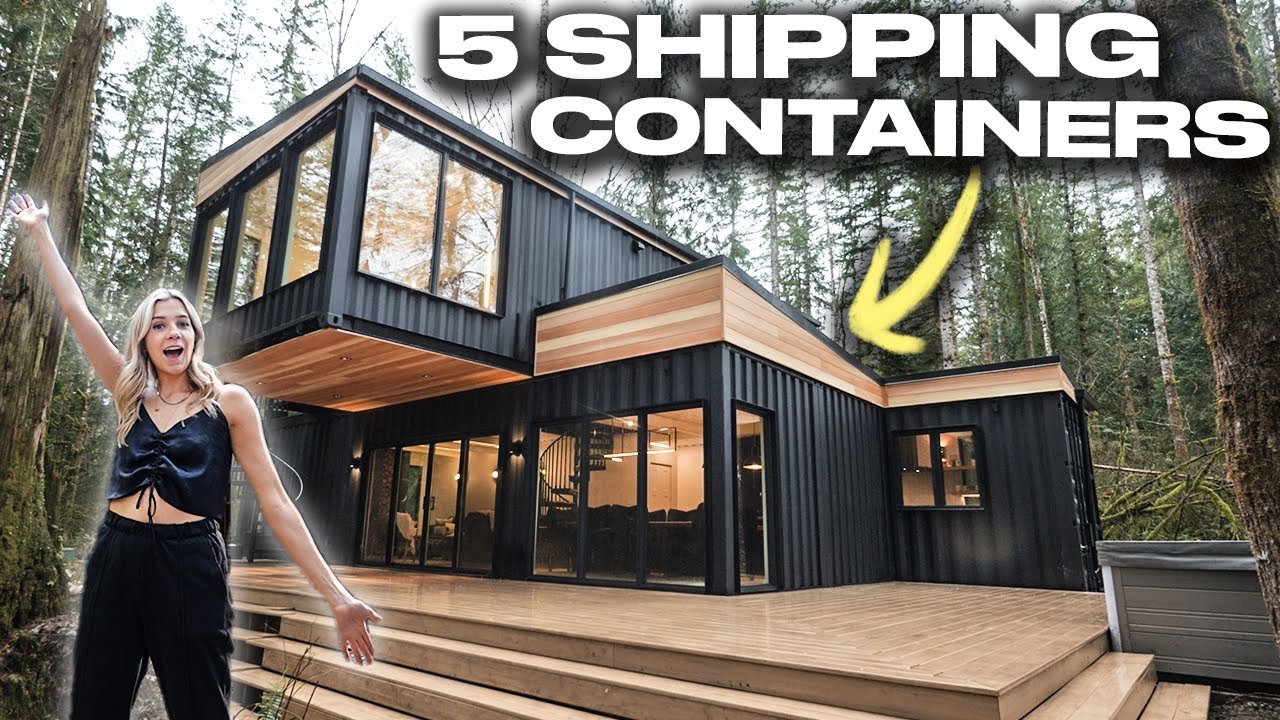
Devin had a picture in his head long before he had a property: a modern Scandinavian home dropped into the mossy forest of Washington state, built from steel shipping containers, almost entirely by his own hands. What followed was a year of 100-hour weeks, 4:30 a.m. alarms, and a wager on himself that turned a welding job from high school and three years of disciplined saving into a two-story home that his real estate agent now values at around one million dollars.
Five containers, one very specific vision
The Pacific Bin, as Devin named it, sits on land he chose precisely because contractors could barely reach it. Three containers run along the ground floor, offset from one another to create distinct living zones: a minimalist matte-black kitchen up front, a dining room anchored by a custom walnut table made from a single fallen tree slab split down the middle and filled with resin in a technique called rivering, and a living room built around a couch large enough to seat nine or ten people. The gas fireplace there is intentional design, not budget compromise. With the home listed as an Airbnb sleeping up to seven guests, Devin wanted hazards engineered out from the start, so he also screwed the decorative firewood together so nobody carries it out to a fire pit.
Upstairs, two containers run perpendicular to the three below, housing all the bedrooms. Every room looks directly into forest. The main bedroom was designed from the drafting phase to have what Devin called a ‘fishbowl-esque vibe,’ with floor-to-ceiling glass pushing the treeline into the room. The en suite bathroom features heated floors and a steam shower: press one button and the room fills with heat like a private spa. A large second-floor balcony, still waiting on railings at the time of the tour, extends the forest connection further.
Where the $600,000 actually went
Devin budgeted $525,000 to $550,000 and landed closer to $600,000, with land accounting for roughly $150,000 of that. The structural steel alone ran nearly $25,000. The five shipping containers cost $5,000. Spray insulation added another $28,000. Drywall came in at $7,000 to $8,000. Real hickory flooring materials ran $16,000. Plumbing across the powder room, full bathroom, and kitchen totaled around $30,000. Furnishings, the line item that caught him off guard, pushed past $100,000.
His own labor kept the number from climbing much higher. ‘I think it easily would have been a million dollars’ if he had hired everything out, he said, pointing to the remote driveway, the custom steel work, and the complexity of stacking offset containers in the middle of a forest as the factors that made outside contractors both expensive and logistically difficult. He financed roughly $150,000 from his own savings and the remainder on a private line of credit locked in at five percent interest, money he had accumulated by working simultaneously as a full-time engineer and a cinematographer in Seattle while putting his savings into Tesla stock.
The table nobody else has
The custom walnut dining table, built in Florida from one fallen tree and shipped to Washington, arrived just weeks before the full tour. Devin lingered on it.
The nearly 1,000 square feet of deck space wrapping the home is almost finished, stairs freshly completed just the day before the walkthrough. The forest presses right up to the edge, and on a clear morning from the main bedroom, through all that glass, the trees are the first thing anyone sees.