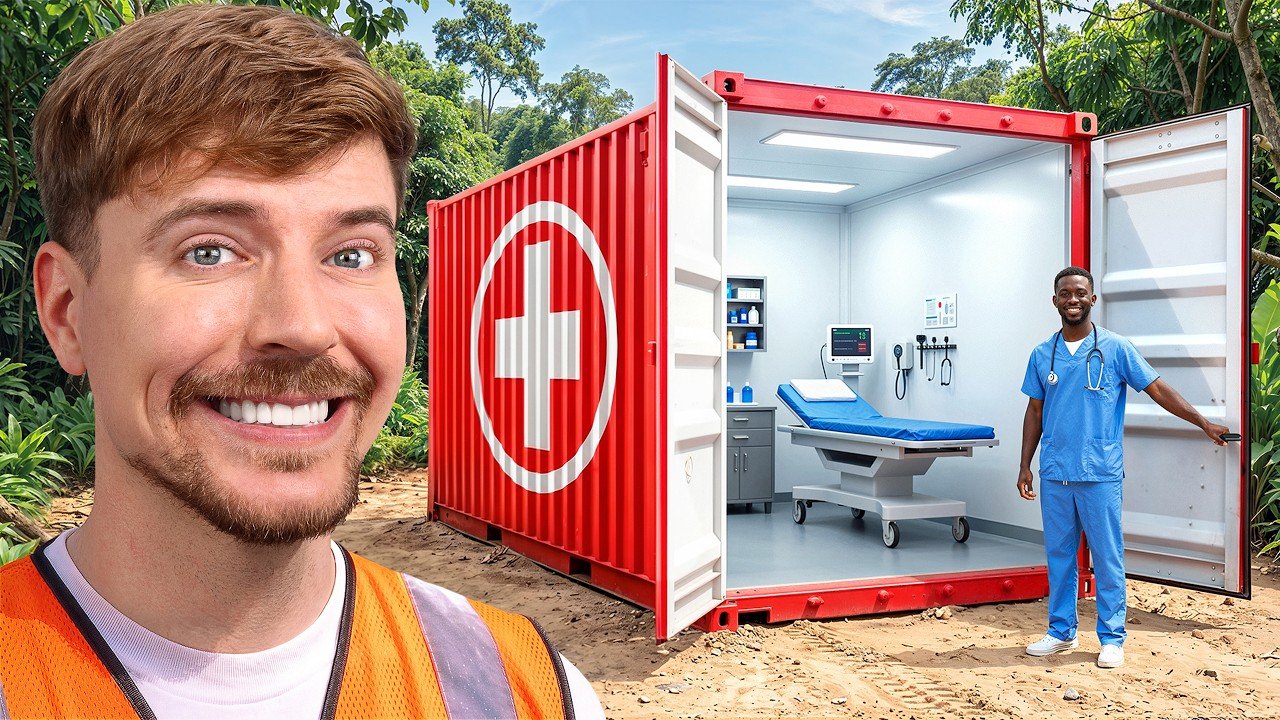
A shipping container sitting empty on a concrete lot can become a fully equipped medical clinic capable of delivering open-heart surgery support, telehealth diagnostics, and clubfoot treatment – and Beast Philanthropy, working alongside the student-run nonprofit BUILD, has now done exactly that five times over, deploying clinics to Chester, Texas; a hospital in Nigeria; the front lines of the war in Ukraine; a coastal community in Kenya’s Kilifi County; and a residential village in Worcester, Massachusetts.
Chester, Texas Receives Its First-Ever Medical Clinic
The clinic delivered to Chester, Texas marked a historic first for the remote town. Prior to its arrival, the local school had experienced two separate medical emergencies in a single year in which students waited approximately one hour for an ambulance to arrive. The new clinic features a fully integrated telehealth center, allowing residents to receive real-time diagnoses and treatment consultations without leaving their community. Timber, a Chester native born and raised in the town, was named director of the new facility. ‘This is my home,’ Timber said at the opening. ‘I believe I was put on this earth to take care of my family and my community.’ The clinic now serves residents who previously had no point-of-care medical access within the town limits.
In Worcester, Massachusetts, the fifth and final clinic in this deployment is now operational inside a residential housing community, providing free health screenings, vision exams, and dental checkups to more than 40 families every week.
Nigeria, Ukraine, and Kenya’s Kilifi County Receive Specialized Facilities
The second clinic was delivered to a hospital in Nigeria, where it will expand capacity to screen and treat pediatric cardiac patients. Open-heart surgery in Nigeria is extraordinarily rare – a patient traveling to the United States for the same procedure would face costs between $50,000 and $117,000. The new clinic is projected to serve an additional 2,000 patients in its host community within its first year alone.
A third clinic was dispatched to Ukraine, where ongoing conflict has destroyed a significant number of hospital facilities and left local physicians without basic medical supplies. The deployment was coordinated in partnership with the DAR Foundation, which ensured local doctors received the materials needed to continue serving their communities. BUILD maintains four additional active clinics across the conflict zone.
The fourth clinic traveled to Kilifi County, Kenya, where Scott and the Hope Walk organization have spent 14 years treating children born with clubfoot from a single small room. In Kilifi County, 16 percent of the population is born with a disability, and Hope Walk currently receives 10 to 15 new clubfoot patients each week. Amani, a local farmer whose own mobility has been severely limited by untreated clubfoot, described the condition’s impact clearly: ‘I cannot do much to support my family.’ His son Joel, however, completed the Hope Walk program and now walks without restriction. The new dedicated clinic will double Hope Walk’s treatment capacity, targeting complete elimination of untreated clubfoot in the next generation of children born in the region.
All five clinics were constructed entirely by university students through the BUILD initiative, which was founded in 2013. Since its founding, BUILD students have constructed 60 clinics across 24 countries, directly impacting more than 200,000 lives. The five clinics featured in this deployment are projected to reach more than 10,000 additional patients annually – a figure that underscores how container-based modular clinic design has quietly become one of the most cost-effective tools in global health infrastructure. The model mirrors approaches used by organizations like Doctors Without Borders and the WHO’s emergency health unit strategy, which prioritize mobile, rapidly deployable care over permanent construction in underserved geographies.
Since Beast Philanthropy began filming this project, the five clinics had already reached more than 2,500 people – before a single facility had completed its first full week of service.
 Wake up to Only Happy News!