
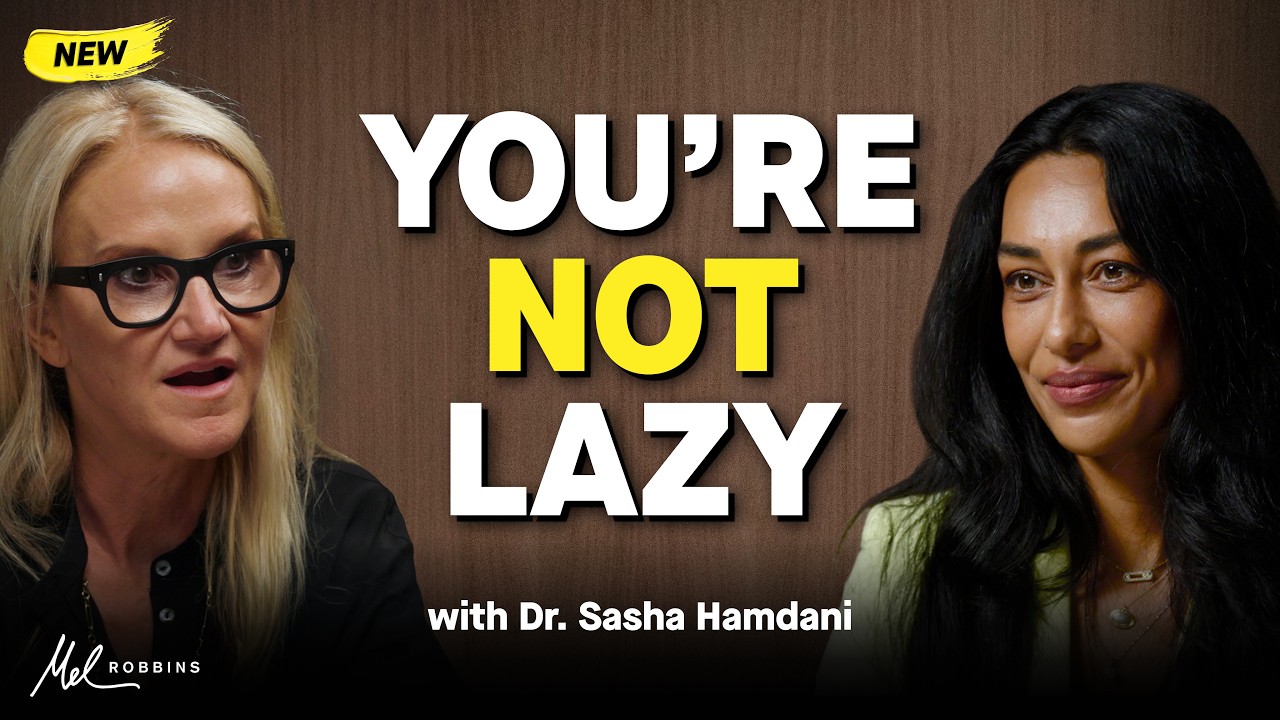
Mel Robbins sat across from Dr. Sasha Hamdani and said out loud what she had never quite been able to name: for decades, she had been treated for anxiety, placed on Zoloft at 22, lived with panic attacks and brain fog through postpartum and perimenopause, and never once been told that the real culprit might be ADHD. It was only after her son Oakley was diagnosed that she sought a neuropsychological evaluation herself, stopped the anxiety medication, and, as she put it, felt for the first time at 47 like she was actually in her body. That moment of recognition is exactly what Dr. Hamdani, a psychiatrist who both treats and lives with the condition, wants more people to reach sooner.
Why ADHD keeps getting missed, especially in women
Dr. Hamdani is direct about the flaw at the center of the problem: the original diagnostic criteria for ADHD were built by studying hyperactive young boys. That left out girls, adults, and every person whose struggle stays internal rather than disruptive to a classroom. ‘The outside of your house is on fire versus the inside of your house is on fire,’ she said. ‘Both are literally in flames. The way we look at it now is we only care if we can see the flames.’
What the criteria also miss is that ADHD is fundamentally a regulation problem, not simply an attention problem. Dr. Hamdani describes it as difficulty regulating attention, yes, but also motivation, energy, emotion, sleep, and appetite all at once. The brain mechanism behind this involves a prefrontal cortex that is slightly thinner and less responsive than typical, an amygdala that is more hyperreactive, and a weaker connection between the two. Dopamine, the neurochemical involved in alertness, mood, and emotional regulation, is not necessarily absent; it is simply not arriving in the right place at the right time.
For women specifically, hormonal shifts at puberty, postpartum, and perimenopause each cause estrogen and dopamine to drop, which throws regulation off in ways that look, to most physicians, like depression or anxiety. The result is a cascade of misdiagnoses, sometimes 10 different medications that only partially work, because the underlying ADHD is never identified.
Rejection sensitive dysphoria, the symptom almost no one talks about
One of the most overlooked features Dr. Hamdani covers in her book ‘Too Sensitive’ is rejection sensitive dysphoria, which she describes as present in nearly 100 percent of people with ADHD. It is a flooding of neurochemicals triggered by real or perceived rejection, criticism, or the fear of disappointing someone. To illustrate it, she pulled up a screenshot of a two-word text reply from Robbins reading ‘no worries’ and walked through exactly what happens in her own brain: ‘Is she mad at me? Is she unhappy with me? Does she want me on the podcast still?’ She described spending hours reality-testing the message with other people, or alternatively sending an over-compensating reply, or in her twenties, simply ending the relationship before the other person could. The practical tool she offers is movement to get oxygenated glucose to the frontal lobe, plus a deliberate 10-to-15-minute delay before reacting, sometimes set with an actual alarm, because that window reliably shifts how the situation reads.
On medication, Dr. Hamdani walks through stimulants, which typically provide four to eight hours of coverage and then drop sharply, and non-stimulants such as guanfacine, Strattera, and Wellbutrin, which provide 24-hour baseline support and often address anxiety and depression alongside attention. A Washington University study published in late 2025 examined how stimulants point the brain toward reward. But she is equally clear that medication is a tool, not a requirement, and that cognitive restructuring through therapy alone has been life-changing for many of her patients.
Her four-step plan for anyone who suspects they may have ADHD: track symptoms across task initiation, distractibility, completion, sleep, and mood for two full hormonal cycles, roughly two months; consult a qualified professional, ideally a psychiatrist, but a primary care doctor or nurse practitioner is a valid starting point given access barriers; discuss the full range of options, medication and non-medication alike; and use trusted resources, peer-reviewed articles, credentialed practitioners with online content, while waiting for an appointment.
The two-word text that stayed on her mind
The screenshot on Dr. Hamdani’s phone: a plain ‘no worries’ from Mel Robbins, two words that sent a trained psychiatrist into a spiral of self-doubt she had to consciously set a timer to get through.
When someone finally understands what has been happening in their brain all along, Dr. Hamdani told Robbins, the grief about lost time is valid and normal. But so is the recognition that every workaround, every routine built without knowing why it was needed, every structure held together through sheer effort, none of that was wasted. It becomes scaffolding for what comes next.