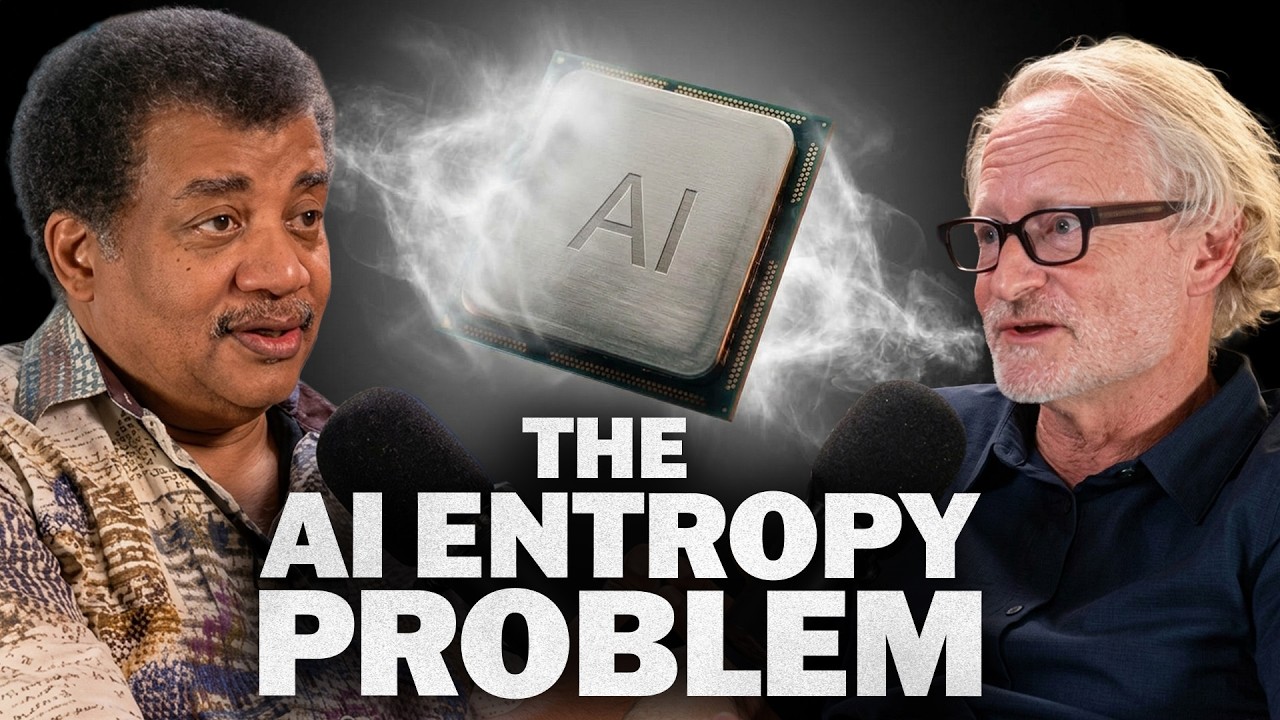
David Krakauer, president of the Santa Fe Institute and William H. Miller Professor of Complex Systems, arrived at the StarTalk studio with a definition of intelligence that cuts straight through the hype: making hard problems easy. Not solving them expensively, not brute-forcing them at planetary energy cost, but finding the elegant path. That standard, he argued across a long and occasionally raucous conversation with Neil deGrasse Tyson, Chuck Nice, and Gary O’Reilly, is precisely what current AI cannot claim to meet, and the gap matters more than most people realize.
Why solving a problem and solving it intelligently are not the same thing
Krakauer’s sharpest illustration arrived quietly in the middle of a wide-ranging discussion about large language models. A recent LLM had solved a long-standing mathematics problem related to the singularities of the Navier-Stokes equations, the dynamics of fluids, at a cost of tens of millions of dollars and thousands of agents. Impressive by any capability benchmark. But Krakauer was unmoved. ‘You could eat a bowl of soup with a fork,’ he said. ‘Slowly. Enough time, enough energy, you can solve a math problem with language.’ Human intelligence, he pointed out, was forged under conditions of scarcity where there was never enough time and never enough energy. That pressure is precisely why brains exist at all. A genome, he explained, can absorb roughly one bit of information per generation through differential survival, and as organisms get bigger and live longer, that process gets slower and slower. Brains evolved as a faster mechanism for pulling information from the world when the world changes. The ratchet toward complexity and greater intelligence is real, but it runs on efficiency, not expenditure.
The LLM path runs in the opposite direction. It begins with language, skipping the hundreds of millions of years of pre-linguistic, homeostatic, sentient existence that every other organism carries. It learns everything simultaneously with no curriculum, which means it develops elaborate heuristics rather than exact algorithms. Krakauer noted that current best models will fail at long division at sufficient scale, confabulating confidently, a point that connects directly to what he called the overconfidence problem. The model has no way to know which decimals matter.
The steam engine comparison that reframes the whole debate
The conversation shifted into genuinely original territory when Krakauer drew a parallel between the industrial revolution and the current AI moment. For hundreds of millions of years, texts have been accumulating in libraries, from ancient Sumeria forward, the same way fossil energy accumulated underground during the Carboniferous period. The transformer architecture, he argued, is the steam engine of the information world: it liberates that cultural deposit the way coal-fired engines liberated buried energy. The analogy holds uncomfortably well. The mining companies of the fossil era became BP and Shell. The mining companies of the conceptual era are Anthropic and OpenAI. And just as industrial combustion produced smog and entropy in the physical environment, LLMs are producing entropy in conceptual space: misinformation, confabulation, probabilistic crap fed back into the very deposit it is drawing from. Coal is finite and depleted. Knowledge, in principle, is not, but it can be fouled.
The abacus in a box on Neil’s shelf
A lacquered wooden abacus appeared from a shelf during the conversation, surfacing a distinction Krakauer has spent years developing. Tools that scaffold thinking, such as an abacus, a map, or a slide rule, are complimentary cognitive artifacts. They build internal competence that outlasts the tool itself: students trained at abacus schools can eventually perform the same calculations in their heads without the physical device. GPS, by contrast, is competitive: it replaces the cognitive function entirely and creates dependence without residue. A generation that begins with GPS never acquires the spatial intuition that would survive a power cut. Krakauer connected this to the slide rule’s disappearance in 1973, the year Hewlett-Packard’s first affordable calculator drove every slide rule company out of business simultaneously. The slide rule, he noted, trained users to think in significant figures, to feel which decimal places were noise. That intuition diffuses into everything else a person thinks about. Whether outsourcing calculation to an AI produces the same diffusion, or simply hollows out the competence behind the capability, is the question he believes no one is asking urgently enough.
The question still sitting in the room
Krakauer’s website address hung briefly in the air after the recording wrapped: davidkrakauer.com.
Outside the studio, the abacus went back in its box.