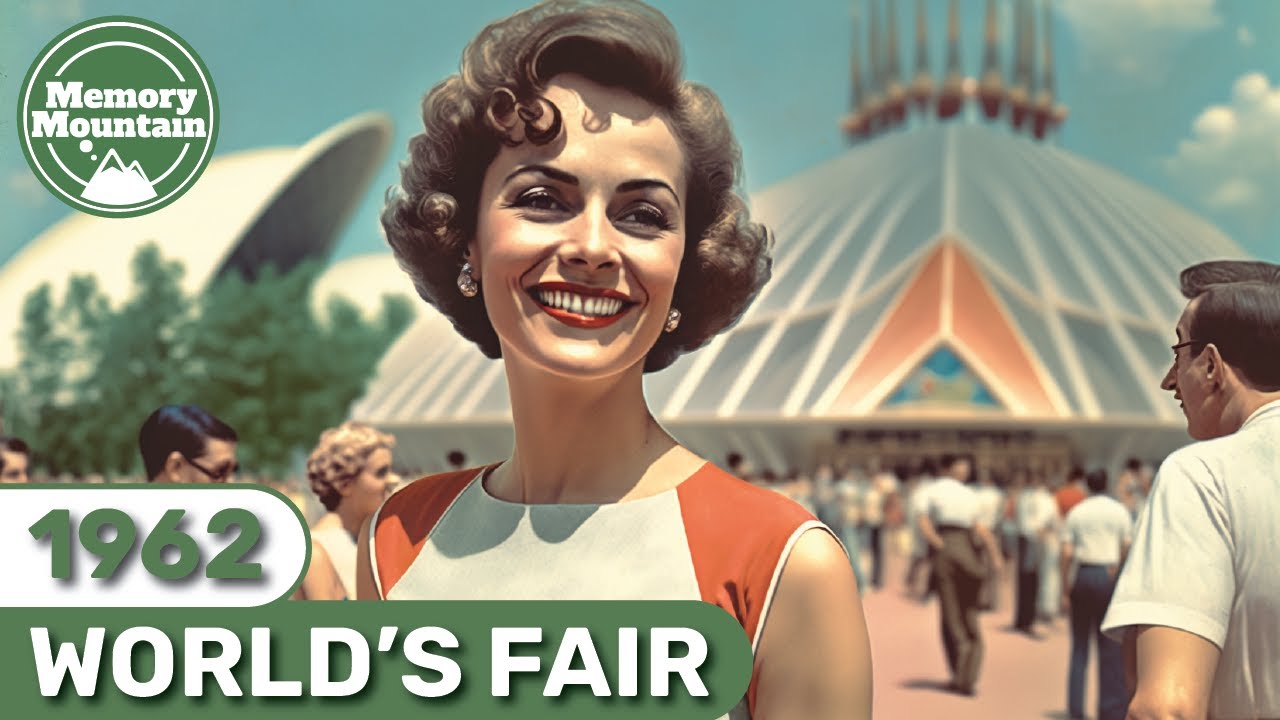
Seattle city councilman Al Rochester was 14 years old when he first walked the grounds of a world’s fair in 1909, and something about the scale of it never let him go. Decades later, as a leader in the city he loved, he wanted that same sense of wonder for his hometown. What followed was one of the most ambitious civic undertakings in American history, a six-month event called the Century 21 Exposition that drew 10 million visitors and permanently changed how the world saw Seattle.
A telegraph key in Florida and a baton in Seattle
The Century 21 Exposition opened on April 21, 1962, with a flourish that was, even by modern standards, logistically creative. President Kennedy, vacationing in Florida, pressed a telegraph key to kick things off from afar. Moments later, guest conductor Igor Stravinsky raised his baton in front of the Seattle Symphony, with pianist Van Cliburn as soloist, and the fair was officially underway. The event had been originally conceived to honor the 50th anniversary of the 1909 Alaska-Yukon-Pacific Exposition, but organizers ran out of time for that plan. Instead, with the space race accelerating and Boeing having strengthened Seattle’s economy and reputation, the fair pivoted to a forward-looking theme: space, science, and the future, with an unmistakable undercurrent of American confidence aimed squarely at the Soviet Union.
Rochester’s idea had grown through a world’s fair commission that secured funding and support across the city, and from there the logistical work began in earnest. One of the commission’s most consequential moments came in a Stuttgart restaurant, when Eddie Carlson, a member of the commission, dined on top of a television tower and sketched an idea on a napkin. The view inspired him. He brought the concept back to Seattle, an architect developed it into a tripod structure with a disc at the top, and construction on the Space Needle began just one year before opening day. To anchor it, workers dug a hole 30 feet deep and 120 feet across. Filling it required 467 cement trucks working an entire day in what became the largest continuous concrete pour ever attempted in the American West. The foundation weighs as much as the Space Needle itself.
Belgian waffles, Elvis, and a supermarket ham
The fairgrounds were spread across different themed zones: a World of Science with a NASA exhibit and a Project Mercury time capsule, a World of Commerce and Industry featuring the Ford Seattleite concept car beside a perfumed pool, and a World of Art that showcased 72 masterpieces from Rembrandt, Monet, and Picasso. Entertainment director Harold Shaw, a New York agent who scouted talent across 43 countries, was blunt when local commissioners pushed for a more regional lineup. As Memory Mountain’s account of the fair puts it, Shaw told the room: ‘This is supposed to be a world’s fair, not a county fair. Grow up.’
The food side had its own landmark moment. Walter Clayman opened two waffle stands at the fair, introducing Belgian waffles to the American public. The larger breakfast treat had debuted at a world’s fair in Brussels in 1958 but found its American audience in Seattle.
Elvis Presley also passed through, filming the movie ‘It Happened at the World’s Fair.’ During his visit he presented Washington Governor Albert Rosellini with a ham he claimed came from his farm in Tennessee. It had not. A last-minute discovery revealed there was no ham on hand, so someone from Elvis’s camp was sent to a nearby supermarket to purchase a large one before the meeting.
The ham nobody mentioned again
A supermarket ham, hastily purchased and handed to a governor with a straight face, somewhere in Seattle in the spring of 1962.
The monorail that ferried visitors from downtown to the fairgrounds is still running. The Science Pavilion became the Pacific Science Center. And the Space Needle, born on a napkin in a German restaurant, remains the city’s most recognizable silhouette, a reminder that 10 million people came to Seattle that summer and most of them looked up.